
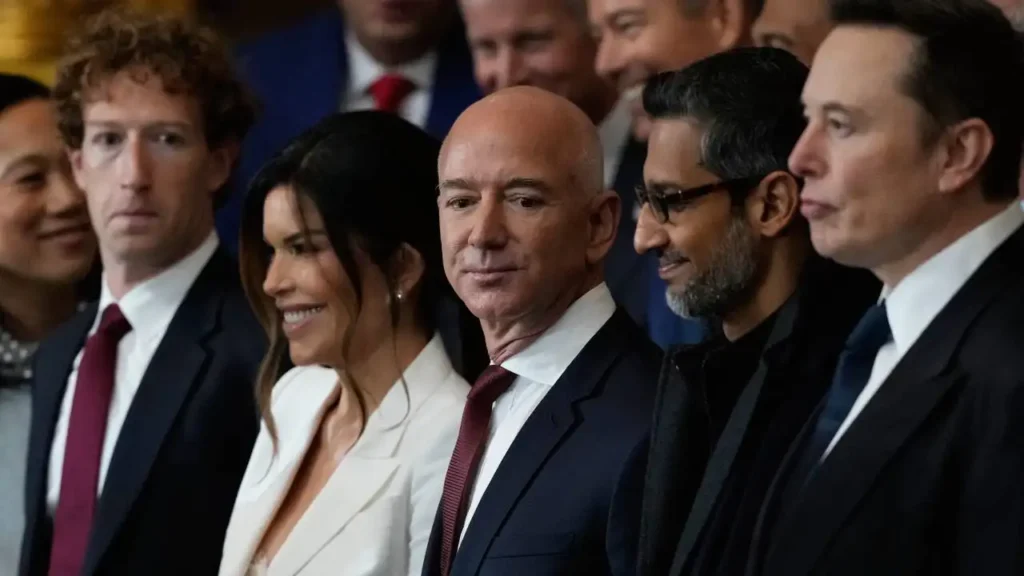
As we reflect on the past year and attempt to digest its wildest moments, it feels fitting to coin these past 12 months as “the year of the billionaire”. Some of 2025’s biggest moments were headed by business moguls, most notably Jeff Bezos and Elon Musk; whether they were launching rockets into space or making themselves comfortable at the White House, these multi-billionaires dominated media headlines.
Despite the names of Bezos and Musk seemingly appearing everywhere you look, there was a time when the ultra-rich were looked down upon, as if their financial wealth subtracted from their social currency. The 2010s to early 2020s were a time of social progress, anti-capitalism and an “eat the rich” attitude. In their book The Decade of Socialist Revolution Begins, David North and Joe Kishore define the 2010s as “years of intensifying capitalist crisis, which set into motion a global resurgence of class conflict”. The idea of growing class conflict has been heavily reflected in film and media within the past decade, most notably films such as Les Misérables (2012), The Hunger Games (2012), Parasite (2019) and The Menu (2022). Although the media industry, famed for its social commentary through TV and film, still produces pieces focused on class commentary, such as Zoë Kravitz’s 2024 thriller Blink Twice, wider social attitudes towards the uber-wealthy have noticeably changed in the past couple of years.
As the cost of living continues to rise globally, making it increasingly difficult for everyday individuals to afford necessities like groceries and electricity, billionaires are being commended for their business acumen and corporate drive. Two of the world’s top ten richest individuals, Mark Zuckerberg and Elon Musk, appeared in Time100 — Time magazine’s much-awaited yearly list of the 100 most influential individuals in the world. Although it’s not Musk’s first time in the top 100, this year’s feature categorises him as a “leader”, which seems to be a greater reflection of how billionaires, like Musk and Bezos, are getting tedious with simply being known for their wealth and are now wanting to gain wider social capital.
A prime example of this is the wedding of Jeff Bezos and Lauren Sánchez, which took place in Venice in June 2025. The wedding was a three-day event that included many A-list celebrities, such as the Kardashians, Leonardo DiCaprio and several of the Trumps, and was estimated to have cost between 20 and 50 million dollars. Not only was this wedding intended as a union between the two, but it was an attempt to redefine themselves as socialites who mingle with the world’s biggest stars. This attempt was made more obvious by Sánchez’s digital Vogue cover for the June issue, which was accompanied by an article detailing her dress fitting and expectations for the wedding. Not only did the Vogue article solidify Sánchez’s position as a reporter-turned-socialite, but it positioned their wedding as an international event that was sure to be splashed across media headlines.
Despite the wedding being labelled as an “extremely intimate” affair by Sánchez, there was still public outrage from Venice locals, with an activist group named No Space for Bezos causing the wedding party to move to a more protected location for one of their many post-nuptial celebrations. Although it is clear that the couple are moving to make their mark on the celebrity world, their efforts are not swaying the opinions of those who exist outside of the A-list bubble.
This is not the power couple’s sole attempt at improving their social standing, with the two sponsoring the upcoming 2026 Met Gala. The announcement, made on the Met Museum’s official Instagram account, was met with public dissatisfaction, with one user commenting, “Stop platforming Jeff Bezos and Lauren Sánchez with art and fashion, two places that these two awful, unfettered capitalists will never belong in, no matter how much money they want to throw around to buy culture they have never cultivated and will never inhabit”. It seems to be painfully obvious that Bezos and Sánchez are attempting to buy themselves a slice of culture and, along with it, social credibility. However, these financially backed efforts are failing to make an impression on anyone but their ultra-wealthy peers, with many people expressing their disgust at the couple’s egregious display of wealth.
Whilst billionaires like the Bezoses set their sights on the A-list inner circle, Elon Musk, the world’s wealthiest man, appeared to have a different target. At the beginning of this year, Musk managed to infiltrate the White House, becoming one of Donald Trump’s top advisors. During his time with the Trump administration, Musk claims he cut federal spending by $175bn, which was partly a result of the loss of 260,000 jobs within the federal workforce. Musk did not hesitate to use his newfound political power to boost his own businesses, most notably Tesla; in March of this year, Musk was allowed to showcase his Tesla vehicles on the lawn of the White House. Despite the controversy caused by this obvious business move, both Musk and Trump refuted the ethical concerns of the White House being used as a prop for Musk’s business.
After leaving the White House at the end of May, amid rumours that the relationship between him and Trump had become precarious, Musk didn’t hesitate to involve himself in other countries’ social politics, with the UK being his first choice. Musk featured at the Tommy Robinson-led far-right rally on 13 September; appearing on video call, Musk spoke out to the 150,000 people who attended the rally, saying “Whether you choose violence or not, violence is coming to you. You either fight back or you die, that’s the truth, I think”. Despite the Labour government condemning Musk’s inflammatory language, he received roars of support from the mass crowds at the rally. Musk’s prolific success as a businessperson, as well as his unapologetic involvement in politics, has made him a divisive figure among the general public, with those who consider themselves far-right thinkers being his biggest supporters.
It’s undeniable that Musk has become a key figure in both culture and politics over the past couple of years, with him holding particular social standing amongst young men. Prior to the 2024 American Presidential election, a group titled the Young Men’s Research Initiative ran a poll on who the key influential figures were for young American men, spanning the 18–29 age group. They found that 68% of young men said that they liked Musk, with him being one of the most popular figures mentioned. Musk’s rise in popularity amongst young men, as well as other far-right thinking individuals, reflects the recent shift in attitudes towards the ultra-rich. Ten years ago, Musk would have most likely been considered a greedy billionaire and any attempt at political involvement would have been met with critique and dismissal. However, Musk now seems to have adopted a “man of the people” façade, with his political advancements and “donations” being accepted and welcomed by those who agree with his way of thinking.
Despite the efforts made by both Bezos and Musk this year, they are far from being coined cultural icons. However, their social plays are not going unnoticed; Bezos and his wife have been embraced by the A-list world, with their wealth being an obvious driving factor behind their effortless acceptance. While the newlywed couple set their sights on becoming socialites, Musk has transitioned into a political figure, influencing the world’s most powerful man. Labelling these infamous billionaires as “trendy” does not feel quite fitting and would face understandable backlash; however, the shift in public attitude that has been incited by their spending can no longer be ignored. As they infiltrate culturally rich spaces and make their mark on high society and the political world, it is clear that the ultra-wealthy are chasing more than money — they desire power, fame, influence and control.