
It is a regular, boring and average night at my house, and I am in bed, doomscrolling as always on my phone on Instagram. My eyes are heavy, and my thumb is on autopilot as the lingering thought in the back of my mind says to me, “I should really be going to sleep right now”. I continue to ignore, of course, because the glow of thousands upon thousands of Instagram Reels is far too tempting. I say to myself that I need to go to sleep and that I have work tomorrow morning. Work that I don’t really enjoy, but I have to do, or else what else?
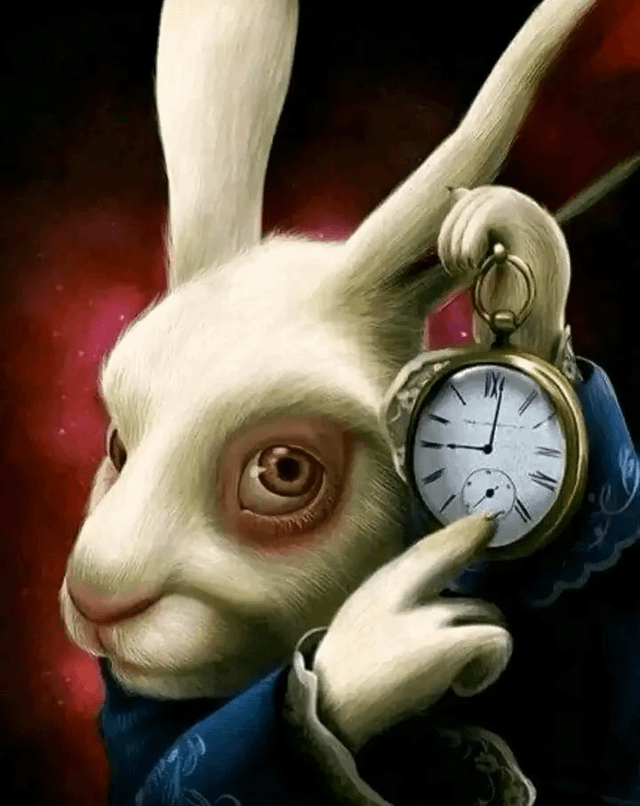
I then land on a meme of what appears to be an illustration of the White Rabbit from the book Alice in Wonderland by Lewis Carroll. The rabbit with its beady red eyes stares directly at me as it taps on its pocket watch, signalling that time is ticking down. The caption above simply read “This is how it feels to be in your mid-20s”. I gave it a like and carried on. It was classically cynical, which, like the rest of my feed at 12 am, wasn’t anything new. However, the algorithm bounced back, and I scrolled down to another White Rabbit staring me dead in the eyes and then another and another, to the point where my feed was just the rabbit calling me out for not reaching my potential. Typical Gen Z existential humour.
For days, I saw the meme appear in various forms. Sometimes it was for something casual and universally relatable, such as when you are running out of time to catch your bus. Gradually, they vary in theme and emotional seriousness. Some are about when the girl you are texting stops replying immediately or when it is Sunday and your weekend is coming to a close, all the way to quoting articles about the depressing socio-economic status quo we are forever sinking deeper into. You, yes, you, are running out of time.
The White Rabbit meme is simply about how you and I are running out of time, whether it be for something small and personal or anything major and beyond. It pokes fun at our anxieties and uses relatable worries we experience as subjects in negative emotions in romance, societal anxiety, work, death and on a meta-analytical level, the negative experience of scrolling itself. It can be argued that having to explain a joke like this ruins it, but I don’t believe this meme is about fun. It’s about the collective fear of our potential.
A simple example I saw circling my feed for a few days was of the damned rabbit pointing at the clock with phrases such as “test re-evaluation”, “internship”, “campus placement”, in a meme targeted at depressed university students to elicit a relatable sense of panic for all who just want to carry on and not be shot down with more struggle. It makes you think, should I get off my phone and actually send that application through? Am I going to have enough time to find a decent opportunity for my career? Should I care more? It condenses into the mind while you keep on scrolling for the next dose of glee from another post.
It is obvious that this meme and contemporary meme culture is centred on Gen Z, who dominate the internet sphere of influence, and the template allows them to mirror fears and frustrations. As with the example of it being used to highlight nagging yet consequential worries in academic life, it has been used as a devil on the shoulder for those in negative headspaces for the future of our climate, the soul-sucking job market of the 21st century in the world of AI, brought on by a political landscape growing more unequal and condescending to young people today. These memes are sometimes just presented as little reminders for us; some are dropped as worryingly toxic and unhealthy signals into the minds, especially in romance, where the White Rabbit meme has flourished, where the White Rabbit is used to display the subject’s naivety when celebrating an anniversary in a relationship. Alt-right dogwhistles aren’t difficult to spot in today’s social media climate; it happened to Pepe the Frog, and it can take any other vessel if it needs to. To treat a seemingly harmless rabbit photo as just that ignores its origins within culture and how it normalises issues by containing them in a palatable format, where, in Exploring Trivialisation of Mental Health Issues using Internet Memes in Young Adults by Aastha Gupta, they summarise perfectly that “Continued exposure to such memes may lead to normalisation of viewing grave issues in a trivial or indifferent manner”. We have become desensitised to the cracked mirror reflecting our world. We can only offer a troubled smile in return.
It is this almost forced façade of sarcasm and irony that is the only way a lot of Gen Z can appropriately discuss grievances with their daily life, that irony is the only way we can laugh about the fakeness of life. When we speak through memes, through the White Rabbit, the real meaning is the thought behind those words, the frustration and choked-up laughter lurking beneath. Memes are funny, but that’s all they are on the surface — memes. The postmodernists have seemingly won. Søren Kierkegaard, in his work The Concept of Irony, highlights this phenomenon, that irony can hide and distort what something really is. The White Rabbit mocking our daily rituals is funny until it scratches something unfair in our mind, and Gen Z is clearly at a breaking point.
Gen Z has been bombarded from a young age to search, gain and complete the ideal life. To finish school with aced grades, to go to university and kick-start a career, find love and start a family, earn enough money to live the good life and to live healthy and die with peace. It’s a saga told to us from a young age, and we bought into it because what else would make us happy? Is it a sign of the times, of how comfortably numb we’ve become, when our only form of protest is various forms of JPEG files rolled onto our social media feeds? Can we escape these walls of postmodern irony and nihilism?
In later iterations of the meme, it takes an even greater philosophical presentation, with many posts with the White Rabbit containing the phrase “All roads lead to Rome”. The phrase, of course, is well known already, literally discussing how every road eventually leads back to the former European epicentre of Rome, but the phrase is also used as a metaphor to describe how every action leads to the same outcome, most typically when used for either a relationship failing or, in the end, death. Everyone’s fate leads to a grave. When applied to the White Rabbit meme, it amplifies the overwhelming feeling of how the little time we are given drips away while we inch closer to death and that these huge decisions we are stricken with all mean nothing in the grand scheme of it all.
On the optimist’s end, a usual response to the phrase is “What if I start in Rome?” Why can’t my final destination be where I want to be right now? Why do I have to accept what’s coming and instead embrace it and live to the fullest while I am here now? Mike Watson, in his paper Nietzsche’s Dionysus vs. The Nihilism of Social Media Shitposting, talks about how these morbid, depressing and plastic-esque nihilist memes have nothing to say besides the surface-level construction they’re promoting, “rather than as identifying nihilistic tendencies in society or as embedded into existence, and mitigating against them”. Memes are fads at the end of the day. I can guarantee that when this article is published, this meme will be forgotten and mocked as “dead”. But there will always be another fad, another White Rabbit to pop up on our feeds to give us a daily pat on the back of relatability, that we aren’t alone; it will just take another form or template, and maybe with the rise of “hopecore” memes — memes highlighting joy, freedom and whimsy in the day-to-day life — we can only hope that perhaps our mindsets as young people also evolve and maybe we can prove the White Rabbit wrong. This influx and flurry of “brainrot” and “doomer” content is a lot to take in. If it’s too much, start over. Feed your head.