












Three, Indian, Chinese and Pakistani, women walk into the bar. No this isn’t a racist joke or a UN meeting for developing countries. It’s just Friday dinner, and the premise of where many of my articles stem from, constant conversation with constant friends (I’m a trained yapologist).
As I sat across from my two friends, we started talking about what we had been reading or what the environment has been for all of us stuck in this education and work limbo .We started talking about our experiences as women in the work place, the casual sexual harassment and all that ‘cute’ stuff.
I was really struck by the fact that we had the same responses about our colleagues; almost all the young women we were working with were diligent and professional. I only worked with women, with the exception of one male colleague who is wonderful. However, the men in my friend’s financial and business circles were much more difficult, insulting and frankly disrespectful. We were talking about how ironic this is since men have spent all of history working, and still can’t work their way out of HR meetings.
We all come from cultures where women are expected to stay at home, and noted how generationally different our lives are from our mothers’. How their labour is so essential in the private sphere but simultaneously they are looked down as the least able or accredited in society from an employability perspective.
It sort of led to this collective exasperation, that house wives are slaves, and Nawal El Sadawi was onto something.
The Legal Language
Legally, being a housewife doesn’t actually register as slavery, because it doesn’t meet the threshold set out in the ECHR. For example, Article 5 of the ECHR which prohibits slavery, forced labour and trafficking emphasises that there needs to be a ‘genuine right of ownership’(M v Italy and Bulgaria (2013), which takes a very de facto meaning. For example, despite the victim (female) in M v Itay, being beaten, raped, threatened with death and forced to participate in robberies within her forced marriage, it still wasn’t “sufficient evidence” of slavery for the court, because there lacked a key element of legal ownership. Even a dowry would not suffice as enough evidence of a monetary exchange that a father was selling his daughter, because the court wants to be sensitive to “the deep-rooted social and cultural connotations” in marriage.
Also being a housewife is considered to be a choice, although, we know in reality that there are many circumstances that manipulate whether this is a real choice, such as cultural pressure, and financial circumstances. However that means it can never qualify as servitude either because it doesn’t suffice the requirement under Siliadin v France (2006), for a high “particularly serious form of denial of freedom”, where there is no room for any consent, consent or freedom, regardless of how manipulated and misguided the victim may be. In this case, the claimant was a young girl who had been brought to France by a relative and required to work almost fifteen hours a day, seven days per week. If she protested, she was threatened with arrest or deportation. The court highlighted that “she was afraid of being arrested, she had no freedom of movement and no free time and as she had not been sent to school she could not hope that her situation would improve,” therefore only in this extreme circumstance did they agree she was in servitude.
However, in CN and V v France, despite the circumstances for the young sisters being similar in terms of abuse suffered, the youngest sister’s case didn’t meet this threshold for servitude, because she was allowed to go to school unlike the older, showing any freedom and contact with the outside world she had, although limited, meant there was no complete ‘coercive control’ and therefore no servitude. This is an insanely high threshold.
The definition for forced labour is a little wider, since Zoletic v Azerbaijan (2022) takes into consideration that when an employer abuses his power and takes advantage of vulnerable employees, the prior consent of the victim is not sufficient to exclude the exploitation as forced labour. However, a house wife doesn’t fall into any labour category, she doesn’t have those worker protections.
Despite all these legal definitions, it doesn’t change my opinion. I think emotionally and spiritually a housewife can still be synonymous to a slave, and here’s why..
‘A Slave’ is Not An Insult
Being a slave is no fault of the slave, and calling out their lack of rights is rather a condemnation of the ones who have put the slave in that position, who have reduced them to such a level, rather than to mock them individually.
When I call a housewife a slave, it’s not because I am trying to negate all the hard work and the value of their importance and presence in the home. I am not trying to strip them of their dignity. It is because, legally, being a housewife is not a job. It is not protected by unions, or labour laws. Despite the work they put into the wellbeing of their entire families, their husbands don’t give them a salary, they work 24 hours usually, and none of this is accurately accounted for once they divorce or separate because the job market just sees a large CV gap and lack of experience in the public sphere, not years of consistent hard work and support.
This makes it essentially free labour. Factually, it is like slavery.
Watching “English Vinglish” the night before my flight, and seeing Sri Devi’s character spend all morning making omelets and orange juices, like most mothers, she was doing exactly what the servers in my KEPZ canteen do in Chittagong, I couldn’t see any difference. Although, the servers got a thanks from us at least. And a paycheck.
Slaves are dehumanised, but that isn’t because they don’t have individual power and capacity to do great things. I don’t think slaves are inferior in this respect.
Whilst at the Abu Dhabi Louvre, they had a special exhibition for the Mamluk empire, an Egyptian era built by the rise of slave soldiers. The pyramids I crossed on the way to work were built by slaves, the economies of the countries with heat like coffee beans pulsing through the fault lines in the hard clay cracks of world trade, were built by slaves. Being a slave is not synonymous with being worthless, neither is being a housewife. However, they both contain traces of free labour at the cost of usually their agency and individualism. The Self for the Other.
My mother is a housewife, who stopped working as an English teacher after marriage, dedicating her life to privately tutoring me and my siblings in English, maths and Islamic studies for ten years. She cooks three meals a day, and takes care of everyone’s needs.
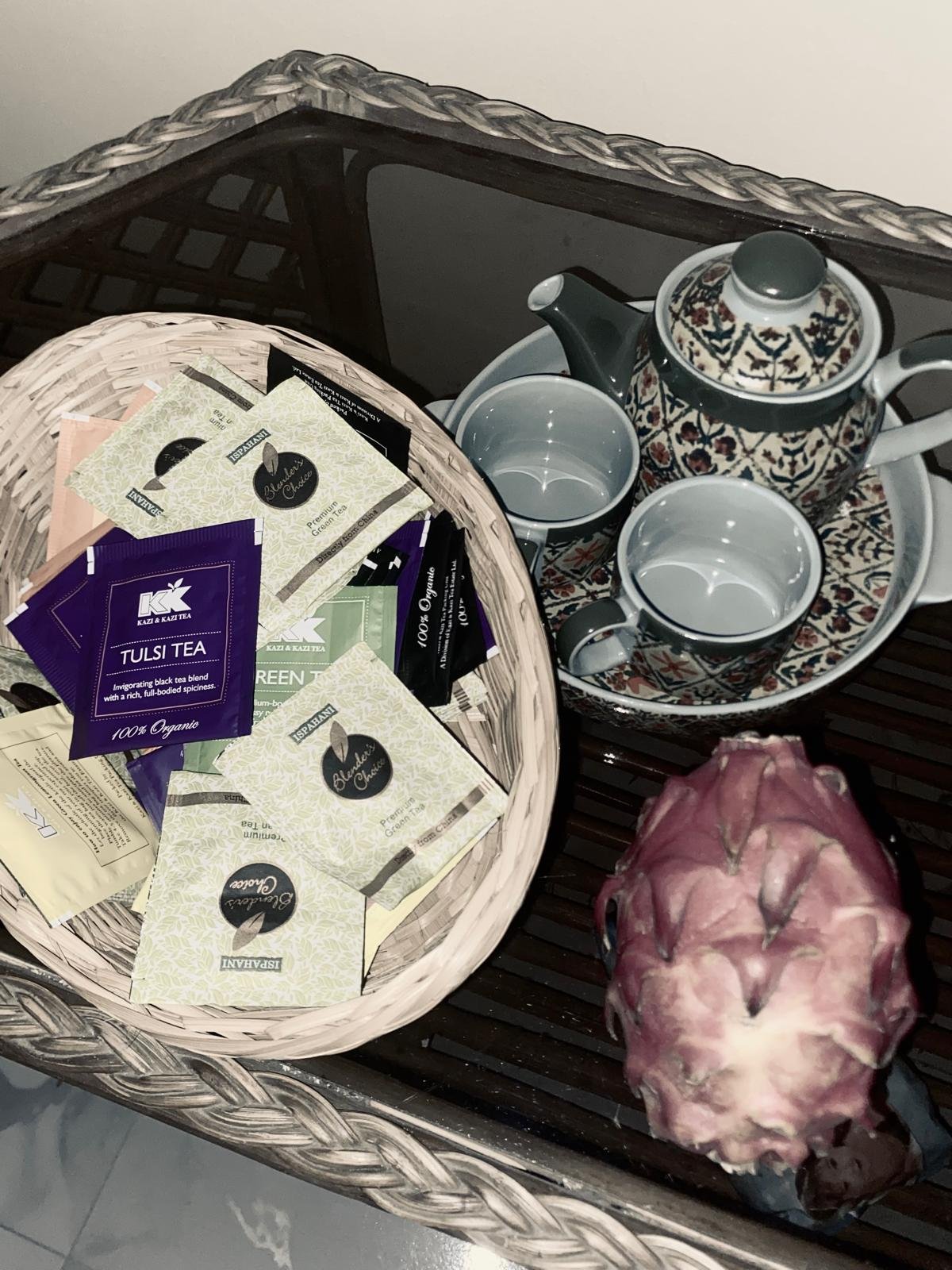
Recently, I was a little annoyed at her in the airbnb when she told me she forgot her entire makeup bag. I was frustrated, thinking, how could you travel and forget the most basic, everyday things? I even bring my own mug and tea leaves with me, to maximise my comfort. But then she started listing all the things she had to remember for everybody else, how she travelled to Pakistan to pack me bottles of homeopathic medicine, and in the heat of folding my brother’s extra socks, she forgot about herself. I realised how much of a privilege it is for me to always be thinking about myself. How psychologically damning it is to be a housewife.
We’re all old enough now that we don’t need anyone to pack for us, or to think for us, but being conditioned for more than 18 years to do that, mothers, mainly housewives, are consumed with this addiction to think for everyone. They are expected to lose themselves and so they do so in the name of home building and familial love . Yet when the house is built and the family is far away, their minds are still running in these selfless circles. Their own wants and needs become ancient memories and whimsical fantasies, until confronted by their lack of use as they age.
Pay your Housewife Or Cut your Costs and Don’t Have One…
It might sound ridiculous to you. You might be thinking:
“Why should I pay my wife, who I love, a salary? Why should I have to register her affection and attention for our family into a cold, transactional way of completing services?”
To that I say, don’t you pay the people who may come to clean your house? Don’t you pay the barista that makes you coffee in a cafe, a laundromat for your laundry, perhaps a prostitute for sex? Then why does the line stop at your wife, why is she worth less than all these strangers, when for many, a housewife is doing all these jobs at once, by herself and for free.
I believe a housewife, househusband or housethey/them (if you may), deserves a contractual agreement before marriage, which includes an agreed monthly stipend between both parties for certain services, and laws to protect these agreed upon contractual rights and services, so their expectations are equally met.
“But I pay for her house, and she can use my card whenever she wants, and if we divorce then she’ll take half my house and my kids anyway? What else does she need?”
The truth is if you had a 24 hour cleaner, helper, educator and nanny, who gives emotional support to you and your children, and also fulfills your sexual needs, the cost would be far more than mere housing and the occasional shopping trip. Also the rights to assets and money from a husband are often easily transferrable to a woman after divorce, but there are no real laws protecting their income, and monthly expenses, during marriage. No one checks how much financial support and compensation a housewife is receiving on a regular basis.
“The hand that feeds you can also starve you,” is my favourite response to people when they ask me why I don’t want to financially rely on anyone else. It is not enough for a housewife to rely on the occasional shopping trip or holiday from her spouse. She deserves respect and recognition through legal formalities that attribute her hard work into translatable rights that can be compensated, like anybody else’s hard work in the private sphere.
Listening to Nawal El Sadawi’s ‘A woman at Point Zero’, her narrator takes a harsher view:
“I now knew that all of us were prostitutes who sold themselves at varying prices, and that an expensive prostitute was better than a cheap one … All women are prostitutes of one kind or another. Because I was intelligent I preferred to be a free prostitute, rather than an enslaved wife.”
Currently writing this in the Cairo she talks about, do I think all women are prostitutes, no. But does a housewife give up almost everything for free? Yes, and being loved is not enough. My father has always given my mum financial stipends, sponsored her post marriage educational courses, and taken her opinion in financial decisions, so not all housewives are enslaved, but their freedom is quite literally contingent on their husband’s whims, wants and nature, especially in South Asia.
The Housewife and the Feminist
The truth is, in this capitalist society, it is impossible for a couple to be everything: fantastic parents and fantastic workers. Call this my marxist critique, but capitalism has made it so that there is no such thing as true life work balance. I got a job and realised the three hours after 6pm to exist are not enough to be whimsical anymore, let alone take care of a family, god forbid.
Someone often has to make the sacrifice, and women are socially conditioned to be the ones to stay in the private sphere. I grew up in a culture, where women aren’t even part of this discussion; they’re expected, pressured and shunned into being a housewife before they are even married. They are considered to be tangible assets that extend from one household to another, an exchange of labour for men to give to other men.
That’s why housewifery has never sat well with my feminist self. However, a true, non prejudicial feminist, also recognises that women should also have the choice to want to provide for their families and take care of their households, if that’s what they want. My only request is that women can be housewives, and consider themselves to still be feminists, as long as they are not selling themselves short by not claiming compensation for their labour.
The Wonder Woman Delusion
Motherhood is so all consuming, that some mothers have no choice but to be a housewife for at least a few years, especially if they don’t have the financial support or desire to leave their babies, and go back to work. You cannot be everything at once, and often being a housewife can be the better option for a woman stuck between a career and being a mother. Putting pressure on them to do both at once can be very detrimental to their well being.
When studying the Chinese and Russian communist movements in A levels, in order to strengthen the workforce, the governments in both countries took these ‘feminist stances’ that working women are the best women. That mothers can also contribute to the workplace and uplift the countries with their laborious efforts, whilst maintaining their families, all at once. This was fundamentally disastrous. The weight of the public and private spheres crushed them.
In China, Mao was mobilising women by giving them the ‘three rights’ (property, divorce and inheritance); declaring that “they hold up half the sky”. However, the impact of collectivisation and communes meant women endured the ‘double shift’ and were put in ill suited tasks, ploughing alongside men, whilst also being forced to leave their children in dirty, disease ridden communities or creches. When famine hit, they ended up starving and eating less, and many turned to prostitution in the communes as a way for survival. They were easily abused at work, for example a local factory in Hunan, forced women to work naked, and many others also were forced to perform labour whilst pregnant.
Similarly in Russia, Stalin’s 5 year plans, allowed for over 10 million women to join the workforce by 1940 but, during the ‘Great Retreat’ (1936-53), he wanted to increase birth rates, and reimplemented pronatalist policies with financial incentives in order to stabilize economic development. This meant many women in the workforce were encouraged to restart and build families, pressuring them into a double shift, and during later soviet rule, this even manifested as a triple burden, which included manual labor in the countryside as well. Although Khrushchev later introduced policies to relieve the triple shift, they were still based on sexist, traditional values.
A woman only has some freedom when she is in the public sector. Although she is still subject to the inherent misogyny and barriers to equality there as well, she is more independent than the housewife, who gets no money for the misogyny and sacrifice she is subjected to.
I want housewives to be recognised as legitimate workers, I want them to have rights and unions, and contracts. Women are always told love and fulfillment is enough, that a happy family is the payment for their labour.
But sacrificing yourself doesn’t make you a hero, it makes you a pawn in the man’s game. He gets a family and a job, you get to fold socks for some validation.