














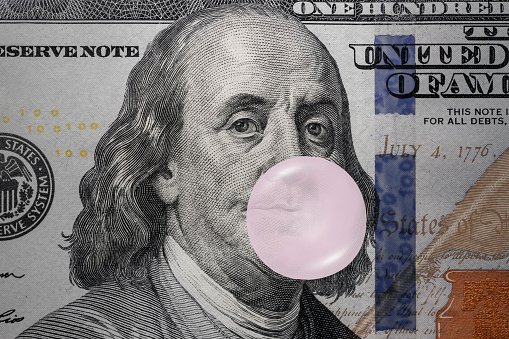
“The work of artifice is to make men believe they are acting of their own free will…”
It’s hard not to agree with Tom Sawyer’s thoughts while digging into the manipulation games in the context of big American money, where manipulation itself is the core of chasing money, prosperity, development and the realized blueprint of a wealthy American economy.
However, history shows that the chase for cheese rarely ends well, as most rats meet their fate in the snap of the trap.
At the end of September 2025, the USA reported its highest inflation rate of 3% since January.
As CNN reported, this particular number is nothing to worry about, despite being higher than usual.
Indeed, the highest annual inflation peak in the U.S. economy since 1981 was 9.1% in June 2022, right after the full-scale Russian invasion of Ukraine began in February 2022, which shook not only the U.S. economy but the global economy as well.
At first glance, the U.S.’s money system could be seen as a huge yo-yo toy, with its ups and downs as part of the natural process.
But unlike the old European markets, with their most influential centers in the UK, France, and Switzerland, the U.S.’s main money-making tool was its art of speculation and manipulation, two things hard to imagine apart, even from the way politics is shaped in the country.
While the drastic economic swings in Europe were caused by two world wars, harshly affecting countries’ development in all possible aspects, the inflation there was a natural outcome.
In the U.S., back then and even nowadays, inflation is mostly caused by the country’s mentality, greedy for money to be printed and created in the same crazy time.
Wall Street never let up on it, so its diabolical image, portrayed by DiCaprio in 2013, perfectly captures what it’s like to conjure vast sums of money out of thin air.
Or, as it is usually called, stocks and investments.
In the USA, where capitalism is given broad freedom and regulation is comparatively lighter than in other advanced economies, markets operate with a high degree of autonomy.
Still, when this pursuit of equality through unrestricted market freedom is not balanced by adequate regulation, it tends to produce damaging outcomes, placing the USA among the countries with the largest income inequality gaps.
This inequality gap has steadily shadowed the American economy from 1900 to 2015, and by 2010–2015, it had widened to levels arguably deeper than the Mariana Trench, with the top decile capturing 45–50% of all income, only slightly above the shares recorded in 1900–1910.
Pushing on equality of opportunity in the rapidly developing industrial USA of the 1900s, and in today’s richly globalized 2020s with Silicon Valley and Elon Musk sending rockets to give a bid to the aliens, reflects the other side of the country’s economy, where equality comes only to the rich, who dominate the prosperous sectors of the economy.
By saying all this, we mean the same percentages as at the start, with today’s top 10% and top 1% still controlling the bulk of influential income, just as they did in the early 20th century, with the only difference being that most of the very top wealth belonged to foreign investors seeking the stability long associated with the New World, the USA.
In the case of American economic development, strongly connected to its socio-political evolution, it would be easier to say that the country’s early decisions affected its wealthy reserves and overall economic growth.
From the start, structures such as slavery contributed to the first inequality gaps, with the majority of rich people coming to the USA with capital, bringing or buying the extremely destitute ones with no assets at all and, further, scarce access to education whatsoever.
At this point, the core of the American myth of equality in opportunities is breaking apart.
Yet, in parallel, both in 1929 and in 2020, the hope for it remains paradoxically alive despite the two being, at first glance, completely different moments and still stemming from the same root issues — the Great Crash and modern inflation.
What used to be defined by traditional shares and stocks is now increasingly replaced by crypto, venture markets and other shadowy projects with not-so-reputable positions but far more ambitious future promises.
It’s worth noting that most of the U.S. venture-capital funding was deployed for AI projects, as major news agencies such as Bloomberg and Reuters reported at the end of 2024 and early 2025.
Among the low-risk investment startups are already strongly entrenched names, such as OpenAI and Databricks, generally considered safe, with a relatively low risk of going bust.
Despite this, some of the other projects receiving the lion’s share of investments not only lack a clear explanation of how they will monetize their products, but in some cases, the projects aren’t even operational yet.
One of the most extreme examples is Safe Superintelligence (SSI), which tops the high-risk speculative list while commanding a very high valuation on the venture market.
In fact, as of 2025, SSI raised $2 billion, while the total company valuation is pushing up to $32 billion.
Some might argue that it would be wrong to directly connect a company’s current income to its overall valuation.
However, in the case of this $30 billion gap, especially when the project itself doesn’t yet exist, the stakes are entirely placed on its future potential.
SSI, like many other speculative startups, and the evident lack of government oversight, reflect the pre-1929 mistakes, when vast sums were poured into thin air rather than into productive sectors of the economy.
Undoubtedly, American industrialization was already ahead of its time, even at the start of the 20th century.
Nevertheless, in the 1920s, the sleeping European gold in American banks, carefully and steadily saved by the finance authorities of that era, would have served the economy better if it had been deployed not primarily into capital credits and speculative venture markets, the core of obscure bubbles, but rather into investments in real, productive sectors, as mentioned before, manufacturing and heavy industry.
Thanks to Andrew Mellon, the Treasury Secretary from 1921 to 1932, who surprisingly came from a wealthy industrial family, the impending wave of the American market crash was largely underestimated.
His pro-business, laissez-faire economic policies helped the wealthy accumulate even more capital, while the poor remained in precarious conditions.
When the speculative bubble finally burst in 1929, a few of the richest investors absorbed losses but the majority of the poor were pushed even further into hardship.
Nowadays, wealth remains concentrated in the hands of the richest segment of society, and some argue that certain speculative markets like AI startups and crypto are relatively underregulated.
This is partly why public projects like NASA receive less funding and visibility compared with high-profile private ventures such as those led by Musk or Bezos.
Some say history spirals like DNA, repeating past mistakes in every generation.
Across different years, but with two similar outcomes shaping the U.S. economy, history is repeating the American ideology of striving for wealth, even if it is still undefined in the future.
The core players, however, remain the same.
The 1% of filthy wealthy and the 10% who are just rich, but still rich enough to speculate on overhyped liquidity, indirectly yet tangibly pressuring inflation.
The wealth effect is real, even if its cause, such as the previously mentioned vague startup products, is far from being created.
The euphoria following this effect inevitably makes the top 1% and 10% feel as if they already have an abundance of future wealth, creating psychological pressure to spend more and buy more.
This “more” pushes prices for goods and property higher, exerting indirect inflationary pressure.
Though the bursting of this bubble, fueled by massive wealth, soaring expectations and the daily labor of ordinary Americans who keep the economy running, is just as real.
What starts as 5% inequality can quickly escalate to 20%.
What starts as 3% inflation can remind us of the 9% levels seen previously.
Enthusiasm and quick prosperity is undoubtedly the desirable fairytale of unrealistic expectations, too good to be true.
Desirable and alluring, its consequences were often ignored in the 1920s and in 2025, history appears ready to repeat itself.
Wall Street, as one of America’s hottest and most influential financial districts, still has to prove it deserves the title of the financial hub that never sleeps.
With memories of past bubbles still looming and the global economy in flux, it may now be even more cautious, wary of letting another speculative surge burst.