














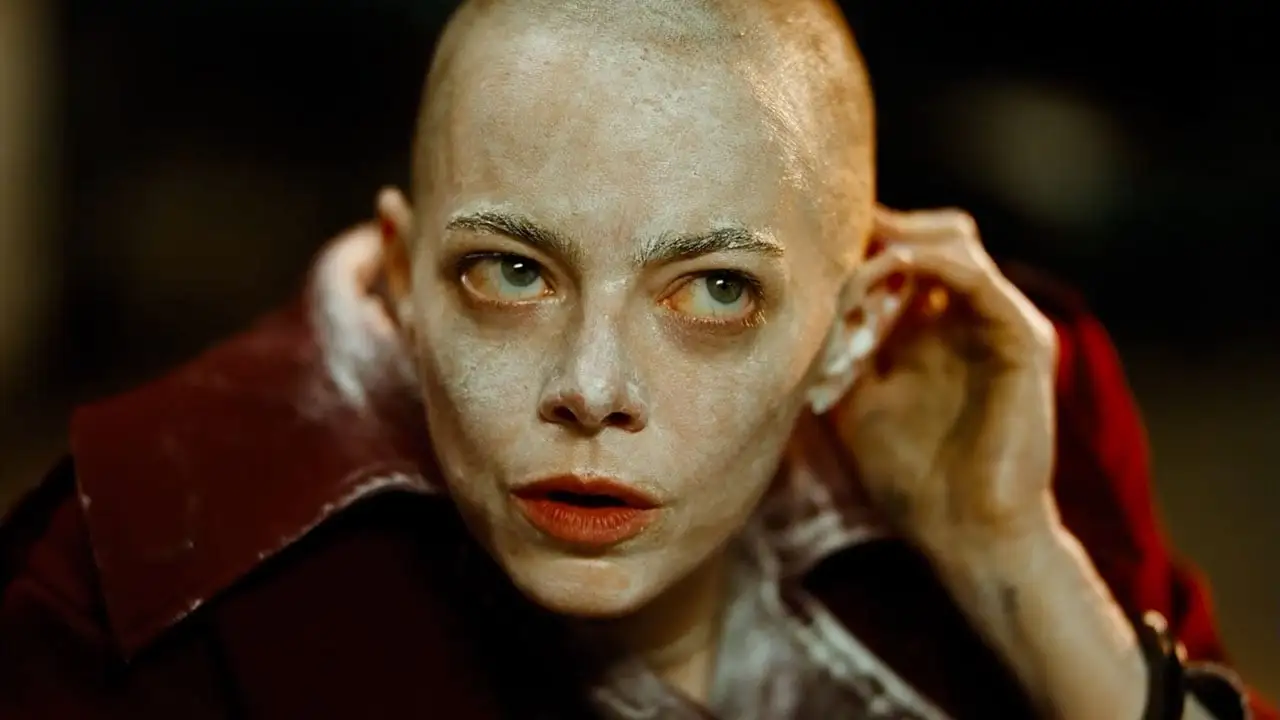
From CEOs basking in their wealth while their employees drown in overtime, to conspiracy theorists turned serial killers, Yorgos Lanthimos’s Bugonia shines a spotlight on the ugly side of humanity. If an alien were to come to Earth and watch it, there’s a high chance they’d be on the next spaceship home.
“Bugonia” was an ancient Greek folk practice based on the belief that bees could spontaneously emerge from the corpses of cows. In a nod to its title, the film begins with a vibrant close-up of honeybees hard at work, while a male narrator explains that one-third of our food is pollinated by bees and Colony Collapse Disorder (CCD) is endangering them. He lists off the possible causes, from pesticides to government manipulation, but he’s landed on a reason much more absurd — an alien posing as a CEO.
Ceo vs conspiracy theorist
Bugonia’s rivalling characters Teddy (Jesse Plemons) and Michelle (Emma Stone) have been dealt distinctly different hands in life and have a direct yet uneven impact on each other. While Michelle operates at the top of the food chain with little regard for Teddy, his low-pay, low-reward labour contributes to the growth of her company and funds her luxurious lifestyle.
Michelle is the perfectly put-together, corporate-speaking ceo of Auxolith, a pharmaceutical company that ran a clinical trial which left Teddy’s mother comatose. She lives in a hypermodern, minimalist home and follows all of the inexplicably sinister self-care routines we’ve come to expect, from intense red-light therapy to ice-water facials. At her lucrative company, she champions workplace diversity (while she’s on camera) and tells her employees they can finish at 5.30 pm (if they’re not busy).
Then there’s Teddy, who works in an Auxolith warehouse and lives with his cousin Don (Aidan Delbis) in a rundown ranch house with decor stuck in the 1980s. He’s a devoted conspiracy theorist, plagued with severe trauma, who believes the only explanation for someone as evil as Michelle is alien invasion. She’s an Andromedan hellbent on destroying the fraying strings that tie humanity together, like empathy, family, community and, of course, the bees.
An alien, or just a CEO?
Teddy’s alien theory leads him to kidnap Michelle and, with the help of his reluctant cousin Don, he ties her up in his basement until she admits her true identity — she’s not one of us. But it’s not so straightforward, because in his quest to find the Andromedans among the humans, he murdered several beings and harvested their organs for research.
After the revelation, we’re left with two vastly different types of immorality. One has been driven by poverty and desperation for a better life, and the other is less clear-cut. “Michelle”, who we now know to be an Andromedan empress, came to Earth with the goal of bettering humanity through an array of clinical experiments. Yet she did this while disguising herself as one of our more socially acceptable forms of evil. Through her role as a money-driven, apathetic ceo, she fuelled the destructive capitalism that left both Teddy and his mother with irreparable damage — to name only two people.
The film takes a sillier turn towards the end when we join “Michelle” on her home planet, until she abruptly decides there’s simply no hope for humanity and it’s time to pop the bubble. In a split second, all humans are wiped out and animals are left to roam the planet alone.
It’s unfortunate that the direction the film seemed to be going in — where the “alien” is in fact an ultra-wealthy person and we’re watching a haunting reflection of our society — isn’t where we end up. As much as we want to, it’s harder to hold the same level of sympathy for Teddy when we learn of his murderous spiral that happened behind closed doors. But without reading so literally into the alien narrative, Bugonia could be a reminder that the elite tend to have a funny way of ending up on top, regardless of who they harm along the way.
What happens when we’re gone?
As Where Have All the Flowers Gone? by Marlene Dietrich plays us out, there’s a strange feeling of acceptance emanating in the cinema I’m in. After two hours of pain, corruption, deceit, murder and the rest, it’s a relief that it’s all over.
As birds glide over the dead, a gentle breeze blows through pages of a book and the bees buzz away, we see just how peaceful and harmonious the planet could be. We don’t see what happens after everyone dies, but there’s a sense of hope and a fresh start. After total destruction comes a new beginning. The planet won’t be the same, but it will be there, and in this moment, there’s serenity.
But what happens when our pets get hungry and we aren’t there to feed them on time? What about all the toxic waste we leave behind, with no one to recycle it or dispose of it safely? When our machines malfunction, who will be there to fix them? What harmful pollution will the mass of dead bodies expel into the air? As our infrastructure crumbles and nature reclaims it, how will the world continue without us to keep it spinning? The brutal truth is, it will likely be just fine. Eventually.
Humans have spent lifetimes disrupting the planet’s ecosystems, through enforced climate change, man-made pollution and deforestation, and although some damage is irreparable, it’s our responsibility to amend what we can. Bugonia’s climax feels like a warning to us, if we stick to our destructive, selfish ways. And by the film’s logic, it won’t be our choice if we get to stay here or not. We won’t even know when it ends.
It leaves us wondering, if by some miracle, human-like life re-emerged after extinction, would they repeat our past mistakes? Like the bees that rise from the corpses of cows, can all this destruction birth a species that feeds everyone equally and learns to respect the systems nature has kindly given to us?