













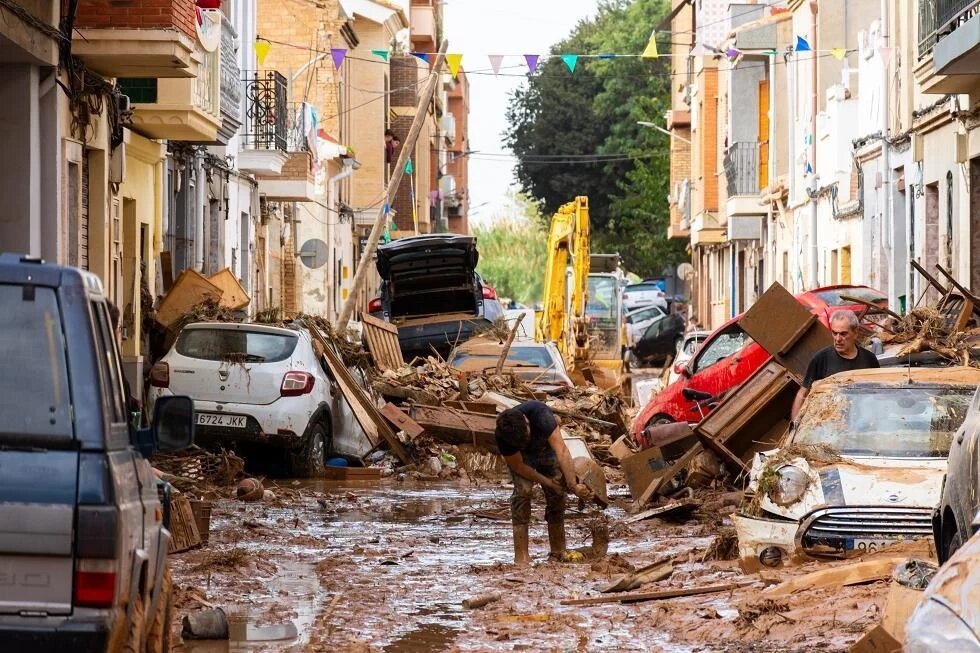
In recent years, Spain’s Mediterranean coast – particularly Valencia – has faced devastating storms known as DANAs (Depresiones Aisladas en Niveles Altos – or in English, Isolated Depressions at High Levels). These weather events bring sudden, torrential rain, flash floods, and severe damage. As Europe (and the rest of the world) experiences more unpredictable climate patterns, we wondered: could something similar to a DANA happen in the United Kingdom too?
What is a DANA?
A DANA forms when a pocket of cold air becomes isolated high in the atmosphere, above a layer of warm, humid air near the surface. The resulting instability can bring intense thunderstorms and heavy rainfall in a short time. In Spain, the warm Mediterranean Sea provides plenty of moisture, while the region’s coastal mountains trap the storm system, amplifying its effects. This specific combination makes the Iberian east coast particularly vulnerable.
On the 29th October 2024, Valencia suffered severely from a DANA, with 232 people killed. That year, Valencia accounted for 70% of flood-related deaths in Europe.
Why did Valencia suffer so severely?
While the meteorology was intense, one of the reasons the recent DANA caused so much damage in Valencia was insufficient preparation and outdated infrastructure. Several factors played a role:
Inadequate drainage systems meant the area struggled to cope with sudden volumes of rain. Stormwater drains filled quickly, leading to rapid street-level flooding.
Urbanisation in flood-prone areas – including low-lying coastal zones and former riverbeds – increased the number of properties at risk.
Limited natural flood buffers, such as wetlands and green zones, reduced the land’s ability to absorb water.
Emergency alerts and preparedness were not strong enough to help residents respond quickly to such fast-forming storms.
In short, the scale of the damage was not only due to the weather system itself but also to long-standing weaknesses in planning and adaptation. Valencia’s own experience serves as a warning: even developed urban regions can be caught off guard when infrastructure does not match the severity of events that are related to climate change.
Ultimately, the scale of the destruction in Valencia was not just a product of extreme weather but of years of political hesitation and short-term planning. The region paid the price for ignoring warnings that had been clear for over a decade. The president of the Valencian Government, Carlos Mazón, resigned In November 2025, due to increased anger from residents in Valencia.
Could something similar happen to the UK?
First of all, the UK’s climate and geography differ from Spain’s, but the underlying atmospheric processes behind a DANA can occur further north. British meteorologists refer to these systems as cut-off lows: slow-moving, isolated pockets of cold, upper-level air that generate prolonged rainfall. Though generally less intense than Mediterranean DANAs, they can still bring serious flooding.
Events such as the 2019 northern England floods and the 2014 Somerset Levels flood were caused by similar slow-moving systems that repeatedly dumped rain over the same areas. The impact in these cases was substantial, even without Mediterranean temperatures to fuel the storms.
But the UK is usually less vulnerable because its seas are cooler, limiting moisture available for extreme rainfall, its geography lacks the steep coastal mountains that amplify storms in Spain and its weather systems are typically more mobile, meaning storms don’t often linger in one region for too long.
However, climate change is altering these patterns. A warmer Atlantic holds more moisture, and changes in the jet stream can trap systems over the UK for longer. This raises the likelihood of more intense, localised downpours – the British equivalent of a DANA.
What lesson are we learning from Valencia?
Although a true Mediterranean-style DANA is unlikely to strike the UK with the same intensity seen in Valencia, the mechanisms behind a DANA already exist in British weather, and similar storm systems have caused significant damage in the past. Valencia’s experience shows how devastating such storms can be when cities are underprepared – a crucial lesson for the UK as climate change makes extreme rainfall more common.
Strengthening drainage systems, revising urban planning in flood-risk zones, protecting natural floodplains, and improving early warning systems are all steps the UK may need to accelerate. If Valencia shows anything, it is that even predictable risks can turn into disasters without proper preparation.
In conclusion, Valencia’s experience should make the UK wary. Although Britain may not face Mediterranean-style storms, complacency could leave its own towns just as exposed. A storm doesn’t have to be as intense as a DANA to cause chaos if a city is unprepared.