













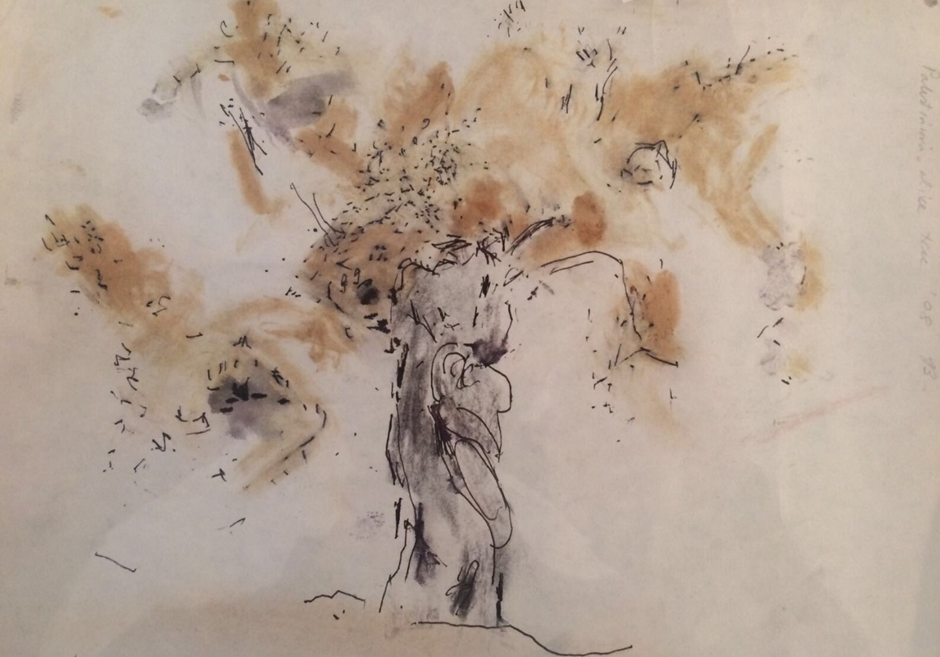
As I am writing this piece, Palestinian families, friends and neighbours are gathered in their ancestral olive groves. The small green or black fruits are ready for plucking during the annual mawsim al-zaytoun (“olive season”), which typically lasts from October to November. Once the freshly picked olives are packed into bags and pails, they are transported to mills for pressing and oil production, a cornerstone of Palestinian cuisine.
Known as al-mubarakah (“the blessed tree”) in the Quran, the olive tree is a long-standing symbol in Palestinian culture and literature, appearing in the works of poets such as Mahmoud Darwish and Tawfiq Zayyad. Its significance is also evident in the landscape—occupied Palestinian territories consisting of 45% of arable land is dotted with olive trees. The majority are located in the West Bank, where farmers have terraced the hillside slopes to cultivate olives and for many Palestinians, these harvests are a means of survival. The olive oil industry represents a quarter of the region’s gross agricultural income and supports approximately 100,000 families.
For several decades now, Palestinian farmers have been targeted by Israeli settlers and soldiers, facing restricted land access, uprooted and torched trees, contamination of already scarce water supplies, intimidation and in some cases, lethal violence from Israeli soldiers and settlers. However, this violence has escalated in the last few years due to the expansion of Israeli settlements and the 2023 October 7 attacks.
In many areas of Palestine, access to olive groves is highly controlled. In the so-called ‘Seam Zone’ areas located between the Separation Barrier and the 1949 Armistice Line, Israeli authorities have implemented a strict permit system requiring Palestinian farmers to seek permission to access their land. Similar restrictions exist in areas near Israeli settlements. If permits are approved, farmers are allocated specific harvesting periods, which can be as short as two days, and even then, they can face further obstructions. During this year’s harvest season, in permit-issued areas, farmers reported limited opening days and hours of barrier gates, long waiting times, extensive searches and occasional denied access.
Despite Israel and its allies’ attempts to project restraint and impose a fragile ceasefire in Gaza, this year’s harvests have been fraught with danger. The UN has recorded 167 olive harvest-related attacks between October 1 and November 10. These attacks, carried out by Israeli settlers and often with the complicity of soldiers, have led to multiple casualties and property damage. In total, 151 Palestinians were injured inside or on their way to olive groves, more than 5,700 saplings and trees were damaged and crops and harvesting equipment were stolen. One harvest-related death was reported recently—following an attack by soldiers one month ago, 13-year-old Aysam Jihad Labib Naser succumbed to his injuries in cardiac intensive care. Naser was harvesting olives with his family in Beita when Israeli forces fired several tear gas canisters in their direction, fatally wounding the teenager.
This violence is part of a pattern of colonial domination. Since its inception, Israel has sought to disrupt the historical and living ties of Palestinians to their land. According to Potawatomi philosopher Kyle Whyte, settler colonies do this to strategically undermine the collective continuance of Indigenous communities on the land. By targeting the West Bank’s self-reliant, land-based economy, Israel harms Palestinian livelihoods and reinforces control over the territory. As an act of anti-colonial resistance, local communities continue to plant and harvest olive trees, sometimes in the face of stun grenades, tear gas and water cannons.
The Ongoing Nakba
Israel was founded on May 14, 1948, a realisation of the Western-backed Zionist movement. The establishment of the Jewish-majority state entailed the forced expulsion of hundreds of thousands of Palestinians from their homeland, an event known as the Nakba (“catastrophe”). Between 1947 and 1950, Israel took over 78% of historical Palestine, ethnically cleansed two-thirds of its population and razed 530 villages and cities, causing the near-total destruction of Palestinian society. During this period, about 15,000 Palestinians were killed by Israeli paramilitary groups in a series of mass atrocities, including more than 70 massacres.
The Nakba never ended. The displacement of Palestinians only intensified, with exiled or fleeing Palestinians denied their right to return and right to lost properties. After the 1967 Six-Day War, Israel absorbed more Palestinian land, taking over the West Bank, East Jerusalem and the Gaza Strip, as well as additional Egyptian and Syrian territory. This is now the longest military occupation in modern history. By the end of the Six-Day War, Israel expelled another 300,000 Palestinians, including 130,000 who were evicted in 1948. As of 2021, there were an estimated 9.17 million displaced Palestinians worldwide—approximately 8.36 million refugees and 812,000 internally displaced persons.
Today, while many Palestinians displaced by the occupation languish in neighbouring countries like Jordan, Lebanon and Syria, those who remain in the occupied rerritories face rising dispossession and discrimination. Israel enforces a system of apartheid in the occupied West Bank and East Jerusalem and, contravening international humanitarian law, facilitates an expansion of illegal settlements, further land-grabbing and dashing hopes for a Palestinian state. Since October 2023, Israel has committed genocide in the Gaza Strip, bombarding and starving the besieged population.
Scholars have long focused on the ethnic cleansing aims of the Nakba. However, an overlooked aspect of the Nakba is its defacing of local ecologies. Environmental mutilation has been a core feature of Zionist colonial domination, wielded as a weapon of control and erasure. Indeed, the Israeli architect Eyal Weizman argues that the Nakba “also has a lesser-known environmental dimension, the complete transformation of the environment, the weather, the soil, the loss of the indigenous climate, the vegetation, the skies. The Nakba is a process of colonially imposed climate change”.
From Environmental Nakba to Colonial Ecologies
When European Zionist settlers arrived in Palestine, they perceived the land as desolate and empty. Determined to ‘redeem the land’ and ‘make the desert bloom’, settlers uprooted native vegetation, including olive trees that villagers had cultivated for generations. Since 1967, nearly one million olive trees have been destroyed by settlers to clear the land for development, excising the indigenous flora just as they removed their caretakers —a dual Nakba, environmental and human.
In place of indigenous arboreta, settlers planted vast expanses of pine trees. These afforestation projects served ideological goals, according to Palestinian scholar and activist Ghada Sasa: to Europeanise the ‘barren’ landscape and, most importantly, further erase the existence of Palestinians and prevent their return. Forests and parks were erected over the ruins of Palestinian homes, concealing evidence of the Nakba. Carmel National Park, Israel’s largest national park, is nicknamed ‘Little Switzerland’ for its resemblance to the Swiss Alps and obscures the remains of the Palestinian villages of Ijzim, Umm al-Zinat, and Khubbayza, which are absent from contemporary maps.
Predictably, these tree species from Europe were totally unsuitable for the arid Mediterranean region. Pine trees are water-demanding, disease-prone and highly flammable, they are also increasingly threatened by climate change, with Israel’s destructive wildfires in 2025 sweeping through these forests and reducing them to ash. To make things worse, Israel’s monoculture afforestation efforts have rendered local ecosystems highly vulnerable to habitat destruction and ecocide. Israeli ecologists found that these tree-planting efforts led to the decimation of grasslands harbouring rare endemic species. Pine trees can inhibit the growth of lower flora when their acidic needles fall to the ground, reducing surrounding biodiversity and depriving Palestinian shepherds of pasture.
In contrast, olive trees are resistant to diseases, require little irrigation, and can retain humidity, creating a natural barrier to fire. For Palestinians, olive trees are symbols of resistance and resilience. Some of these trees have been standing for thousands of years, weathering Roman, Ottoman, British and Israeli occupations. Where colonial pines fail to adapt, olive trees endure.
Cultivating Olive Trees: The Practice of Eco-sumud
Despite the wanton brutality of the Israeli occupation, Palestinians continue to resist through the practice of sumud (“steadfastness”). A term with several meanings, sumud can be defined as everyday acts of resistance and resilience, according to Palestinian climate activist and researcher Manal Shqair. It can also refer to their resolve to remain on their territory and to conserve their identity and culture in the face of Israeli dispossession and narratives framing Jewish settlers as the land’s rightful owners. Eco-sumud, a concept coined by Shqair, describes environmentally rooted ways of maintaining a deep relationship with the land, resisting the occupier’s efforts to sunder this bond. Its practice relies on indigenous land-based knowledge and cultural values. By that definition, olive tree planting and harvests are all acts of eco-sumud.
The Joint Advocacy Initiative, the Land of Canaan Foundation, the Palestine Fair Trade Association and the Arab Group for the Protection of Nature are organisations involved in sapling planting initiatives. Supported by partner organisations in other parts of the world, these afforestation projects have several objectives: assisting Palestinian farmers, rehabilitating land and safeguarding local seeds. These campaigns have borne fruit. Notably, the Joint Advocacy Initiative has reportedly planted nearly 250,000 olive trees in its first twenty years, with substantial afforestation successes in 2021 and 2022. These initiatives emphasise olive tree planting as a tangible act of Palestinian resistance. For instance, the US Campaign for Palestinian Rights invites supporters to ‘root resistance by planting an olive tree today!’, while the Arab Group for the Protection of Nature-led Million Tree Campaign slogan reads ‘They Uproot a Tree, We Replant Ten’.
Today, olive harvests continue in defiance of the restrictions and violence imposed by Israel. Organisations such as the International Solidarity Movement and the Centre for Jewish Nonviolence enlist volunteers to assist local farmers, establishing international networks of solidarity. This work is coordinated with on-the-ground Palestinian organisers, including Ghassan Najjar, founder of the Land & Farming Cooperative in Burin, a collective of farmers working to create sustainable farms, achieve food sovereignty, provide free education, and combat environmental degradation under Israeli occupation.
Eco-sumud is rooted in the belief that Israeli settler-colonialism will someday be defeated. Broadly, it affirms the Palestinian people’s unfaltering determination to shape their own destiny and reclaim stewardship of their land. By cultivating olive trees, Palestinians enroot. Each sapling planted is an assertion to remain; each harvest is an act of reclamation.
For people and land are inseparable, both awaiting liberation, as captured by Mosab Abu Toha in his poem ‘A Litany for One Land” After Audre Lorde’.
And when we die,
our bones will continue to grow,
to reach and intertwine with the roots of the olive and orange trees, to bathe in the sweet Yaffa sea.
One day, we will be born again when you’re not there.
Because this land knows us. She is our mother.
When we die, we’re just resting in her womb
until the darkness is cleared.