

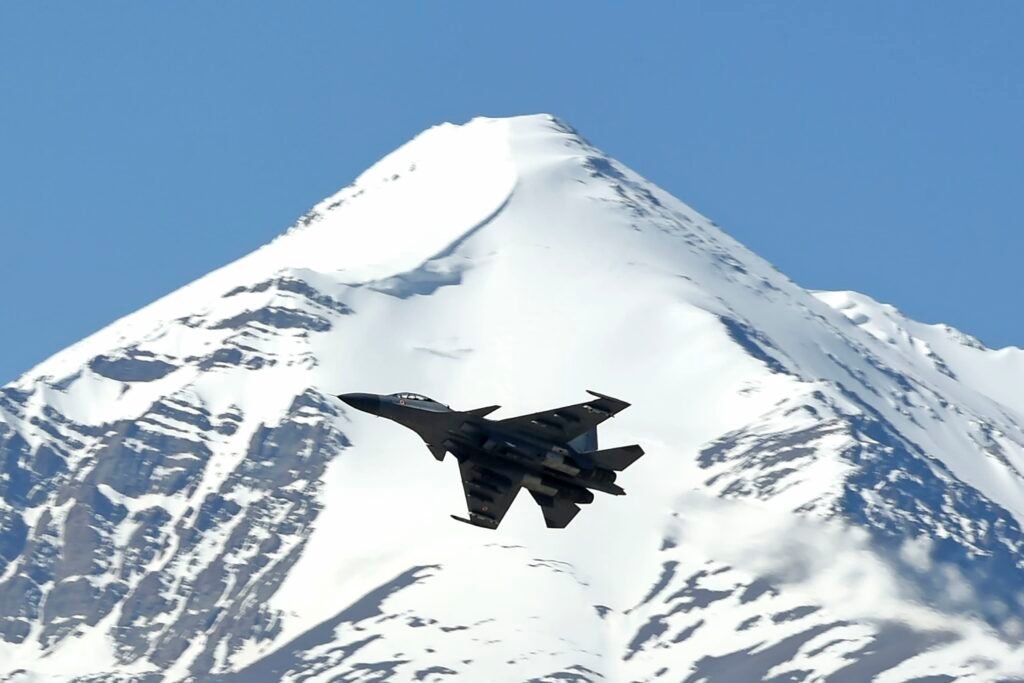
High in the barren mountains of the Himalayas, Indian soldiers overlook a broad swathe of icy terrain. Gazing back at them are thousands of Chinese soldiers, each protecting what the other claims. The object of desire is an unmarked landscape spanning thousands of kilometres, stretching from India’s border with Pakistan in the west to its border with Myanmar in the east.
The tension has not been limited to glacial stares. In 1962, India suffered a devastating defeat at the hands of Chinese forces in a month-long war. A sense of calm was thought to have been secured by a 1996 treaty banning the use of firearms and explosives along the border. Yet in 2020, this era of restraint came to an abrupt end when Indian and Chinese soldiers engaged in large-scale, almost medieval, hand-to-hand fighting that left dozens dead.
When Chinese troops once again found themselves in what India considers its territory, hundreds of Indian soldiers lay in wait armed with clubs and tasers. This time, the Indian Army was able to repel the Chinese incursion, suffering only a handful of injuries. How did India reverse its series of losses against China? The answer lies in unprecedented American cooperation and intelligence sharing.
How did we get here?
Shortly after the 2020 clashes in the Himalayas, India signed an intelligence cooperation agreement with the United States and ties between the two nations began to deepen. By 2022, American intelligence officials were sharing information with their Indian counterparts indicating that China was preparing for another territorial advance.
Weeks before the attempted incursion, India held joint military exercises with the United States’ 11th Airborne Division. While the drills appeared to aggravate Beijing, an open-air concert staged by American troops within earshot of People’s Liberation Army soldiers may have further inflamed tensions and pushed China to move across the border. This time, Indian soldiers, aided by American intelligence, were able to push them back.
India has warmed to the United States and its allies in recent years in response to an increasingly antagonistic China, which seeks to enforce what it claims are its national boundaries. This has prompted several regional powers, most notably the Quadrilateral Security Dialogue, to strengthen ties in order to counter Beijing.
Formed in the aftermath of the 2004 Indian Ocean tsunami, Australia, India, Japan and the United States initially banded together to coordinate disaster relief. Over time, the partnership evolved into something resembling a strategic alliance. A 2021 declaration outlined the group’s shared vision for a free and open Indo-Pacific region, anchored by democratic values and unconstrained by coercion. All four nations have since engaged in joint military exercises, and following its 2020 defeat, India has grown increasingly receptive to deeper cooperation.
There is an old Russian proverb which states that a man is judged by his deeds rather than his words, and India is testing both the wisdom of the saying and the reliability of its source. During the Cold War, the United States cultivated close ties with Pakistan as a counter to Soviet influence. Although officially non-aligned, India forged a deep military relationship with Moscow in response to a Pakistan backed by Washington.
That relationship has endured long after the fall of the Iron Curtain and the collapse of the Soviet Union. As a result, India remains tethered to Russia, relying on Moscow for spare parts to maintain its ageing, Russian-made arsenal. This dependence is reflected in India’s refusal to condemn Russia’s invasion of Ukraine and in statements from foreign minister Subrahmanyam Jaishankar, who has described ties with Russia as “the only constant in global politics”.
Such remarks may be delivered through gritted teeth. Without Russian spare parts, India’s military would be critically vulnerable to Chinese or Pakistani aggression. Increasingly, however, signs suggest New Delhi is attempting to loosen its historic reliance on Moscow by developing a domestic defence industry and cultivating new partnerships in the West. These efforts are already bearing fruit, with India purchasing fighter jets and submarines from France and high-end drones and jet engine technology from the United States.
Why India?
India’s geography is likely to dictate its long-term alignment with the United States. By land, it shares a lengthy border with regions historically resistant to centralised rule. Tibet rose up against Beijing in 1959 in a revolt that left thousands dead and forced the Dalai Lama into exile in India. Although the uprising failed, sporadic protests have continued under Chinese rule, met with relentless repression. In the event of a conflict over Taiwan, China fears, and Washington may quietly hope, that unrest could be stirred in this restive region.
By sea, India’s influence extends deep into the Indian Ocean, through which vast quantities of Chinese oil imports flow. More than 70 per cent of China’s oil imports pass through the Indian Ocean before transiting the Strait of Malacca en route to the South China Sea. In the event of a future conflict, this supply line could be disrupted by American or Indian naval forces.
The United States has already signed agreements with India allowing for the maintenance and repair of naval vessels, and some officials suggest this cooperation could expand significantly in the event of war.
What are the challenges to future cooperation?
Despite growing strategic alignment, unease persists in Washington over India’s human rights record, particularly under Prime Minister Narendra Modi. Nevertheless, the United States views India as an indispensable partner in its efforts to counter China’s rise.
This has placed American intelligence agencies in an unusual position. By day, they must prevent Indian operatives from targeting dissidents on US soil. By night, they work alongside the same agencies to contain Beijing’s ambitions. These competing imperatives have locked the two nations into an uneasy but inescapable embrace.
Ultimately, geography tends to define a nation’s destiny. It is India’s geography, as much as ideology or diplomacy, that is likely to bind it to the United States for generations to come.