
On 26 July 2023, the presidential guard commander of President Mohamed Bazoum of Niger, General Abdourahamane Tiani, detained the president and declared himself in charge of the country via a new military junta. As a result, the military forces closed all borders, suspended the government and put in place a curfew. Although the coup was widely condemned by both domestic and international forces, it seems that the new head of state is here to stay. However, to fully understand the insight that led to this coup and what the potential consequences for both Niger and the wider world are, it is essential to look back at its political history.
Niger was a French colony until it gained independence in 1960. However, like many former colonies, there are many cultural and linguistic ties that bind the two countries together. In fact, there are many French defence forces still in the country. As such, as with many historical places that keep ties with their colonial factions, there is always an undertone of unease and tension in the country. Colonialism impacted and continues to majorly impact many places, and the hurt and anger that is caused is passed through generations. As a result, a country like Niger, which did not immediately start out with a strong democratic government and a system that keeps the apparatus in check directly after its independence, was bound to have problems such as this.
The country has gone through four military coups since 1960, the last one occurring in 2010, with multiple attempts since then. An attempted coup took place as recently as 2021 when military forces tried to seize the presidential palace before the inauguration of the president-elect Mohamed Bazoum. He was the country’s first successful democratically elected leader. This also came in the wake of many coups in neighbouring countries in the same year, such as in Sudan and Burkina Faso, which are known for having unstable governmental structures. One of the main issues in these parts of the world is the political turmoil that goes on in the region. There are perceptions of governmental incompetence and corruption throughout the administrations, as well as experts revealing the rising cost of living hitting especially hard and the toll of Islamic insurgencies taking a hold in the region. This is one of the reasons why the US, Turkey and France have bases in the country and continuously support the military through tactical training and logistical support. However, it is this Islamic insurgency issue that is at the heart of this specific coup.
In 2022, after the president had been at the helm for a year, he was widely considered to be one of only a few people in the entire region that was in support of the West and the reason why they still needed to be in the area: the insurgencies. The Belt is known to be a hotbed of activity for everything from Al-Qaeda to Boko Haram and, as such, the West is allowed in the region to cease their activities.
The president’s actions kept him in conflict with many of his supporters, with even the coup leader stating that the “Nigerien military overthrew Bazoum due to rising insecurity in regards to jihadism”. However, this does not seem to be the case as their activities were declining at the time of the incident.
The day of the coup, it was led by General Abdourahamane Tchiani who experts say was going to be relieved of his duties by the president soon and saw this as a way to strike first before striking out. He tried to start an anti-republican demonstration and did not have the support of the other security forces; as such, he led the people under his command to detain the president and flood the presidential palace with military forces. As per recent reports, Bazoum, his wife and son are being detained and treated as prisoners, while his daughters were safely in Paris at the time of the coup. After much political and diplomatic infighting in the days after, it was finally declared that Bazoum had been removed from power and that the junta, led by Tchiani, would be in charge until further notice.
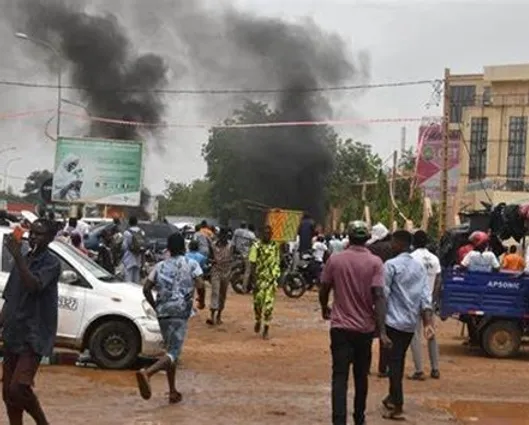
The reactions to the coup, both domestic and international, were as expected: all-around condemnation. Domestically, the country’s political coalitions expressed support as to the aspects of the governance that were worrying the country, but denounced any use of force to create change. Throughout Niger, the people were up in arms after having successfully elected a democratic leader. Mainly, the revolts on the streets were essentially anti-West and specifically anti-French. The people in the country have finally had enough and, like many in this part of the world, their only way of speaking out is to join in revolts and non-peaceful protests.
As for internationally, practically every global organisation has called out the junta as unlawful and has demanded the release of the president. Without the release, there are consequences facing the country now. For example:
- The World Bank has suspended monetary distributions to the country.
- ECOWAS has threatened international sanctions and the use of force by other countries.
- As of 5 August, sanctions have been imposed, electricity has been cut, borders have been closed and the country has lost access to ports.
As the tension rises, there could be massive consequences to these actions.
The consequences that face Niger are great and, depending on what happens, could send shockwaves across generations. Firstly, the junta has exceeded the deadline to agree to terms set out by ECOWAS. This could see the deadline be indefinitely extended while military and diplomatic forces try and find a solution that suits all sides. This could be seen as stepping back from the situation by the leaders of ECOWAS, but could also be seen as saving face as diplomatic solutions are found.
The problem is that the military junta has announced that they will cut ties with the US, France, Nigeria and Togo over diplomatic issues. This in turn could cause these countries to withhold food and humanitarian assistance that they provide, which could be disastrous for Niger. Another solution—one that many who condemn the coup agree on—is the two sides coming to an agreement about a transition of power. However, this also comes with consequences, evident by the countries around Niger that have also gone through this process, such as Mali or Burkina Faso, where elections are indefinitely pushed back and the junta holds onto power as long as possible.
Lastly, the option that many leaders do not want to take is military intervention. ECOWAS has hinted that if the president is not reinstated there could be a use of force, something they have shown the ability to do via the reconstituted position of power given to Gambia after the coup there in 2017. However, because of geographical and political issues in the region, this conflict could snowball into a full-out regional war.
For now, the international community is forced to look on as ECOWAS and the military junta in charge try to come to a peaceful resolution. No matter what actions are taken, there will be major long-term consequences that will affect the diplomatic, political and economic relations in West Africa and their relations with the rest of the world.