











As early as the 14th Century, a woman exhibiting signs of sexual confidence, prosperity or self-expression was deemed inherently evil.
An excerpt from 1486’s Malleus Maleficarum — perhaps the most notorious “witch hunter’s manual” — reads: “All witchcraft comes from carnal lust, which is in women insatiable… What else is a woman but a foe in friendship, a necessary evil, a natural temptation?”
The slightest hint of sexuality, success or autonomy that defied societal control was twisted into opportunistic claims that innocent people (most of them women) were evil and corrupt — claims which were then used to rationalise horrific violence against them.
When we reflect on the brutal treatment of women in the past, it seems almost impossible to reconcile the hatred of female agency with the countless women we see thriving in mainstream media today — many of them heralded as feminist icons and pioneers. However, even some of the most iconic figures in the music industry have been subjected to accusations of supernatural ties which undermined their independence. However, these same women have transcended the rumours by reclaiming control over their narratives and embracing their mystical aesthetics.
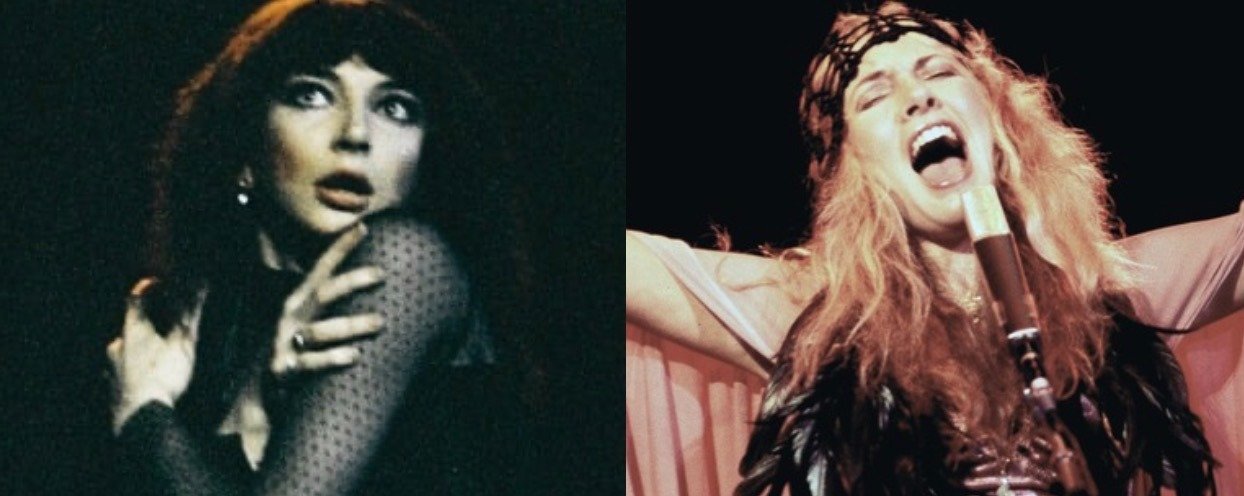
Let’s return to the mid-1970s. A band is performing, and at the forefront stands a woman, draped from head to toe in black chiffon and platform boots. Her knuckles are white around the microphone as she enters a trance — a ritualistic incantation, shrouding herself in a cloak of mystery and bewitchment. She has an incendiary stare, and her voice is hoarse and piqued as she begins to chant in an archaic tongue. The drums and punchy electric guitar don’t attempt to keep her in time — instead, they chase her wild tempo. With arms flung wide and boots slamming the stage, she is no longer a performer; she is a conduit. A vessel for whatever mythical force is moving through her.
Three hundred years ago, a spectacle like this would have been a one-way ticket to persecution — seeing the woman drowned or hanged. However, in the 1970s, this performance was vital in helping to establish this band during their early commercial breakthrough. Today, this performance has 17 million views on YouTube and was dubbed by Rolling Stone in 2020 as “the coolest thing in the universe”. The performer is Stevie Nicks, frontwoman of Fleetwood Mac and two-time Rock and Roll Hall of Fame inductee, captivating audiences during the band’s 1976 live version of “Rhiannon”.
Fleetwood Mac — Rhiannon (Official Music Video) [HD] — YouTube
The early seventies saw Nicks emerging onto a male-dominated rock scene, where all-male bands like Black Sabbath and Blue Öyster Cult were already freely exploring themes of satanic rituals and occult imagery. While her aesthetic was no less provocative, Nicks’s gender made her the target of rumours and scrutiny — the kind her male contemporaries never faced.
On the surface, these rumours could be easily explained — from her choice of stagewear (outfits that saw her small stature adorned in layers of chiffon, with dramatic sleeves and shawls decorated in fringe), to the titles and lyrics of many of her songs. References to “black widows” are found in “Gold Dust Woman” as well as the aptly named “Sisters of the Moon”, which conjures up more eerie imagery with mentions of “black moons” and “black robes trailing”. During other live performances of “Rhiannon”, Nicks would preface her song with the haunting tagline: “This is a song about an old Welsh witch.”
However, similar to many women who preceded her, it is entirely possible that the term “witch” was thrown at the singer in an opportunistic, sexist attempt to dictate her narrative while minimising her success.
To some, it was not enough that Stevie Nicks was a brilliant lyricist with a magnetic stage presence, or that her resolute independence made her a groundbreaking force in the music industry. No — there had to be more to it. We often see examples of female success met with a similar mindset: when women become too powerful, they pose a threat to those who can no longer control them.
However, the rumours never knocked Nicks out of line, and she has continued to thrive in the music industry for over 50 years with unwavering force. By brazenly bypassing those who tried so desperately to shrink the multi-faceted musician down to a gendered stereotype, Stevie Nicks represents a kind of female liberation that, centuries earlier, would have been met with persecution, torture and even death.
Another fiercely affluent woman in music who faced similar scrutiny is Kate Bush, whose debut single “Wuthering Heights” saw critics in 1978 branding her unique vocal style and bohemian beauty (cascading brown hair, long fingernails and floor-length dresses) as “bizarre” and “rotten”. Even the Brontë Society deemed the song a “disgrace”. Why? Simply because she was not afraid to experiment in order to find a place for herself in music. Her charismatic, theatrical approach to her craft was something rarely seen before — and the backlash she faced demonstrated similar societal anxieties seen centuries before.
In the 1970s and 1980s, Bush was met with sexist ideations of who she was — with journalists often describing her as being reclusive, eccentric or downright odd. Some even cuttingly described her aesthetic as “smell[ing] of tarot cards”, with lashings of “witchy” tropes. This is another example of a young woman who, between navigating a heavily misogynistic industry and attempting to gain recognition for her own successes, was also being reduced to chauvinistic misinterpretations.
Bush’s song “Waking the Witch”, with its panic-inducing rhythm and disturbing, cacophonic soundscape, addresses some of the sadistic torture methods used in the witch trials — specifically, ducking (the method of bounding the accused and throwing them into a body of water to see if they would sink or float) and sleep deprivation.
Bush constructs a claustrophobic listening experience through whispers, distorted voices and frantic splashes of water — making you feel as though you are being dragged underwater, between being repeatedly jolted awake. Church bells ring out, an angry mob chants and the listener is forced into the role of the accused. Bush once described witch hunting as “the fear of women’s power”, saying that the inspiration behind her haunting song was “the idea of a witch-hunter hiding behind the priesthood, as a guise, and coming to get this woman who is not a witch, but he wants to make her so”. “Waking the Witch” explores sexism whilst accurately depicting the brutal reality of institutional authority; more specifically, how it was used as a guise to persecute innocent people in the name of moral superiority.
In today’s culture, the symbol of the witch has shifted dramatically — particularly in the world of music. Artists like FKA twigs and Lorde not only enjoy significant commercial success, including numerous hits and music awards, but are also branded with the same label — “witchy”. These two performers happily embrace the association, however, along with the power and agency that comes with it.
On challenging society’s expectations with her music, FKA twigs said, “I’m appealing to people who want something different, but the world, on the whole, doesn’t really embrace different things.”
From her avant-garde performance style — which blends ritualistic dance with hypnotic, almost incantatory vocals — to Lorde’s poetic lyricism — which sees her self-identifying with the elements and emphasising the nurturing properties of nature — both of these women have welcomed the “witchy” image, actively reclaiming the label as part of their creative identities.
We will always see artists pushing the envelope to explore boundaries and find a place for themselves in the music industry — and they will inevitably upset people in the process. Whether it’s Nicks and Bush, or Lorde and FKA twigs, many notable women in music have helped reform what it means to be “witchy”, curating an empowering and unifying identity which will also be adopted by people to come. The symbol of the witch no longer signifies danger, but instead encapsulates fearlessness, creative freedom and female resilience.