











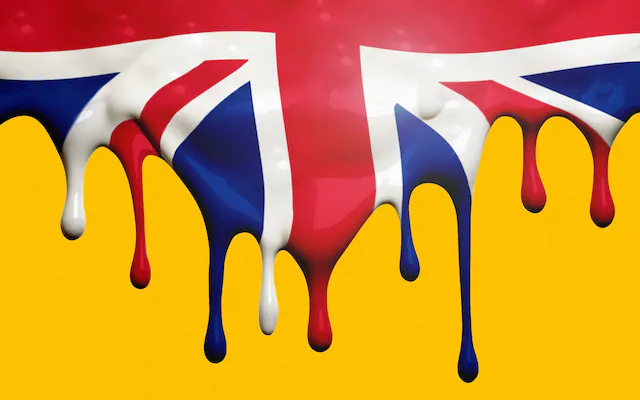
What do we define as “Britishness”? In the most vague sense of the word, how do we as citizens of the UK define what it means to be British? Do we highlight the charming clichés of our love of an English breakfast tea, morning, afternoon and night, holding our mugs while gossiping about our neighbours and our work woes; the regal institution of our royal family, and fondly remembering the monarchs of our past, and still wishing Queen Liz was still on our bank notes; our legacy as a nation of great musicians stretching from the past with the Beatles in the 60s, Oasis in the 90s, Arctic Monkeys in the 2010s and Charli xcx today while still singing Mr. Brightside out of our lungs at the end of a night out.
As well, some would undoubtedly mention the fruits of our labour and our grand accomplishments of the British Empire, the empire that we learned so much about in our history lessons from a young age, either directly or passively. Through the sheer power of our collective military, the mass organisation and control of trade and pursuits, as leaders of the Industrial Revolution, within a few centuries, an island on the coast of Europe managed to become the most dominant force the globe had ever seen. The sun truly never set on the British Empire, and the memory of our colonial providence remains with many British citizens today, and that is holding us back.
I believe the average British citizen today harbours the soul of an empire, an empire that doesn’t exist anymore, and they are left deep inside, frustrated because the profits of that empire aren’t being returned to them — instead, handed vague symbolism of Great British grandeur from our governance and dwindling culture, a hackneyed phrase if anything.
I can sit and discuss the brutal customs and actions committed by the Empire across the globe during its peak, but frankly, I don’t see it as a necessary part for this discussion, not because it’s not valuable in its lessons, but because it will not reverse the myth harboured in the subconscious of the average Brit who would take the time to listen to it because even if they hear it and feel the appropriate amount of sorrow and realisation, we as British citizens will still hold in our hearts a belief that we should still be the greatest state on Earth. We hold it because the culture you are born and live in is the air you breathe — it comes naturally. We continue to then frustrate ourselves when that idea, that identity, is crushed ever so further.
Why can’t the United Kingdom find a unifying sense of self?
But how can we not feel such an even inkling of shame when we discuss the United Kingdom today? Socially, the UK is a state lost in scrambling for an identity. For years, the United Kingdom has become more and more secular, with recent statistics from the National Secular Society reporting that over 80% of Brits do not think it is important to be Christian to be British, yet the growing far-right of this country will use the story of St. George and will use his cross held on the flag of England, a flag that should represent all of us to terrorise the streets with vengefully crude and cringe graffiti. The country has birthed a legion of doom-spouting wealth hoarders, who have been able to coerce the working class into believing they are one of the same — the Reform party is the clearest signal of a country trying to scrap together the last piece of glory they had a century ago, the soul of that empire has rotted them and their followers to the core. What happens to those who protest, thrown into police vans for holding signs simply denouncing mass ethnic cleansing in Gaza, which our cowardly government refuses to step away from under the guise of maintaining law and order and being indiscriminate in the most bastardous use of the phrase, and when international organisations and esteemed courts around the world can only rule the disaster in Palestine as genocide, our country and its government has royally lost the plot in how it treats innocent protesters with a valid conscience in mind. The current Labour government has lost its sense of self, a hollow shell that, like the country, has lost its identity and is bursting at the seams with controversy after controversy in how it manages crisis after crisis. It is almost as if the nation is being handed on a silver spoon to the mouths of Reform, a class who serve as wolves in sheep’s clothing to the working people under the guise of fixing our NHS, an NHS which would slowly be put to sleep under Reform leadership, costing the UK taxpayer and government up to £1.6 billion. Truly a party for the growing elite, and it will only get stronger if something is not done. Reports from the Equality Trust have released statistics crediting us as having the ninth most unequal incomes in the Organisation for Economic Co-operation and Development (OECD), and while incomes for the top five increased by 7.8%, those of the lowest 14 million individuals decreased by 7.5%, we appear to keep sinking into a hole of disparity and austerity while we are told each night on TV, the women and children on boats are the true enemy of this country’s devastation. You can only hope that Labour somehow, maybe, come to their senses and return to their roots or that Polanski of the growing Greens can maintain his party’s momentum within the youth of the country and yet, so many cannot help but feel a sense of melancholy with how split the country is — there is no more a common goal, no common identity.
And of course, none of this is only found in the UK. I won’t rag on the country, for these problems are not unique to it. These are rising problems found across many states around the globe, but the disingenuous notion that the United Kingdom is a shining beacon, a symbol of global power and unity, is frankly a joke, especially when the UK is a sheep if anything on the international stage. Donald Trump, the president who has repeatedly disrespected and frankly demolished any remaining respect his nation had by undermining repeatedly international law based on his own morality, his own words. While the US plays Farkle with tariffs against our industries, the United Kingdom sighs, keeps calm and carries on instead of retaliating like other western allies such as the collective EU, showing how much of a mistake as well us leaving the EU was — as always, the UK believed we were too big to fail, to be a part of something. Our country has small dog syndrome like a chihuahua. Brexit was meant to be UK showing that we don’t need the rest of the world, that the country is still on top of the food chain globally in our history and influence. We are meekish at best. Bluntly, we aren’t all that — the culture and soul of the UK must forget our empire days.
If we diagnose this dying holy spirit of British glory held in the minds of the United Kingdom, what is the cure? How do you end this embarrassingly slow death of what should be one of the most brilliant nations on Earth? The answer is changing what we call patriotism, what it means to be proud of being a part of Great Britain. It may surprise those who read to find out that I do consider myself a patriot of my country, a country which has dealt me cards of financial sabotage, casual racism, cultural neglect, political humiliation and a disgusting sense of embarrassment to our institutions. I call myself a patriot to what I consider this nation could be. It’s why I believe in a future of alternative patriotism. The line between what is considered patriotism today and what is considered nationalism is drawn on an unfortunate, blurry line and it’s not like this hasn’t always been the case. Pride for a country has been taken advantage of by authoritarian leaders for centuries, falling into the hands of fascism like dominoes. It’s nearly a taboo in leftist spaces to show pride in a culture and country and I do not blame any of them at all, for marginalised groups, what exactly is there to be proud of when kindness has been taken advantage of and turned against them. From the houses of parliament to a local parish, minorities have been pushed away and mocked. In my own experiences, as a mixed man with Irish–Caribbean heritage, there have been days where I felt like a stranger walking amongst everyone else in school, the high street and at work. I have said to people in frustration before bluntly “I’m not British — I’m not English, I’m Irish — I’m mixed” because god knows the days I just didn’t care for this place. What keeps me held on to this sinking ship of a culture?
Well, it’s when I go to the pub during an international competition and I see groups of friends, of all creeds in England jerseys, with a pint in hand screaming for when we scrape a win. I hold on when I see strangers hold hand in hand protest for a cause across the sea. I hold on when I read about the legends, myths and customs of English, Scottish and Welsh heroes and people who built a unique folklore to teach and learn about. I hold on when I see my friends of marginalised communities bind together to build community. I hold on when I see Sir Ian McKellen recite a 400-year-old Shakespearean monologue on TV about the wasteful fears of the immigrant in this country showing that this conversation has been done and defeated before. I see it in a family stretching far and wide from a grandfather from the Windrush generation who emigrated to this country.
We are a state built from multicultural life and nothing will change in that regard. One of my personal favourites in multicultural thought is Bhikhu Parekh who coined “Discussions of multiculturalism should not be centred on the pathology of different communities as they often tend to do, but should also appreciate their virtues, rich insights into the human condition, and worthwhile values. No culture represents the last word in human wisdom”. And in these discussions, there is a tendency to focus solely on the other, the minorities and subcultures of this country but this needs to apply to the dominant culture of the UK as well, the culture which is stuck in a different time yet holds the potential and lessons to advance. Britain’s culture must advance and to celebrate it is the biggest middle finger that can be handed to the far-right who appropriate what it means to be “British”.
I’m proud to be British because I know and I’ve seen what British could be. Just as the seasons change, the meanings of words evolve and cultures unfold into something new, being British can be something different.