














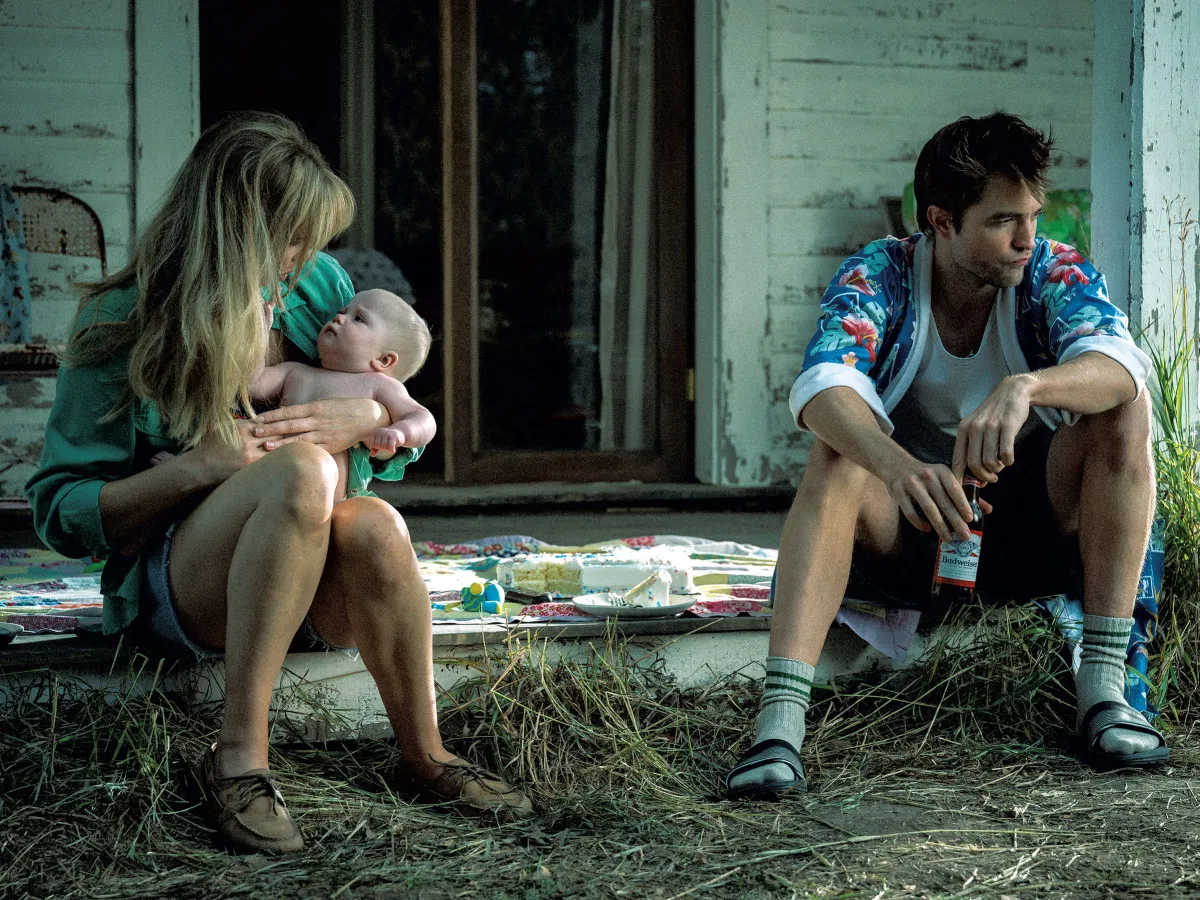
Die, My Love (2025) is directed by the brilliant filmmaker Lynne Ramsey, who has a fearless way of exploring motherhood on screen. She doesn’t show us the happy, gentle, and joyful version of being a mother. Instead, she forces the audience to see the messy, uncomfortable reality- the postpartum depression, the internal chaos, the moments women rarely confess. Ramsey is more interested in emotional truth than straight facts, which is why you feel like you’re living inside someone’s mind rather than watching the usual plot play out.
Grace is a writer who moves with her husband Jackson to the countryside to work on her novel. At the beginning of the film, they come across as the happy young couple that are crazy in love with each other- sexual, wild, free. They treat isolation like their private paradise, walk around the house naked, drink wine, and enjoy each other’s company. But once their baby boy is born, things shift brutally. Jackson works in town, and he is gone most of the day, while Grace becomes the default “housewife,”. Being alone in that house, with no friends, no other moms to talk to, traps her in boredom that slowly eats her alive.
The film shows her descent gradually: hallucinations and episodes that drive her to do insane acts involving self-harm, like jumping through the glass door and cutting herself, or shooting the dog that barks too loudly. And then there is the mystery man who appears, and she starts having an affair. Except, the more the film goes on, the more we question whether this is real or it’s simply her mind’s way of tricking her into an escape.
Jennifer Lawrence and Robert Pattinson’s acting is completely in sync here. The chemistry between them is so human and realistic that even the strangest moments feel justified. They really give the audience a peek into the life of a young couple as they navigate the early days of parenthood—days filled with exhaustion, laughter, suspicion, guilt, and the quiet terror of becoming different people after the baby arrives.
In a TikTok interview with ITV’s Lorraine, Jennifer Lawrence mentioned she was five months pregnant during filming. She also shared that after having her second child in real life, she went through severe postpartum depression, even though she felt “so prepared” and genuinely excited for the baby. “It was very surprising,” she said. Her honesty echoes what Ramsay tries to show: motherhood can be joyous, but it can also be profoundly lonely. Grace isn’t failing as a mother; she’s drowning in everything around motherhood. And that’s the uncomfortable truth Ramsay wants us to confront.
Lynne Ramsay explored a different angle of motherhood years earlier in We Need to Talk About Kevin (2011). That film asks what unconditional love looks like when your child is the source of your deepest fear. No matter what Kevin does — no matter who he hurts — Eva is still his mother. She still visits him. She still loves him. It’s a love that feels like punishment. While both movies have very different plots, one thing connects them strongly- the bittersweet complexities of being a mom.
We need to Talk About Kevin is the story of a mother who becomes the town’s punching bag because her son is a monster. Kevin is born a psychopath. From the early days, there are signs that there is darkness in him- coldness, manipulation, cruelty. One day, he goes to school, locks the doors, and massacres his classmates with a bow and arrows. But just before that, he does the unimaginable: he murders his father and little sister in the garden, leaving them to his mother to find. Eva loses her family, her house, her reputation, and almost her sanity. People blame her, avoid her, hate her. Yet she still visits Kevin in prison. She still asks him why. And she still carries the responsibility he never will.
In Die, My Love, Grace’s isolation is internal — the depression, the hallucinations, the suffocating expectations placed on her. In Kevin, Eva’s isolation is external, forced onto her by society. But in both cases, the mother is alone. The mother is misunderstood. The mother is being punished.
Lynne Ramsay has a very specific, unapologetic approach to filmmaking. She focuses on the emotional truth over the factual one. In an interview with The Guardian, she said: “I’m not interested in explaining my characters. I want you to feel what they feel.”
She also once described motherhood on screen as “a landscape of guilt, love, and things we can’t put into words.” That’s exactly what she captures in both films. Ramsay never gives straight answers. She lets discomfort sit in the room. She trusts the audience to sit with the uncanny rather than run from it. She is one of the few directors willing to show that mothers can be complicated, scary, broken, or lost — and still be human.