

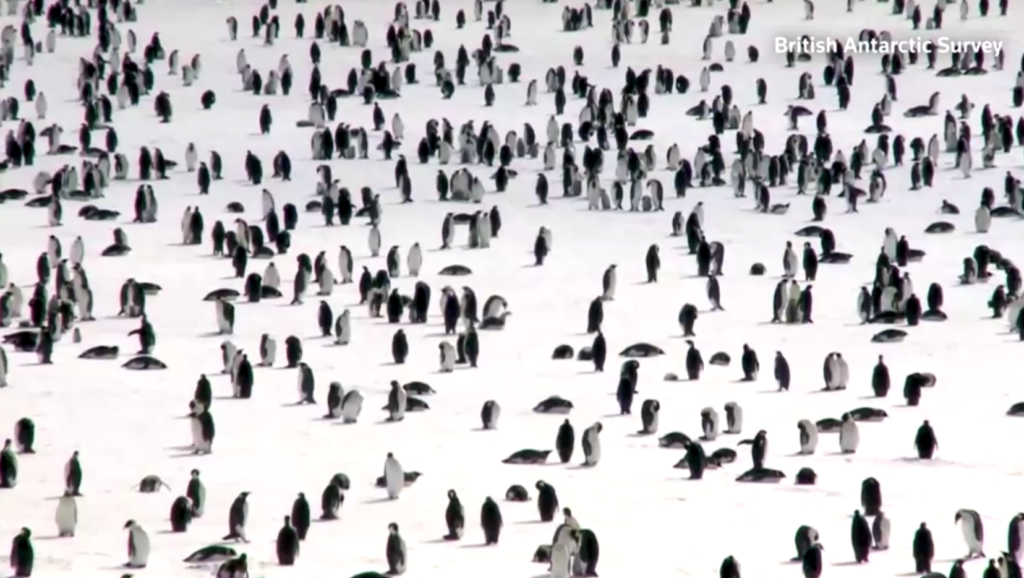
Record low sea ice in late 2023 led to breeding failures in one-fifth of Antarctica’s emperor penguin colonies.
Record low sea ice in late 2023 led to breeding failures in one-fifth of Antarctica’s emperor penguin colonies.
Emperor penguins suffered mass breeding failures due to record low sea ice in 2023, according to scientists with the British Antarctic Survey (BAS). “We’re predicting that we’ll lose around 99%, possibly at least all the emperor penguins by the end of this century — that’s 75 years from now”, said Dr Peter Fretwell, a geographic information scientist at BAS who studies wildlife from space.
Emperors are the world’s largest penguin species and one of only two endemics to Antarctica. They depend on sea ice firmly attached to the shore — known as “fast ice” — to lay their eggs and raise their chicks. If ice breaks up too early, the chicks will be forced to enter the sea before their waterproof feathers have fully come in.
A race against the melt
“If that ice breaks up too early then they’ll go into the water without their waterproof feathers and they’ll die”, Fretwell explained. “They’ll either freeze to death or they’ll drown.”
That happened in 14 of Antarctica’s 66 emperor penguin colonies last year. Scientists say it is because Antarctic sea ice shrank to a record low, driven in part by rising temperatures and climate change. The timing is critical; chicks hatch in the winter and need reliable ice beneath their feet until December or January when they fledge. In 2023, sea ice extent fell below two million square kilometres, an unprecedented low that saw ice breaking apart long before the chicks were ready to swim.
Signs of adaptation
Despite the grim forecast, there are glimmers of resilience. Even though 2023 saw a lower sea ice extent than the year before, emperor penguin colonies experienced fewer breeding failures than in 2022, when 19 colonies were lost.
Some of the birds seem to be adapting to the changing conditions. Researchers have observed colonies moving location to find more stable ice, with some even climbing onto ice shelves or icebergs to breed — a behaviour previously thought to be impossible for the clumsy giants. However, scientists warn that this adaptation may not be enough to outpace the rapid environmental changes.
The long-term threat
The losses in 2023 are part of a worrying trend. Between 2018 and 2022, one-third of the known emperor penguin colonies were affected by poor sea ice conditions. The worst affected area was the Bellingshausen Sea region, where all five known colonies experienced total breeding failure in 2022.
Current climate models paint a stark picture for the future. If greenhouse gas emissions continue at their current rate, the stable fast ice that emperors rely on will disappear from much of the coastline. The prediction of “quasi-extinction” for 99% of colonies means that while individual birds might survive, their populations will have collapsed to the point where they can no longer sustain themselves, silencing the call of the emperor across the frozen continent.