








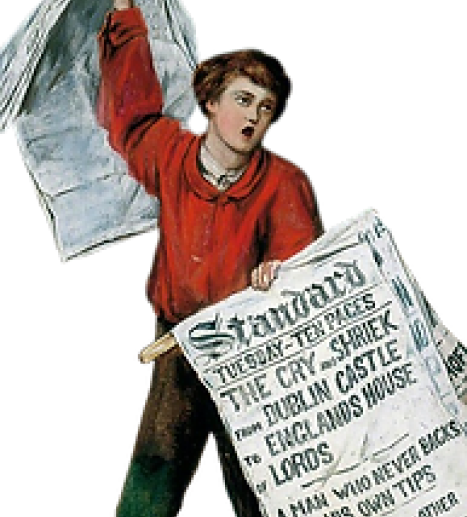
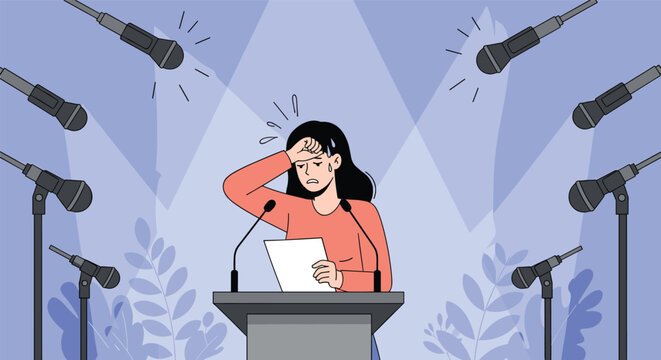
We live in the age of performative inclusion and the political destruction of DEI. Newsrooms, late-night shows and political figures discuss the impact and relevance of diversity, equity and disability rights as casually as a morning routine. And yet some of the most ordinary forms of difference: speech patterns; remain fair game for mockery. The very media class that claims moral authority over compassion often reveals its real morals through whom it allows itself to laugh at.
Speech occupies a strange moral blindspot. Physical disabilities that are visible are treated with care, but the moment it moves into the realm of the invisible: a voice that stutters, or has a nasal tone, or a difficulty with certain articulation patterns; then empathy vanishes alongside it. Speech has always been a performance to be judged. The distance between manners and cruelty shrinks the bigger the stage the jokes occupy. In practice modern media puts speech differences as beneath protection.
I understand this not as an abstract critique, but as a lived reality. I was born with a cleft palate: a congenital condition that left no visible mark on my face but permanently shaped how certain sounds leave my mouth. The scars are hidden, on the roof of my mouth and deep in my throat. To the outside world, I look “normal.” To dentists and specialists, the story is written clearly in tissue and bone. This kind of invisibility is its own form of isolation: the struggle is constant, but the permission to be understood is never automatically granted.
The battle to get visual diversity (race, visible disability, body type) has been long and it should be celebrated for having reached the status of being institutionally protected. However, it is still unfortunate that speech disabilities as well as accents that signal lower class, rurality, or certain kinds of foreignness still exist almost entirely outside this institutional framework. Invisible disabilities unsettle the aesthetics of modern inclusion by not announcing themselves, they do not offer the instant clarity of a wheelchair, a scar, or a prosthetic limb. Instead, they surface through pauses, misfires, nasal resonance, and imprecise sounds. By being first heard rather than seen, they are also easier to deny and easier to mistake for incompetence, laziness, or moral failure.
A cleft palate illustrates this contradiction perfectly. After surgical repair, it rarely appears on the face. There is no visible reminder of difference. Yet the speech mechanism remains altered. Air moves differently. Certain consonants demand greater effort. Some sounds never behave normally. My body carries history that the audience cannot see. But as voice is a social credential: polished speech is evidence of intelligence, credibility, and belonging. When someone does not conform, we do not hear difference but disqualification.
I underwent reconstructive surgery at five years old in a public teaching hospital. The operating room was crowded with residents. I was shown two options for anesthesia: an injection or a mask. This choice, highly adult in nature for a five-year-old, became a moment of control and fear. Without hesitation, I ripped the mask from the resident’s hand and inhaled deeply. I didn’t resist or theatrically fight the anesthesia as children are often dramatized online. Rather what I experienced was an immediate conflicted welcome of the surgery. The last sounds I had heard were of the residents laughing at my reaction. Students learned from my body before my voice or agency were recognized.
The recovery ward introduced me to visible disability for the first time. Children with feeding tubes, surgical bandages, and mobility braces shared the room. I remember silently asking myself whether I would eventually look like them. This was not fear of “ugliness” but of being seen as different.
Speech therapy came next, leaving a new tsunami of trauma. Exercises were mechanical: cork held between the teeth to force airflow discipline, exaggerated articulation drills, nasal occlusion tasks. The sensations were intrusive. I learned to associate improvement not with empowerment but with surveillance. Less than a year in, I rebelled. Now I understand that it was out of psychological fatigue.
As I started schooling, the difference in speech became public property. Classmates pinched their noses shut to imitate my voice. Teachers treated it as unfortunate but not urgent. Institutional anti-bullying policies existed only on paper. From first grade to senior year of high school I learned that being quiet was safer, that being invisible meant having peace.
I hadn’t known that the media had made it possible. On TV the character of Janice in FRIENDS had become a recognizable cultural shorthand: nasal, loud, ridiculous. My voice and dignity existed inside a joke long before I even had a chance to get the surgery. Speech was never an intellectual limitation, it was a social one. Thought flowed freely; speech did not.
Later when I was in college, Joe Biden became president. I was anxious while being happy for the representation all together. When I saw him speak openly about his stutter, it felt like a reclamation of legitimacy. Before him I had seen how Melania Trump was mocked for her accent on late night tv shows. The hosts and their audiences were a picture perfect copy of the children who bullied me when I was young, but this time it was adults with platforms enforcing the ridicule. The machinery was the same; only the stage had grown larger.
Speech carries outsized political weight. President Biden’s stutter, visible in public addresses and debates, exemplifies for children with speech differences, that someone with a similar impairment can occupy the Oval Office. This experience is profoundly validating: it signals that cognitive ability, leadership, and authority are not contingent on flawless articulation. But the media had not been kind, it revealed a persistent double standard. Biden’s stutter has repeatedly been treated as a source of humor; late-night hosts, political commentators, and social media users circulate jokes with minimal care of the impact on others.
The cultural lesson is clear: linguistic difference remains a barometer of legitimacy. Media narratives implicitly reinforce the idea that a “competent” voice must adhere to an unmarked, neutral standard, and those who deviate are objects of critique rather than empathy. This extends beyond politics, shaping which voices feel safe entering public and professional discourse. In short, speech is still treated less like a body part that can be injured but rather as a metric of intellectual authority.
This is not merely a problem of disability awareness. It is a matter of social capital. A voice that signals pedigree, education, or cultural refinement is implicitly granted legitimacy; a voice that signals the opposite is framed as comical, flawed, or suspect. The argument is not for pity, nor for special protection. It is for recognition grounded in intellectual honesty: speech differences, invisible disabilities, and nonstandard accents are not deficiencies of character or intellect. They are signals of human variation, deserving neither ridicule nor erasure. Inclusion that only tolerates what is polished is a curated diversity, one that reinforces social hierarchies under the guise of progress. Media coverage makes this explicit. Apologies for accent mockery are rare but performative; ridicule of stutters, nasal speech, or subtle articulation differences persists unchallenged. These choices are not neutral.
If we only defend voices that sound good on television, we aren’t protecting differences. We are curating it. And in that curation lies the quiet perpetuation of exclusion. True inclusion would demand that all voices; regardless of tone, rhythm, or polish; carry weight. Anything less is performative at best and deceptive at worst.