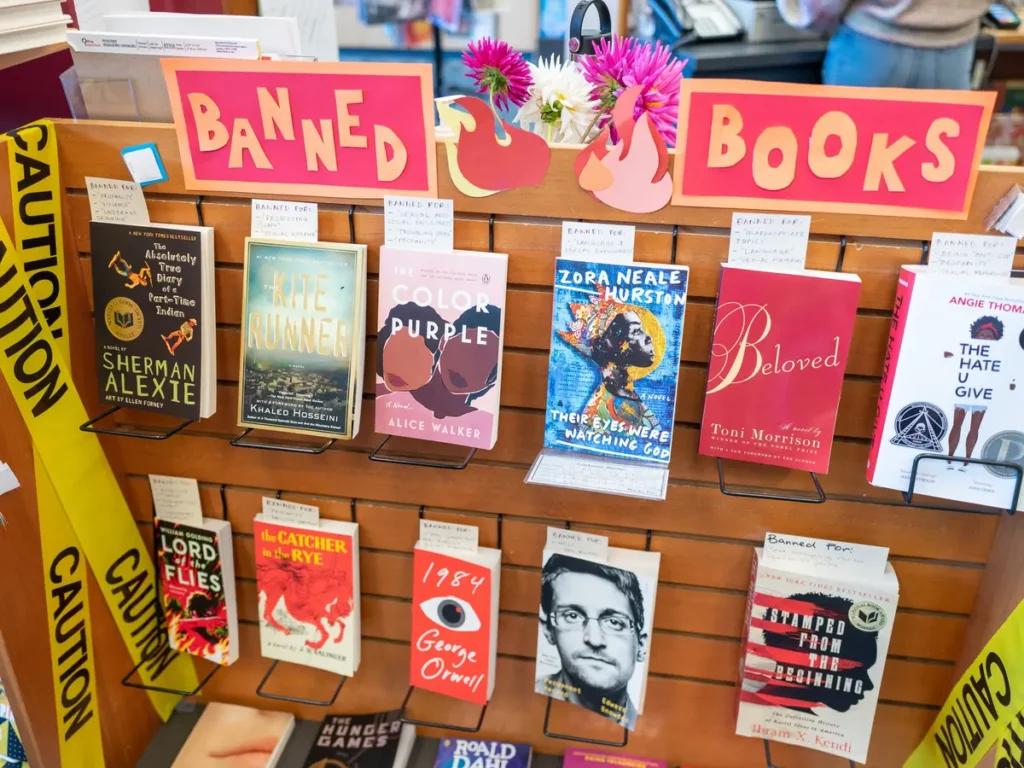
The United States has become a nation divided over important issues in K-12 education, including which books students should be able to read in public school. Efforts to ban books from school curricula, remove books from libraries and keep lists of books that some find inappropriate for students are increasing as Americans become more polarised in their views.
These types of actions are being called “book banning”. They are also often labelled “censorship”. But the concept of censorship, as well as legal protections against it, are often highly misunderstood.
The political landscape of book bans
On the right side of the political spectrum, where much of the book banning is happening, bans are taking the form of school boards’ removing books from class curricula. Politicians have also proposed legislation banning books that are what some legislators and parents consider too mature for school-age readers, such as All Boys Aren’t Blue, which explores queer themes and topics of consent. Nobel Prize-winning author Toni Morrison’s classic The Bluest Eye, which includes themes of rape and incest, is also a frequent target.
In some cases, politicians have proposed criminal prosecutions of librarians in public schools and libraries for keeping such books in circulation. According to the American Library Association (ALA), there was a record-breaking surge in challenges in 2023, with 4,240 unique book titles targeted for removal. Most books targeted for banning, says the ALA, “were by or about Black or LGBTQIA+ persons”. Specifically, 47% of the titles challenged in 2023 represented the voices and lived experiences of LGBTQIA+ and BIPOC (Black, Indigenous and People of Colour) individuals.
There are also some attempts on the political left to engage in book banning, as well as the removal from school curricula of books that marginalise minorities or use racially insensitive language, like the popular To Kill a Mockingbird.
The legal definition of censorship
Whether any of these efforts are unconstitutional censorship is a complex question. The First Amendment protects individuals against the government’s “abridging the freedom of speech”. However, government actions that some may deem censorship—especially as related to schools—are not always neatly classified as constitutional or unconstitutional, because “censorship” is a colloquial term, not a legal term.
Some principles can illuminate whether and when book banning is unconstitutional:
- Government vs private action: Censorship does not violate the Constitution unless the government does it. For example, if the government tries to forbid certain types of protests solely based on the viewpoint of the protesters, that is an unconstitutional restriction on speech. In contrast, when private individuals or companies engage in activities that suppress speech, these actions do not violate the Constitution.
- Content and viewpoint neutrality: The government generally cannot restrict an individual’s ability to produce or listen to speech based on the topic or the opinions expressed. It may, however, enact reasonable regulations that restrict the “time, place or manner” of speech, provided they are neutral.
- School board authority: Control over public education is largely given to state and local authorities. The government has the power to determine what is appropriate for the curriculum. However, the Supreme Court ruled in Board of Education v. Pico (1982) that school officials may not remove books from library shelves simply because they dislike the ideas contained in those books.
The constitutional gray area in schools
It is hard to definitively say whether current incidents of book banning in schools are constitutional. Decisions made in public schools are analysed by the courts differently than censorship in non-government contexts.
While officials may exercise control over the curriculum, students retain some First Amendment rights. Public schools may not censor students’ speech unless it is causing a “substantial disruption”. There are also exceptions to government power: the Supreme Court ruled that a state law banning the teaching of evolution was unconstitutional because it violated the Establishment Clause, which prohibits the state from endorsing a particular religion.
Schools, with finite resources, also have discretion to determine which books to add to their libraries. Removal is constitutionally permitted only if it is done based on the “educational appropriateness” of the book, but not because it was intended to deny students access to ideas with which school officials disagree.
Book banning is not a new problem in this country—nor is vigorous public criticism of such moves. And even though the government has discretion to control what is taught in school, the First Amendment ensures the right of free speech to those who want to protest what is happening in schools.