
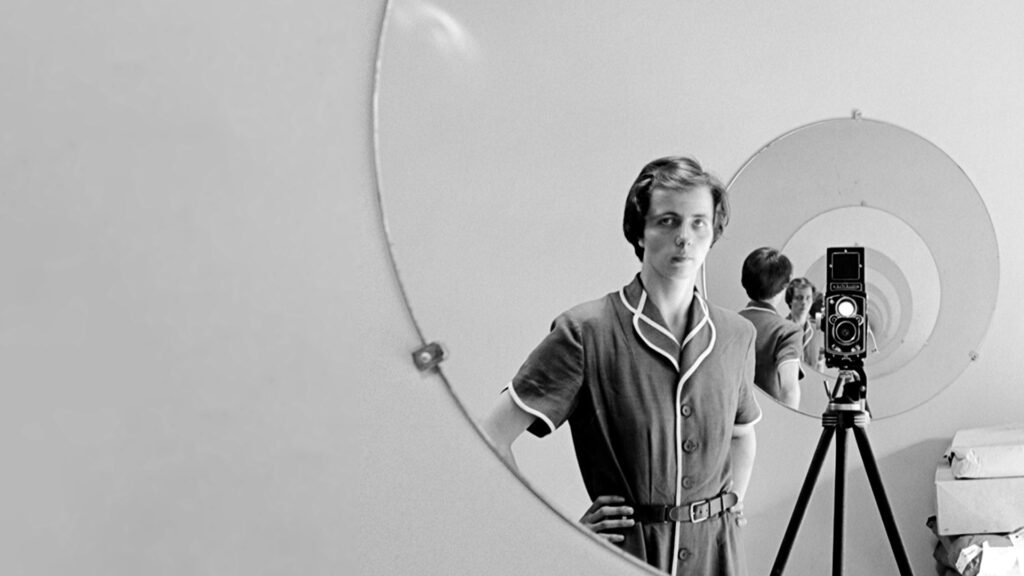
They found her by mistake — a life sealed away in cardboard and dust, as though she’d slipped herself into the margins of the world and trusted time itself to stumble upon her one day.
Inside that storage locker were hundreds of rolls of film, some never touched by light, as if she believed certain truths were too delicate to expose. No note. No plea for remembrance. Just small, silent anchors of memory waiting patiently in the dark.
By the time Vivian Maier was discovered, she was already gone — quietly, the way she moved through the world. And when her photographs surfaced, it didn’t feel like a revelation so much as a return. As if she’d stepped out from behind the curtain of her own life, not to justify anything, not to correct the record, but simply to be present once more.
I think there is a peculiar defiance in that kind of silence.
Most people rewrite themselves endlessly, editing out the parts that don’t fit, softening their edges to win approval from strangers who will forget them by morning. Maier went the other way. She recorded the world and herself without performance, without apology and without any intention of unveiling it. She stored herself away because she didn’t need witnesses to confirm that she existed.
Her self-portraits — those strange, spectral reflections in shop windows, car bumpers and panes of glass — aren’t confessions. They’re coordinates, evidence of a person who knew exactly who she was, even if the world hadn’t thought to look. And when you study them, really study them, they feel like a message left under a floorboard for whoever might have the nerve to find it:
You can be real without being revealed. You can live truthfully without surrendering your truth to everyone.
She reminds us — quietly, almost conspiratorially — that the world is not entitled to all of you. That mystery is not a flaw. That hiding is sometimes a form of protection, not fear.
And yet, here’s the twist, the strange hope blooming at the edges of her story:
Even in hiding, she was never lost.
The essence she kept tucked away, those private glances, unguarded moments, the odd electricity of her solitude — survived her. It waited. It endured. And eventually, it was found by people who had never met her but recognised something familiar in the way she saw the world. A person’s truth, it turns out, doesn’t vanish just because they refused to perform it.
Maybe that is what lingers after the final photograph: the quiet suggestion that you do not have to offer yourself up to everyone in order to matter. That the parts of you you’ve kept hidden are not shortcomings; they might be the very things that outlast you.
Vivian Maier didn’t seek immortality.
She simply lived — and the world arrived late, breathless, finally ready to understand her. And perhaps that is the lesson threaded through the dust and negatives she left behind:
If your truth is real, it will wait for the right eyes.
You do not have to become someone else to be seen. You only have to remain yourself long enough for the world to catch up.