
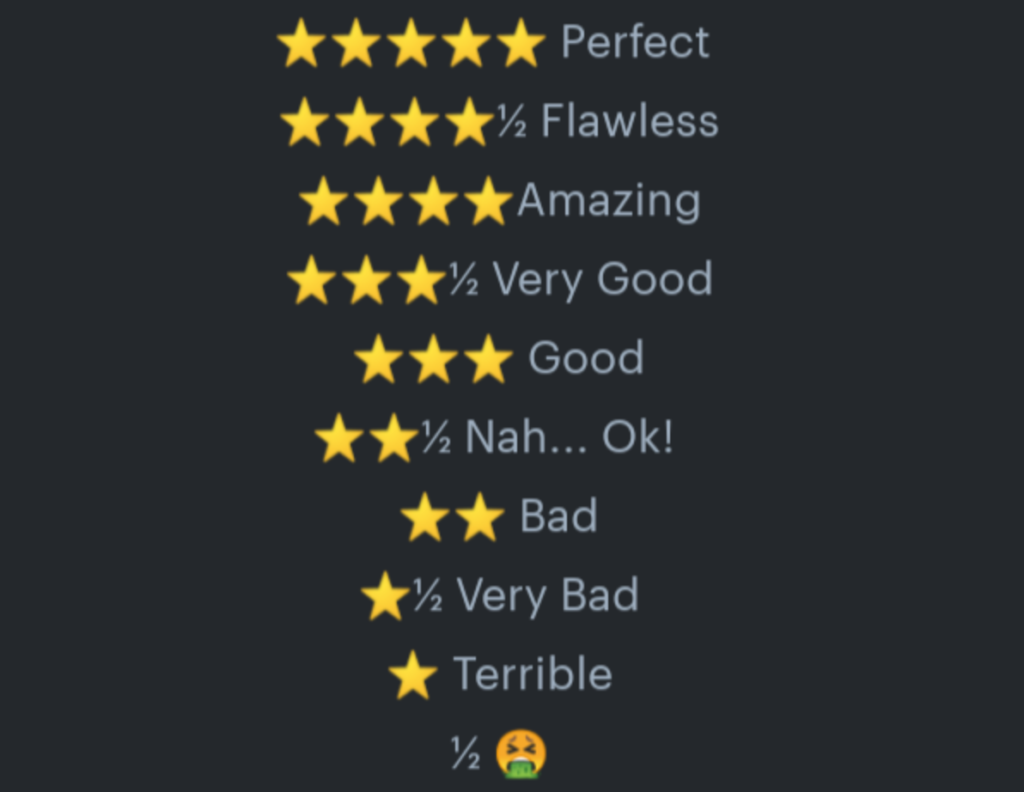
There needs to be some way to distil a review that enables audiences to navigate the sheer density of productions in one quick bite. With the average ticket becoming prohibitively expensive, it would be impossible for even the most avid theatregoer to watch everything on offer across the UK and West End. Understandably, we turn towards the ratings and reviews for a universally accessible and transferable metric of assessing quality.
Shining stars slapped across posters satisfy our desires for straightforward, instant marketing to gravitate us through a bombardment of adverts. Critic Michael Billington bemoans that this marketing strategy symbolises how “the arts are now part of this consumer package”. While a foul truth to swallow for us stalwarts of theatre who will get something out of any production, this does have its benefits for audiences who have a more distant relationship with theatre. Entertainment is therefore the crux: four- and five-star ratings give no insight on production content, but offer a safety blanket of assured satisfaction for the less active consumer. Equally, a one- or two-star rating is a warning that the production will not have mass appeal and is not worth pursuing by those who are less likely to suspend their critical disbelief. When a highly anticipated production (Kenneth Branagh’s King Lear as a recent example) receives poor ratings, the publicity buzz created can ironically have the effect of increasing ticket sales. Critic Lyn Gardner muses on the perverse “pleasure in a one-star review”, which “gives a show a good kicking”.
To ease this insect torture, Time Out ditched one- and two-star ratings. Summing up an entire, multifaceted production — often employing hundreds of people — in one grade, whilst impossible, has an unfair monopoly on making or breaking a production and the reputations of those involved. Hence Time Out’s decision. I argue that this only makes three stars the new one star and simply sticks a plaster on deeper issues, but that’s another debate. Conversely, what warrants five stars? For every single aspect to align perfectly is exceedingly rare, without even interrogating what “perfect” looks like. Yet four-star ratings are somehow anticlimactic — the difference between 100% and 80%. In my own reviews I avoid giving star ratings where possible. But I was recently asked to retrospectively award a rating for a show I’d previously loved and reviewed, to aid its Edinburgh Fringe marketing. I was alerted to the arbitrariness of quantification, as I could have plucked five stars from thin air to furnish their flyers. At university it may have been “five stars”, but I reasoned myself into a four based on my experience with Fringe reviews. Gardner says that often “five-star-laden shows from the Edinburgh Festival Fringe can look more like three-star shows in the cold light of London”. If the stars carry different meanings in different performance contexts, is their quality assurance really as universal as we thought?
A compromise? There is always a way to nuance ratings, whilst still satiating society’s obsession with quick quantitative fixes: through compartmentalising different aspects of the production. Scores could be given for design, creative direction, performance, front of house theatre experience (all part of the consumer package!) and so on. Any more than five and critics would have a GCSE mark scheme-like, box-ticking exercise, and suddenly a whole constellation of star ratings further eclipses the more important write-up. Then there are the infinite interwoven facets at play that make it impossible to distinguish each choice: a “five-star” actor may struggle to shine with a “one-star” script, and their choices may have been dictated by a “three-star” director anyway. Laid out in print is the dismantled essence of teamwork a production is supposed to foster and carry throughout the whole run. With messier marketing too, simply adding more stars is still unsatisfactory for all parties.
Perhaps without total anti-capitalist reform across all industries that prioritise quantification of quality, the plight of many critics to abolish ratings will remain futile. Where money is centralised, and deeper conversations on art undervalued by consumerist mindsets, the destiny of a production will continue to lie in a handful of vague, uncontextualised stars. The best we can do to sift through the density of exciting theatre as consumers, is to establish our own tastes, have empathy for the teams of professional creatives, be wary of marketing and read the whole write-up!