
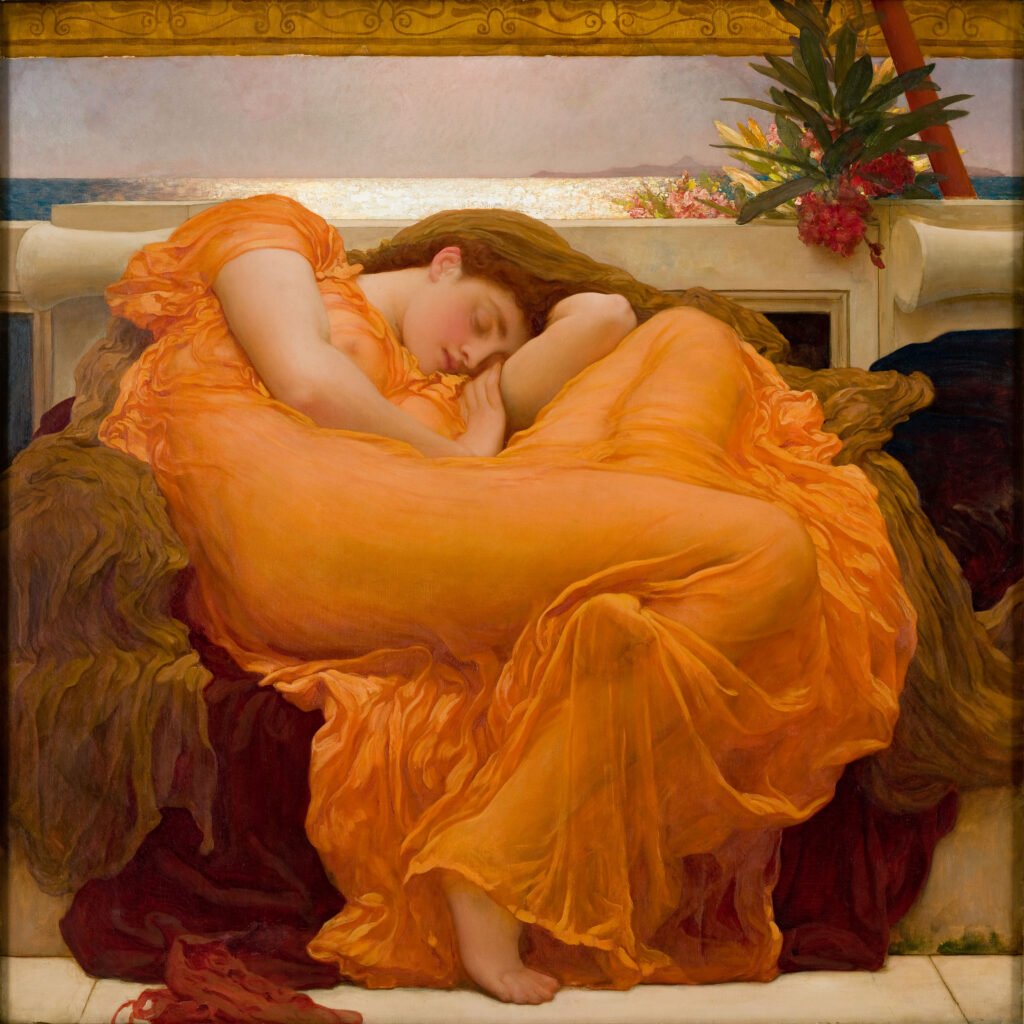
Now displayed in New York’s Metropolitan Museum of Art, Frederic Leighton’s 1895 oil painting Flaming June orbits an unconscious female subject. Against the painting’s calculated — almost architectural — composure, this image of female repose becomes a charged site where sex and sexual desire are insistently inscribed. Leighton choreographs the woman’s body into a carefully staged theatre of exposure: the languid fold of her arms loosens the neckline to reveal the swell of her breast; her head, tipped back, exposes a throat that reads as both passive and inviting; the drift of her leg uncovers the naked foot — an unexpectedly erotic focal point; and the diaphanous fabric of her gown pools and clings to the contours of her form.
This tone of passion is not abated by the theme of sleep; rather, sleep itself becomes the condition through which eroticism is intensified. The languor of the woman’s posture and the fervid colouration — and near-sheerness — of her nightgown function as the painting’s highest erotic points, while her closed eyes and softly parted lips merge the iconography of slumber with that of climax. In this suspended state, the body is doubly encoded within the visual economy of the painting: it appears to harbour desire within itself, while simultaneously presenting that desire outwardly, legible and enticing to the implied — and assumedly male — observer.
Flaming June is far from unique in this regard. In 19th-century art, the female body on the verge of sleep was frequently represented as both desirable and desiring. Other notable examples include Waterhouse’s Ariadne, Edward Burne-Jones’s The Rose Bower and Dante Gabriel Rossetti’s Beata Beatrix.
The prominence of this trope was not merely aesthetic but closely linked to contemporary medical and scientific discourses, which sought to pathologise female behaviour — and, in particular, female sexual behaviour — in terms of sleep and insentience. Male authorities of the period were preoccupied with the so-called “degenerative effects” that sexual stimulation could have on a woman, and in response sexologists aimed to render female sexuality more passive and therefore more controllable. As William James argued in Volume three of The Principles of Psychology, in language that would profoundly shape cultural representation, female desire was understood as “instinctive”, “spontaneous”, “periodic” and “diffuse” — terms which combined to locate erotic activity at the level of the unconscious.
The aesthetic reduplication of such psychological theories was not confined to the visual arts. Reacting to these conceptions of female sexuality, a significant number of novels in the 1880s and 1890s characterised women falling in love and experiencing desire as dreamy or somnolent, lulled into semi-consciousness by the affective, psychological and physiological experience of passion. Concurrently, these texts present male lovers interpreting this semi-consciousness as evidence of desire, and that desire as an invitation to initiate sexual contact. Taken together, these recurring tropes produce a narrative dynamic through which the barely conscious female body becomes both expressive and consumable.
This dynamic is widely attested. In Sarah Grand’s The Heavenly Twins (1893), Evadne Frayling and Edith Beale are overtaken by a “misty veil of passion” — Evadne in particular lulled into a “delicate, dreamy” state during her “sensuous” interactions with George Colquhoun, whose attentions are intensified by her passivity. Likewise, in George Gissing’s In the Year of Jubilee (1894), Nancy Lord yields her will to the “dreamy luxury of desire”, guiding her lover’s attractions through this vulnerability. In The Awakening (1899), Edna Pontellier’s passage into a “languorous sleep, interwoven with vanishing dreams” follows a moment in which Arobin’s touch — “the warmth of his glances, and above all the touch of his lips upon her hand” — is described as acting “like a narcotic upon her”. Similarly, in Annie Sophie Cory’s Anna Lombard (1901), Anna, contemplating the “thousands of little tentacles” that make up love, falls into a sudden sleep of weakness, resettling into the “suddenly tightened” embrace of Gerald Ethridge’s arms.
This dynamic is perhaps most pronounced in Thomas Hardy’s Tess of the d’Urbervilles, a novel deeply complicit in eroticising the passive, semi-conscious female body. Tess — the novel’s heroine — is repeatedly made to experience love and desire in states of diminished consciousness, turning to sleep whenever a sexual atmosphere is created. Simultaneously, male characters repeatedly interpret Tess’s unconscious body as a declaration of desire and read this desire as permission to initiate contact.
This logic saturates the novel, colouring Tess’s entire experience of sexual desire and male sexual attention. Nowhere is it more apparent, however, than in the novel’s romantic climax, when Tess begins her relationship with Angel Clare. From their first meeting, Tess’s desire for Angel is figured as an “exaltation” that comes “without any determination of hers” and leaves her “conscious of neither time nor space”. When she is around him, she “unconsciously studie[s]” his appearance, drifting towards him “as surely as a stream in a vale”. While at Talbothays Dairy, “the ardour of his affection” lulls her into “a dream, wherein familiar objects appear as having no particular outline”, and when he first kisses her, she is taken “completely by surprise”, yielding to his embrace with the “unreflecting inevitableness” of one in a dream.
Concurrently, Angel’s own attraction to Tess is structured around moments of her dreamy passivity, such that his desire appears predicated upon her semi-conscious responsiveness. Early in their time at Talbothays, Angel focuses most intently on Tess’s features when she is revealed to be in a sleepy “reverie”. It is early in the mornings, when Tess is least conscious, that she “impress[es] him most deeply”. When it “grow[s] lighter” and Tess is more awake, Angel sees her features as “simply feminine”, changed “from those of a divinity who should confer bliss to those of a being who craved it”. Most tellingly, when Angel first kisses Tess, she is in a “trance” state of “dream-like fixity”. His “waxing fervour of passion” is stirred by her “silent” unresponsiveness, and he observes her physical features — her “deep eyes”, “fair cheeks”, “arched brows” and “red top lip” — all while she is unconscious of his gaze.
A similar dynamic haunts Tess’s other romantic entanglement, with the far more predatory Alec d’Urberville. When Alec picks up an “inexpressibly weary” Tess after the villagers’ dance, he reads her exhaustion as an invitation to initiate physical contact, “enclos[ing] her waist with his arm to support her”. This scene acts as a prelude to the later episode at The Chase, where Alec initiates sexual contact with Tess while she is asleep — the novel’s most explicit enactment of a violent misreading of unconsciousness as consent.
Elsewhere in the novel, links between female sexuality and sleep continue to surface, even where sex is only obliquely suggested. During Prince’s death, for instance — where the “pointed shaft of the cart” entering the horse’s “breast” functions as a phallic prefiguration of Alec’s later penetration of Tess — Hardy’s heroine is asleep. So too does Tess appear to “obey like one in a dream” when fed strawberries by Alec, a moment slyly indicative of her sexual passivity.
This double-edged image of the desiring and desirable, sleepy and passive female body is deeply problematic. In 19th-century art and fiction alike, it functioned as a cultural technology: one that eroticised female vulnerability while systematically evacuating female agency. By aestheticising unconsciousness as desire, these representations naturalised a sexual logic in which women were most legible — and most desirable — when they were least able to act, choose or refuse.
This logic was embedded in the psychological theories that gave rise to the trope. In locating female desire below the threshold of awareness and decision, 19th-century sexologists served two mutually reinforcing, and profoundly patriarchal, ends. First, by relocating women’s erotic feeling to the unconscious mind, female sexuality could be rendered inaccessible — and therefore unthreatening — to women themselves. Female erotic thoughts and wishes were widely regarded as “unnatural”, and Victorian culture consequently sought to keep women’s desires latent and women themselves “extremely ignorant of the whole question of sex”. In Tess of the d’Urbervilles, Alec articulates this system with remarkable clarity during his admission of guilt, identifying Tess’s sexual ignorance as the product of an education that leaves young women defenceless before male predation: “I say in all earnestness that it is a shame for parents to bring up their girls in such dangerous ignorance of the gins and nets that the wicked may set for them”. Within this framework, unconsciousness becomes the sanctioned mode of female sexuality — a state that neutralises desire by severing it from knowledge, deliberation and self-recognition.
Secondly, and more insidiously, this same logic works to erode the boundaries of consent. If female desire is presumed to manifest as silence, stillness or sleep, then women’s non-responsiveness can be reinterpreted as evidence of erotic feeling, and erotic feeling as permission. The sleeping woman thus becomes uniquely legible within this system: her body appears to speak even as she cannot. A dreaming body cannot consent; it can only be interpreted by others. What results is a dangerous conflation of passivity with assent, one that allows male desire to overwrite female incapacity. Yet 19th-century law was explicit in its requirements: consent depended upon judgement, understanding and volition — capacities unavailable to the unconscious or semi-conscious subject.
It is within this cultural logic that Tess of the d’Urbervilles must be read. Tess’s repeated lapses into sleep at moments of sexual threat do not register erotic responsiveness but instead expose the consequences of a system that persistently confuses vulnerability with desire. Her body is repeatedly positioned as readable precisely when her will is most diminished. That Tess is most endangered when she sleeps is insistently underscored by the narrative itself: Prince’s death and Alec’s assault, the two foundational traumas of her life, both occur while she is unconscious.
In the novel’s closing chapters, Hardy strips sleep of any remaining erotic charge. A “really tired” Tess, physically and psychically exhausted, flings herself “upon an oblong slab” and “in a minute or two… falls asleep”. Here, sleep no longer functions as a sign of desire but as the endpoint of dispossession — Tess’s body laid out, inert and exposed, like a sacrifice offered up by the very logic that once made her silence erotic. Hardy’s novel does not merely reproduce the trope; it anatomises it, revealing what happens when a figure designed to make vulnerability beautiful is followed to its logical conclusion.