
After World War I, Yugoslav artists and intellectuals pursued a clear cultural objective — to assert their place within European modernity as equals, not as latecomers. Their response was neither imitation of the existing European art nor quiet assimilation. Instead, they entered the cultural arena with the conviction that they already belonged there. Through publishing, experimental art and collaboration with foreign artists, they worked to dismantle the idea of cultural hierarchy and to present Yugoslav creativity as an equal participant in modern European life.
This was not an attempt to become members of European culture and art, but to make clear that the nations within Yugoslavia already formed an integral and historically established part of European culture, shaped by the same intellectual, artistic, political and social forces that shaped other European societies, sharing common identities and ideas that emerged from centuries of participation in the continent’s cultural life.
The Zenit magazine
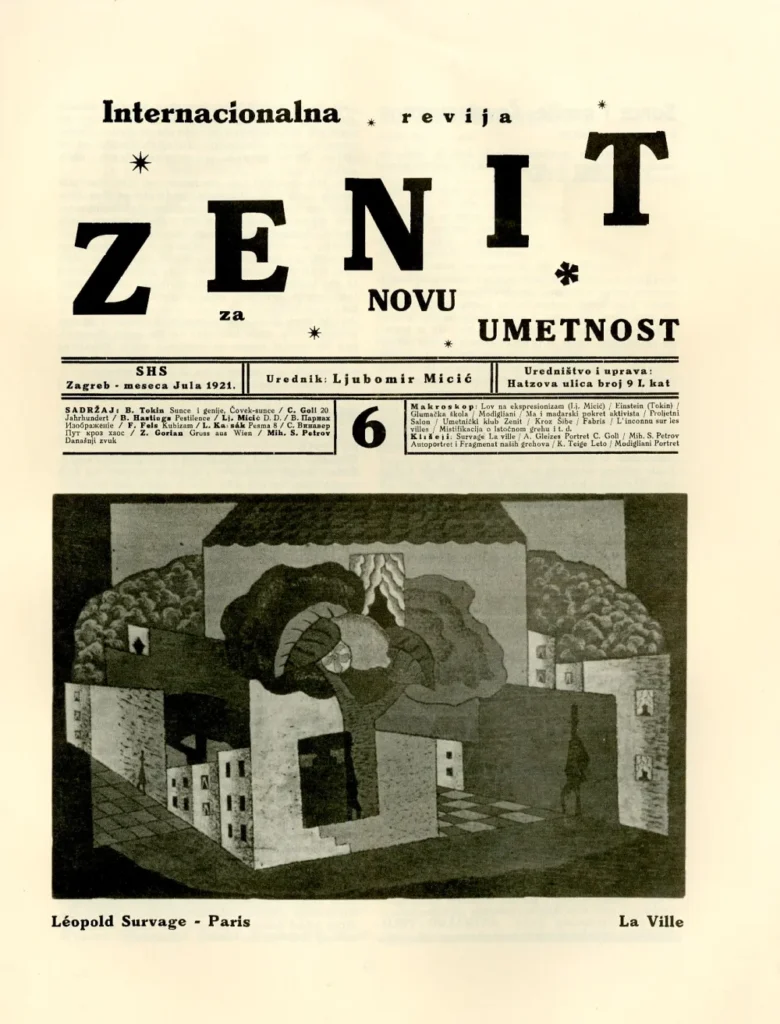
The Zenit magazine, founded in 1921 by poet and literary critic Ljubomir Micić, became one of the clearest and most successful expressions of this cultural idea. First published in Zagreb and later in Belgrade, Zenit was an international avant-garde journal, printing texts in several European languages and maintaining direct connections with leading modernist circles across the continent. Its editorial policy was direct, confrontational and experimental, rejecting any idea of cultural inferiority.
Zenit took Europe’s stereotype of the Balkans as “barbaric” and turned it on its head with a mix of sarcasm and provocation. Through the concept of barbarogenius, it claimed that this so-called “barbarism” was actually a source of raw, untamed creativity, and that the Balkans, far from being culturally backward, could lead and energise European modernism. The idea was that Europe’s polished, established culture had grown stagnant, and the “barbarian” Balkans could shake, challenge and even “civilise” European art and thought with its intensity and freedom — showing that originality and innovation did not belong only to the Western centres.
With this idea, Zenit was inviting those who saw Europe ending at the Balkans’ borders to reconsider their view. At the same time, it showed highly modern and innovative art, arguing that Europe would only lose by failing to recognise the region as European, because creativity and modernism thrived there — right on the magazine’s pages.
Zenit was not just leading the way in avant-garde art; it was also socially forward-thinking, challenging backward traditions, with the prominent role of women in the magazine serving as a clear example of this. Zenit displayed an unusually high degree of female participation for a European avant-garde journal of its time. Art historian Žarka Svirčev documents that Zenit included a “notable presence of women artists and intellectuals”, a structural feature that distinguished it from most contemporary avant-garde periodicals which remained overwhelmingly male-dominated. At the heart of this was Anuška Micić, who wore many hats — editor, manager, translator and visual contributor — helping shape both how the magazine was run and how it looked. Other women, including Višnja Kranjčević, Vjera Biller and Ana Balsamadžieva, were active too, contributing with art, taking part in exhibitions and performing in the first Zenitist public events and international shows.
By contrast, much of the early 20th-century European avant-garde, from Parisian to German-centric modernist circles, has been shown by scholars to marginalise or limit women’s visibility in central artistic narratives, despite their contributions. European avant-garde journals such as Der Sturm, De Stijl and L’Esprit Nouveau show markedly lower visibility and agency of women, typically confined to marginal or auxiliary roles.
A century on, Zenit still pops up in Europe’s art world as a point of reference and inspiration, not just as a historical curiosity. Zenit left a mark on other regional journals like the Hungarian Út and Slovenian Tank, shaping the broader avant-garde scene in Central and Eastern Europe. It was one of the first Balkan movements fully engaged with European avant-garde networks — a fact scholars still note today. Projects like the centennial Zenit 21/21 show that its experimental spirit and mix of media continue to inspire contemporary artists in Zagreb, Belgrade and across Europe.
EXAT 51 (Experimental Atelier 1951)
Zenit was only the beginning. After the magazine’s provocative pulse, a new generation of Yugoslav artists picked up the threads of modernism and carried them forward into the post-war era. In the decades after World War II, Yugoslavia — unlike the Soviet Union and many Eastern Bloc states — moved away from strict Soviet cultural policy and created space for a distinct form of socialist realism. After the 1948 Tito–Stalin split, the state distanced itself from the official USSR socialist realism and the Soviet socialism style that demanded figurative depictions of workers and revolutionary ideals, opening the door for broader artistic expression.
In Zagreb in the early 1950s, a group of painters, sculptors and architects calling themselves EXAT 51 emerged with a clear mission — to break with the rigid confines of socialist realism and open Yugoslav art to the wider world of abstraction and experimentation. EXAT 51 brought together figures such as Vjenceslav Richter, Ivan Picelj, Aleksandar Srnec, Vladimir Kristl, Božidar Rašica and others, all committed to synthesising fine art, architecture and design into one unified visual language.
EXAT 51’s founding manifesto from 1951 articulated a belief that art should not be tethered to tradition or ideology but understood as a space of pure exploration of form and socially engaged visual thinking. Instead of painting familiar landscapes or heroic scenes, they embraced non-objective art, geometric abstraction and the idea that visual language could shape not just galleries but everyday life. Although the group rejected even the more moderate forms of socialist realism practised in Yugoslavia, along with its narrower interpretations of socialism, it did not oppose socialism itself, instead proposing a vision of a more dynamic, forward-looking and culturally connected socialist society. Their work extended beyond canvas and sculpture into furniture design, industrial objects, journal publishing, animated film and even world exposition pavilions — most notably Richter’s Yugoslav pavilion at Expo 58 in Brussels.
In defying the strictures of socialist realism — the dominant style in much of Eastern Europe at the time — the group helped redefine what the role of art could be in a society rebuilding itself after war. Their embrace of Bauhaus, Constructivist and De Stijl principles was not mere imitation; it was a strategic choice that reconnected Yugoslav cultural life to the leading currents of European modernism. In just a few years, EXAT 51’s ideas spread across art and design, inspiring a new generation of artists and paving the way for the New Tendencies movement of the 1960s.
New Tendencies
Where EXAT 51 insisted on abstraction as liberation, New Tendencies took that liberation into new territory — kinetic art, optical and perceptual experiments and even early forms of what we today call digital or algorithmic art. Beginning in Zagreb in 1961, a series of exhibitions under the New Tendencies banner drew artists and theorists from across Europe, united by a shared interest in how systems, mathematics, perception and technology could reshape visual experience. These gatherings were not provincial or insular; they engaged with international art communities and invited contributions from luminaries such as François Morellet, Gianni Colombo, Getulio Alviani and Julio Le Parc.
What made New Tendencies truly forward-looking was its willingness to use computers as creative tools — a radical idea at a time when digital machines were still novel curiosities outside academic or military use. Panels and discussions at events such as the 14th International Architecture Exhibition (Venice Biennale 2014), titled “New Tendencies and Architecture — Abstraction, Ambience, Algorithm”, show how deeply these explorations anticipated later developments in media art, interaction design and computational aesthetics. Unlike official socialist realism, which confined expression to familiar social narratives, New Tendencies embraced complexity, interdisciplinarity and international engagement. The movement’s willingness to treat computers, optics and systems thinking as legitimate artistic tools was itself a break from traditional expectations about both art and society — but one that was made possible by Yugoslavia’s unique position outside Soviet cultural strictures.
Faces behind EXAT 51 and New Tendencies
Beyond the movements themselves, figures associated with EXAT 51 and New Tendencies had significant careers that rippled into the broader European art scene. Ivan Picelj, for example, became known for his systematic geometric compositions that aligned with — and at times prefigured — Western minimalism and concrete art. Aleksandar Srnec extended his kinetic and lumino-kinetic work into international exhibitions, earning recognition in cities like Paris and London. Vjenceslav Richter, an architect and theorist, did not just design pavilions — his ideas of synthurbanism blurred boundaries between urban planning, visual composition and conceptual art in ways that foreshadowed later multimedia practices.
Once at the margins of Yugoslavia’s socialist cultural scene, their works are now firmly recognised in discussions of 20th-century abstraction, conceptualism and the evolving definition of modern art. The Museum Haus Lange exhibition in Krefeld, Germany, which paired EXAT 51 historic works with contemporary responses by artists like Jasmina Cibic, underscores how these ideas continue to be mined for relevance in European artistic discourse today.
It is one thing to say that EXAT 51 and New Tendencies were important in their moment. It is another to show why they still matter. Their insistence on hybrid practice — dissolving the lines between painting, architecture, industrial design, visual communication and spatial experience — anticipated many of the interdisciplinary demands placed on artists and architects today. Their embrace of international networks during a time of Cold War tension offered a blueprint for creative exchange that prefigured much of contemporary Europe’s cross-border cultural work. And their success in challenging both socialist orthodoxy and Western avant-garde assumptions shows that Yugoslavia was not merely a receptor of ideas but an active contributor to Europe’s artistic evolution.
Barbarogenius reimagined
The playful, ironic energy that Zenit once called barbarogenius has not faded; it still echoes in how artists and thinkers approach Balkan identity today. Originally, Zenit and its contemporaries turned Europe’s stereotype of the Balkans as “barbaric” into a creative artistic and expressional potential — not to deny the region’s complexity, but to assert its vitality and originality as cultural forces in their own right. This counter-hegemonic stance of these ideas appears in recent scholarly works, such as in the work from Olga Saveska: “Balkan Barbarians Against European Civilisation”, published in Wiener Slawistischer Almanach, where such ideas are taken as a deliberate attempt to unsettle old notions of centre and periphery, using the Balkan “primitive” not as a mark of inferiority but as a catalyst for renewal and critical engagement with European art’s own assumptions.
A century on, this idea still resonates. The Zenit centennial and exhibitions, public projects and collaborative events in Zagreb and Belgrade motivated by the centennial brought young artists and students face-to-face with Zenit’s legacies, showing that its provocative spirit continues to inspire new artwork and debate. The projects’ participants explicitly riff on Micić’s notion of barbarogenius, linking it to their own explorations of hybridity, tradition and contemporary expression — reminding us that identity and innovation can grow out of what others once dismissed as “marginal”.
The recent English-language anthology Zenithism (1921–1927) — A Yugoslav Avant-Garde Anthology, edited by Aleksandar Bošković and Steven Teref, is the first comprehensive English translation of the key texts and creative output of the Zenit movement, including poetry, manifestos, conceptual writing, hybrid prose and experimental media originally published in Zenit and associated publications. It traces the movement from its beginnings through its peak and eventual decline, presenting works by central figures such as Ljubomir Micić, Branko Ve Poljanski, Ivan Goll, Marijan Mikac and MID, and making this prolific but long-overlooked avant-garde chapter accessible to a broad international readership for the first time. Far more than a simple anthology of texts, the volume reframes Zenit as a vital part of European modernism, drawing out its hybrid aesthetics, experimental range from cine-poetry to conceptual writing and advocacy of barbarogenius as both artistic manifesto and cultural critique.
This way, the legacy of Zenit and the wider Yugoslav avant-garde still challenges art today — not just as a historical reference, but as a living reminder that Yugoslavia has always been part of Europe’s creative core — capable of unsettling assumptions, opening new imaginative paths and insisting that the map of modern art is richer when its so-called “peripheries” are embraced as sources of innovation.