

18 September 2018. I still remember the exact day I took my one-way flight to Berlin. The place I had decided, at the age of 22, was to be my home. Intoxicated with the city I had visited many times before, I couldn’t wait to jump in head-first. The city already had its hooks in me. The incredible history Berlin had withstood — wars, division, reunification — and now it represented to many a hedonistic, welcoming utopia which the city and Germany had done its best to create in response to the horrors of the past. It was a haven for the LGBTQ+ community, a place where art and culture flourished and it boasts a world-famous techno music scene. For anyone who felt like they did not connect to where they were from, they could find a community and home here. For myself, growing up in the UK with mixed Palestinian and Norwegian heritage, a child of diaspora, I felt I had chosen a home for the first time in my life.
I sat at a café waiting to meet my friend who was allowing me to stay with them the first weeks whilst I got settled. The sun shone on my face and the world felt alight with possibility. I was taken in, completely, utterly… foolishly.
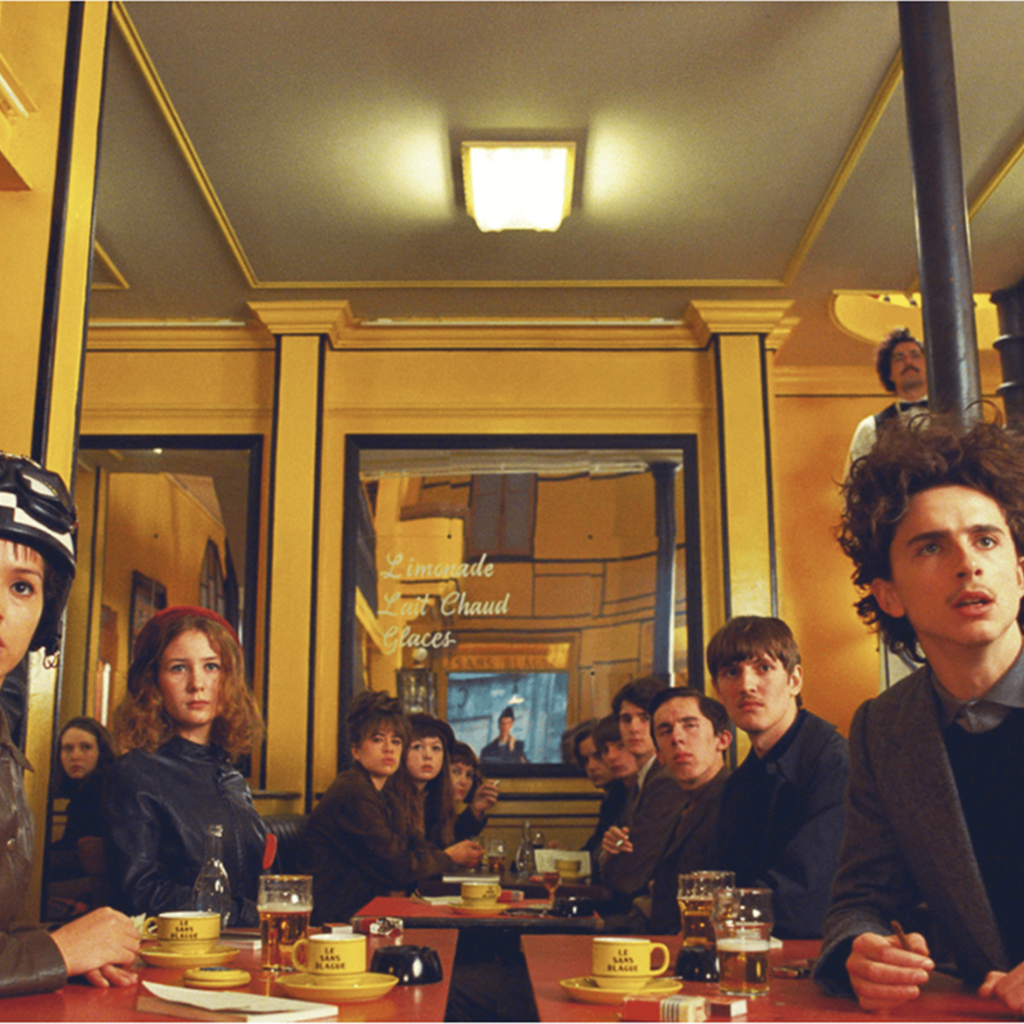
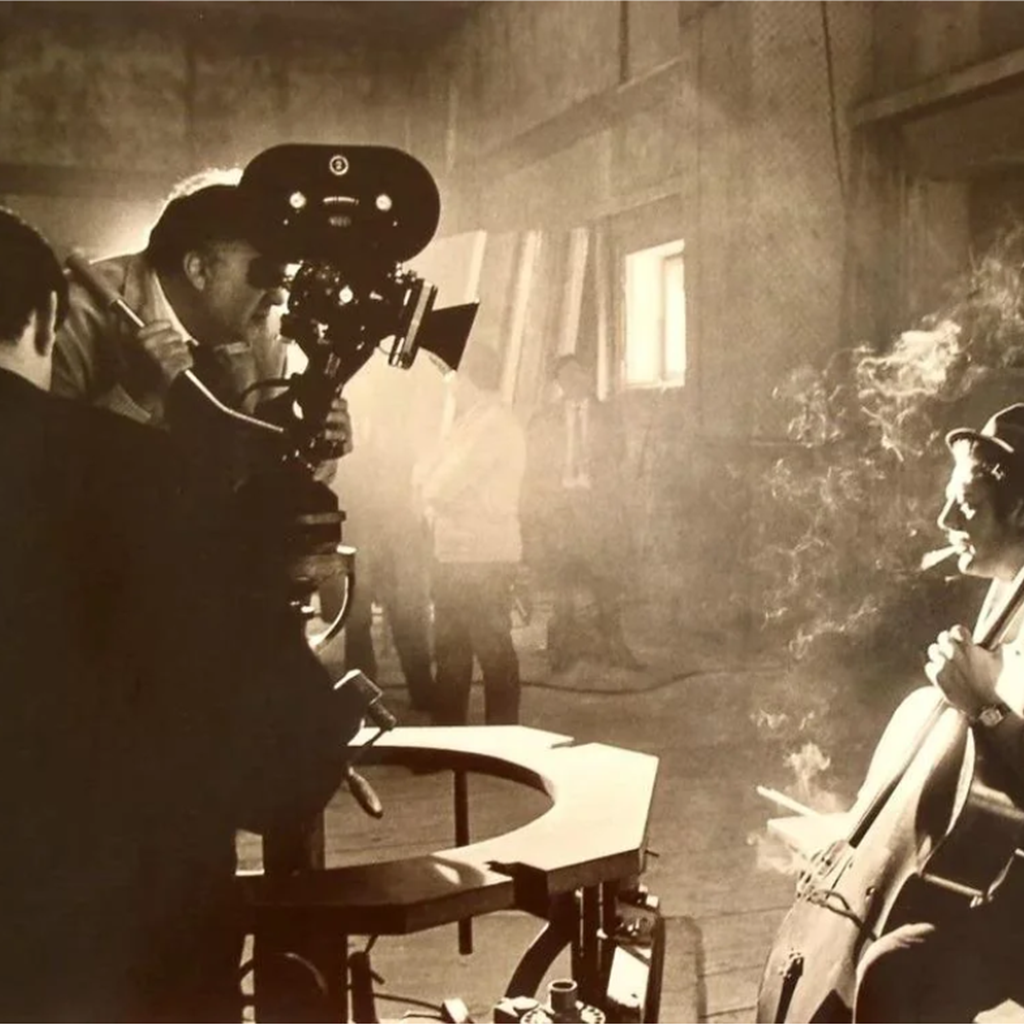
I was taken in, similarly to an individual nearly 100 years before me. In 1929, Christopher Isherwood arrived in Berlin. A gay British writer, Isherwood was attracted by the freedom and hedonism of the Weimar Republic in which, despite the bad economic state of the country and the shadow of WW1 and its reparations, culture, art and sexual liberation, in particular for gay men, were thriving. He lived in Berlin for four years, which inspired his work such as Mr Norris Changes Trains (1935) and Goodbye to Berlin (1939). The latter, recognised as a semi-autobiographical account of his time there, was adapted into the world-famous musical Cabaret. The 1972 film adaptation of the musical starred Liza Minnelli as Sally Bowles, Michael York as Brian Park — based on Isherwood — and Joel Grey as the Master of Ceremonies at the Kit Kat Klub where both he and Sally Bowles worked. Through song, Minnelli and Grey welcome the viewers to the club, Berlin and the Weimar Republic, famously declaring “in here life is beautiful” and “life is a cabaret old chum”. The industrial techno that welcomed me to the infamous and globally revered techno club Berghain in 2018 had the same message.
Goodbye to Berlin and subsequently Cabaret document Isherwood’s parties, romances, friends, trips to the lakes and experiences of his time in Berlin, that in many ways felt similar to the years I spent there. However, most importantly, Isherwood captures the rise of Nazism and antisemitism in Germany. Isherwood’s work cleverly highlights how both crept into the open but were always part of German society. It came slowly at first, then openly, boldly and without challenge. This is represented clearly in a scene from the 1972 film of Cabaret featuring the song “Tomorrow Belongs to Me”. The song is started by a member of the Hitler Youth, before slowly, one by one, members of the public join in, with the song becoming louder and overpowering. Only one old man refuses to stand up and sing, yet simultaneously he does nothing and looks away. The scene ends with a cut to the harrowing images of Grey’s character in the club, smiling, nodding and staring directly into the camera. His clown-like make-up, which felt fun and expressive before, now seems grotesque, intended to mask reality. He is confirming that Nazism is finally here and no one stopped it. Both the book and the musical end abruptly as Isherwood himself fled Germany to return to England when the Nazis came to power. The final scene of the film shows Grey’s character at the Kit Kat Klub abruptly stop singing, take a quick bow and leave the stage before we see the reflections of the audience, which is now filled with Nazis, and the credits roll.
The Berlin I found in 2018 was similar in many ways. Certainly, there were differences, primarily the terrible economic status of the Weimar Republic versus Germany as Europe’s economic power in 2018. Yet, interestingly, both, fuelled by past horrors, had had a burst in art and culture. Similar to Isherwood, I filled my time with music, art, trips to lakes and lots of laughter. Having studied German culture and history at university, I had fully bought in. I was sold on their “Erinnerungskultur”, their repentance and societal development away from the terror of the Holocaust which, to me, was confirmed by memorials and museums dedicated to these atrocities. I was sold by Angela Merkel opening the border to Syrian refugees in 2015, that Germany had a moral compass to assist those who needed refuge. I was sold on the thriving LGBTQ+ scene and techno music that had grown from a place of resistance against the division of Germany after WW2.
However, I was sold on misrepresentation.
I quickly learnt how a museum is just a building. It does not represent real systemic change in society, a society that is now open and active in its support of Israel. Opening the borders is one thing, but failed integration and the rise of the German far-right party Alternative für Deutschland (AfD) is telling. An LGBTQ+ and techno scene spawned from division and resistance does not equal inclusion when it is dominated by white German men with an affinity for Tel Aviv Pride. I spent five and a half years in Berlin before abruptly leaving in February 2024, five months after the 7 October attacks and the start of the genocide of Gaza, feeling that there was no way I could possibly stay there as a Palestinian. Suddenly the mask of liberalism, of the fun Berlin, started to look as vulgar as Grey’s character and dropped, revealing the reality of a society deeply entrenched with racism, Islamophobia and a warped perception of Germany’s own moral standing in the world. True, these things had been present before, but now Germany appears to be wearing its extreme discrimination like a badge of honour.
Since October 2023, social media has been flooded with images of the horrors from within Gaza, and with the authoritarian clampdown on freedom of speech and support for Palestine across the West in particular. In the USA, we have seen a clampdown on students, resulting in withdrawn degrees and arrests, most notably Columbia student Mahmoud Khalil, who was held in detention for over three months. In recent months, we have seen the UK’s attempts to silence Palestine Action by having it deemed a terrorist organisation, and arresting members of the public for showing support, including the British police arresting the elderly and disabled engaged in peaceful protests. As well as the clear breach in freedom of speech and right to protest, the arrest of the elderly hardly seems like it should be a priority for police time and funds.
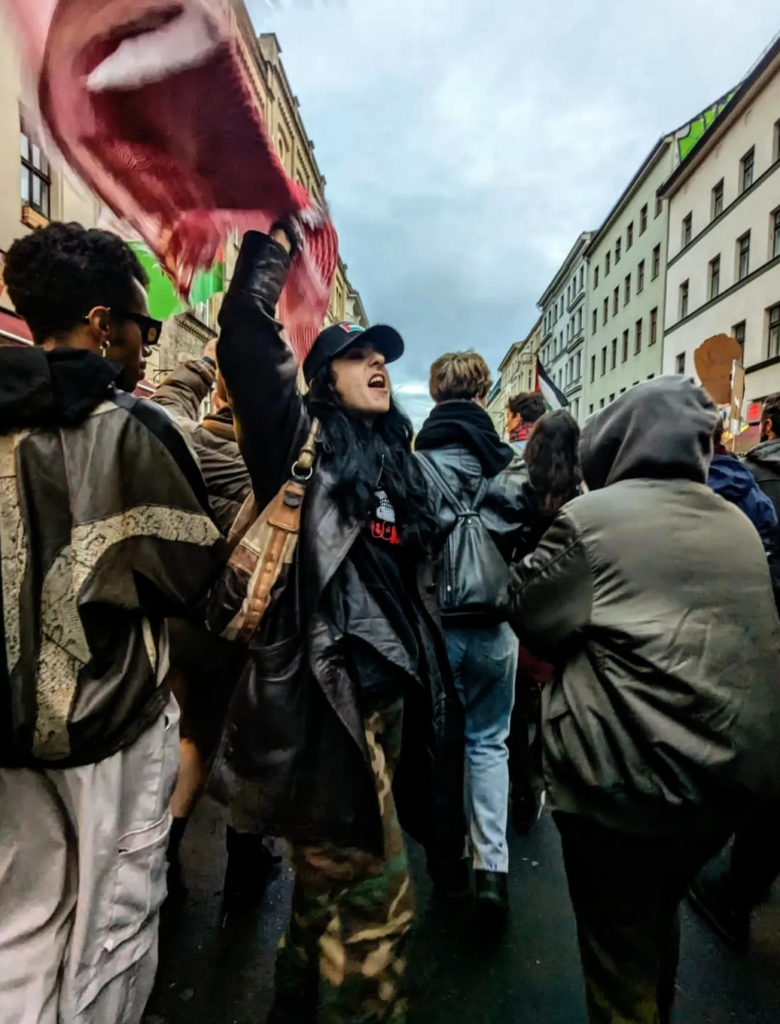
The actions of the state and police in response to support for Palestine in the UK and USA have become increasingly brutal over the last two years. However, their response feels delayed in comparison to the immediate brutality, stance and censorship I witnessed whilst still in Germany and via social media platforms since I left. Germany swiftly greenlit extreme police brutality as the norm for dealing with protesters. From scenes of extreme brutality I witnessed with my own eyes, to the countless videos that have been circulated online of police punching protesters, putting young women in headlocks and violently pushing protesters to the ground, even knocking them unconscious and aggressively dragging people away to police vans. From a legal perspective, the country rushed to change the law, equating antisemitism with anti-Zionism or criticism of Israel. Additionally, new citizens of Germany must now acknowledge Israel’s right to exist in order to gain German citizenship. The AfD was voted in as the first far-right party since the Nazi Party in the state of Thuringia in September 2023, eerily on the same day as the anniversary of the Nazi invasion of Poland, and in the February 2024 elections the AfD placed as the second largest party in Germany. The same month I said my Berlin goodbye.
The signs were there before 7 October but similarly to Isherwood, my fellow revellers and I did not take it as seriously as we should have, thinking nothing could penetrate our sacred bubble of liberal Berlin. The rise in anti-immigration and racist rhetoric was there and growing before the outward hate for the Palestinians and Islamophobia we now see took hold, with no one stopping it. In Goodbye to Berlin, Isherwood’s character Christopher introduces his Jewish friend Natalia Landauer to Sally Bowles. The interaction doesn’t go well as Sally immediately makes an antisemitic remark upon arriving before going on to casually discuss her various lovers. Natalia freezes up and slowly ends her friendship with Christopher as a result. Christopher, rather than reprimanding Sally for her antisemitism, merely is bothered with her uncouth discussion of her love life and equally annoyed with Natalia for being a “prude” in response. His inability to see the true reason for Natalia’s discomfort, and quick dismissal of Sally’s remarks as merely uncomfortable rather than dangerous, highlight the greater issues of how unchecked prejudice can lead to horrors that, at the time, could not be predicted.
This interaction highlighting the unwillingness of others to intervene is paralleled today as I witnessed in Berlin during the Christmas period at the end of 2023, as police attacked protesters of majority-Arab heritage whilst local German society continued its Christmas shopping. Indeed, perhaps many across Germany did not think that the rising AfD, Islamophobia and anti-immigration sentiment of the past decade, combined with Germany’s historical guilt, could result in Germany’s unequivocal backing and support for Israel in its genocide in Gaza in the forms of weapons, money and diplomatic support, as well as changes to German law and extreme police brutality.
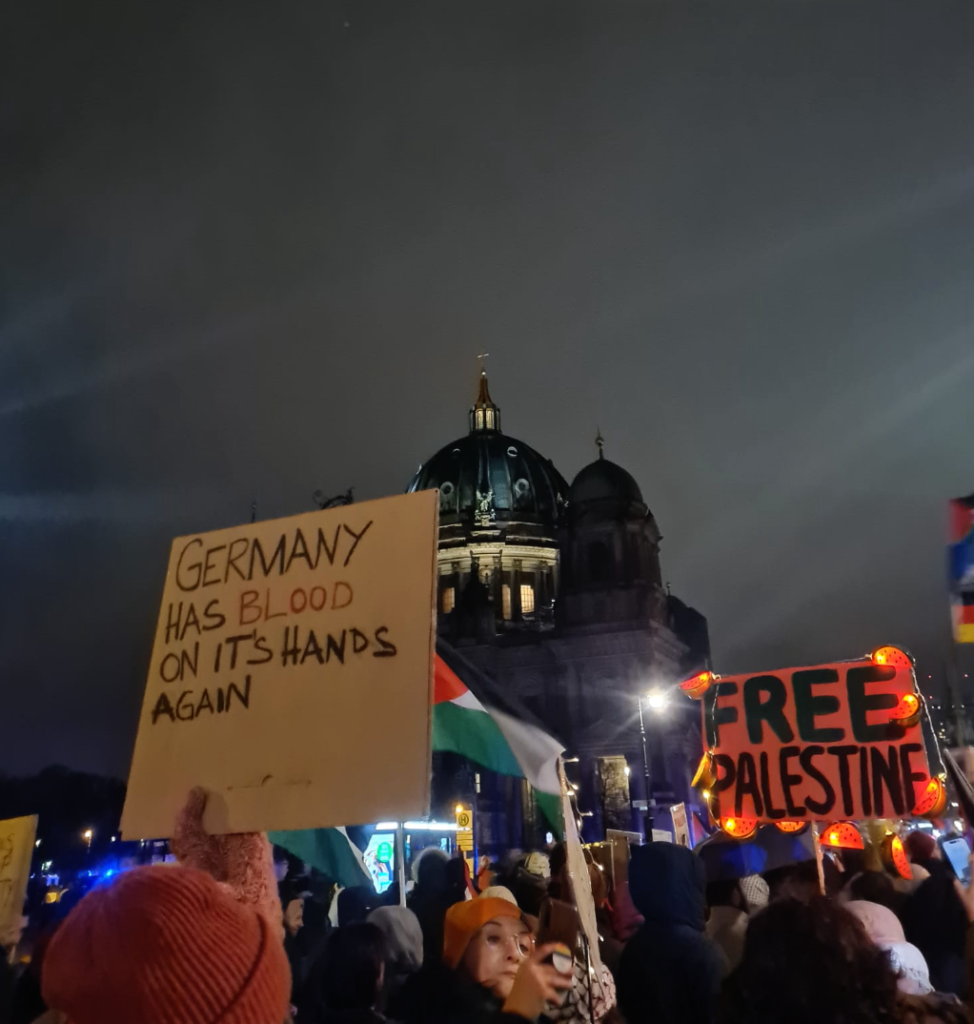
Isherwood shows us clearly how prejudice can go unchecked by society before its inevitable hideous explosion. As for this current explosion in German apathy, anti-Palestinian racism and Islamophobia, in the weeks after I left Berlin I turned to the writing of the White Rose, a student group in Munich who published pamphlets hoping to stir German society into action against the Nazis. Sophie Scholl, aged 21, along with her brother Hans Scholl, aged 24, and Christoph Probst, aged 23, were caught and executed by the Gestapo for distributing leaflets at the university in Munich. Famously, their writing asked “why do German people behave so apathetically in the face of all these abominable crimes… Who among us can imagine the degree of shame that will come upon us and upon our children when the veil falls from our eyes and the awful crimes that infinitely exceed any human measure are exposed to the light of day”. A clear warning that rings true still, not just for German society but for society globally in light of the genocide in Gaza. These young students paid the price for speaking up with their lives. Today, people fear speaking up for Gaza due to societal pressure or the loss of jobs and money, a price that seems to pale in comparison when we consider the end of a genocide as the justification for the means.
In 2013, former White Rose member Liselotte Furst-Ramdohr spoke to the BBC of her resentment at being perceived as a hero as soon as the war was over by the same people who would have, at the time, had them all executed. The question then remains — will the Germany of the future look back once again and celebrate the people standing up for Gaza? Will the same people whom they currently censor and brutalise be future acclaimed heroes? Will the whitewashing of this period of history, along with performative guilt, be utilised as a tried and tested method to mask the guilt of their ever-growing list of atrocities?
In many ways, my life in Berlin had been a cabaret. A never-ending hedonistic lark, fuelled by friends and techno. The 2000s’ own 1920s, very similar to Isherwood’s Weimar. Germany continues to benefit from the hedonistic reputation Berlin has, to the extent that the clubs have become protected institutions. But I couldn’t help finally seeing the at first seemingly subtle undertone after years there. For sure now Germany’s true face is no longer an undertone — it’s about as subtle as a bullet. As subtle as a genocide.