

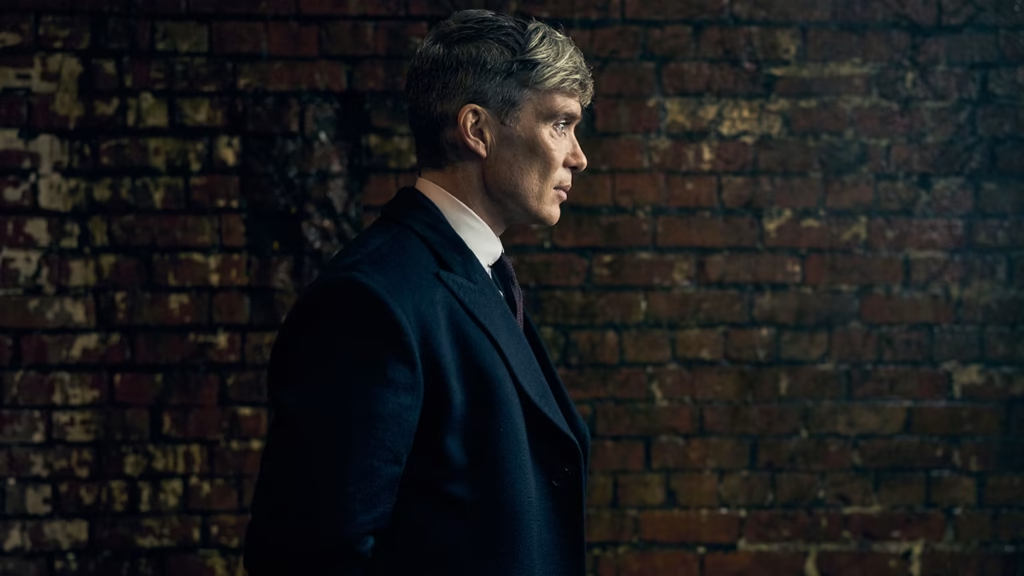
I walked out of The Immortal Man grieving a character that never existed. The film beautifully presents us with the unwrapped gift of death. Of confrontation. Of full realisation. The immigrant circle of life, so to speak. And yet even with the finality of Tommy’s mortality, we as an audience are left with a sadness that peaks like a swift sunset on the first generation of the Shelbys themselves. Can we actually come to terms with a fictional character’s ending?
“Hunting the Wren (The Immortal Man Version)” by Lankum and Grian Chatten calmly embellishes the wake, no pun intended, of Tommy’s death, with a powerful monologue delivered by Cillian Murphy himself as his human life is engulfed in inflamed rites of the soul’s rest. So in the end what is a human life worth? Where is the meaning in family? Why are so many invested in this character’s demise?
In my mind, it comes down to the perception of humanity. Tommy’s character has widely been described as a complex, ambiguous, power-hungry, family-loving man with a hot side dish of serving death himself. The audience begins to believe that his ambitions for wealth, for the support of a higher living standard and for peace are necessary in the cut-throat era where Peaky Blinders is set. And yet, the large majority of those who follow their own moral compass would find the actions abhorrent in our own human reality.
When Peaky Blinders first aired as a small show on BBC Two in 2013, I wasn’t interested at all. I was much more naïve and living in the whimsical land of bar and pub sessions integrated with early morning essay writing to submit for university deadlines. It wasn’t my age as such but my experience that hindered my lens of the real world. But I suppose we cannot understand the world without actually living it. Which is why I now focus on my parents. I promise I’ll come back to Tommy soon, unforgettable really; Steven Knight is a writing legend.
My family are Asian Sikh immigrants who settled in Coventry and Birmingham in the late 1960s. Hard graft work, my grandparents remind me of. My dad absolutely loved Peaky Blinders. Because he grew up with some similar experiences, albeit not racketeering, crime etc. His father died when he was 14, with two younger siblings and his mother who he looked after. He had to grow up at an exceptionally young age without a father figure. They lived in poverty and the biggest treat was fish and chips on a Friday if they could afford it.
But he wanted more for his life and became a self-made man. The hardships of hard work eventually paid off. An exceptionally bright mind enabled his university journey at Imperial College London. He spent his first grant allowance on booze, started working behind the university bar and became part of the rugby crew, as well as being the vice-president of his year. His tutor famously told Nab he would fail if he didn’t get his act together. He did and scored a Desmond in his third year, much like me at the rival UCL. But Nab never forgot his roots. And he cared about people deeply and the impact of injustice everywhere.
“I’m not a traitor to my class. I’m just an extreme example of what a working man can achieve”. — Tommy Shelby
I could hark on about many more of his achievements but ultimately my mum and dad created a better life for themselves through hard work. That’s what Nab achieved by the time he met death in 2020 and suddenly left our lives. Family, loyalty and that special connection matters. Who to trust, which “enemies” to keep closer through more disastrous means complements Tommy Shelby quite well. And I suppose those hardships that we see him overcome financially but grieve forever emotionally, helps us to understand that we are often the cause for our own rise and downfall.
So what does Tommy Shelby teach us about our own mortality and grief? And why do we grieve fictional characters? Because we see parts of ourselves in them. Our successes and failures. We wear masks to conceal our biggest battles. His character reminds us that we cannot always control the narrative or outcome of events in accordance with our own emotions. Vulnerability is seen as a failure and strength is a constant expectation.
Tommy also reflects another truth that we as a society ignore — that men’s mental health is dismissed, misunderstood and underserved. We grieve past versions of ourselves with remorse only to forget our worst moments helped to shape our characters now. Softness and strength are victims of cruel shame when they need not be. And perhaps tragically, crime, violence and war erodes our human will. Compassion and love is overridden by greed and survival, until we no longer recognise ourselves as human.
To be invested in a fictional character played and delivered extraordinarily well by Cillian Murphy is a testament not only to excellent writing but the amalgamation of human thought process, emotions and catastrophic consequences when we allow our egos to best our limits. And I suppose I had to grapple with a huge comedown back to planet reality when I started to live my life without my father, with many twists and turns post-2020. I write another article about my own experiences from ten-year teacher to poet and writer. Perhaps that’s why I cried at the end of this film. The title alone reveals the cutting joke to us — in our own warped heavens of immortality, our sins and worries are the real hell that we cannot escape when living, only through death can we find peace.
“When you’re dead already, you’re free”. — Polly Gray
Tommy
Is it your face you’re hiding or soul
deciding
on never worse frontiers?
A shattered dream, pieces of glass
that reflect our plentiful years?
What can I say, I try to delay
our sudden realisations now.
I couldn’t remember but piece
together,
Love on a victory bow