

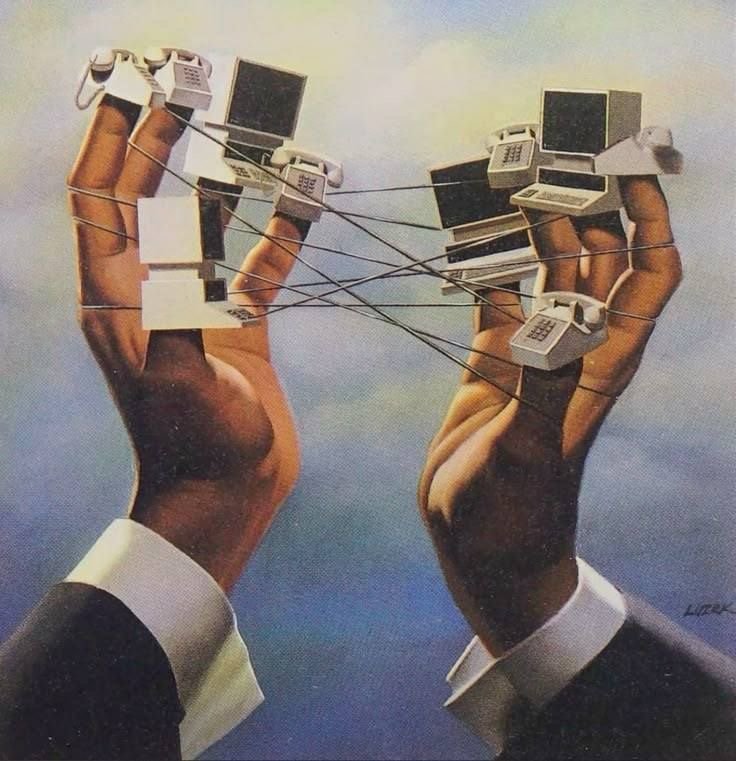
In the age of AI intermediaries, websites become infrastructure — and humans stop navigating the web directly. Promising frictionless knowledge but at the cost of the chaos that made the internet creative.
Have you ever wondered whether people still lose themselves online the way we once did, chasing one search into another until hours have quietly disappeared? It begins innocuously. How long can I store rice in the fridge? One click becomes two, and two becomes a Wikipedia spiral. Forty minutes later you’re reading about the agricultural economics of the Han dynasty, the fall of the Roman Empire, bread riots, the invention of modern farming logistics and somehow, at 2 am, you’ve landed on a prepper forum dedicated to storing rice for the harsh winter months. You started with rice. You ended with rice. The two hours in between are completely unaccounted for; and the path that led you there is completely untraceable, but new knowledge was always the goal either way. That was the internet as most of us knew it; chaotic, self-interrupting and genuinely boundless.
But consider when you last actually did that.
There’s a generation growing up right now who may never experience what it feels like to get lost online, not because they’re less curious, but because the internet has quietly stopped requiring curiosity of them. The architecture has changed. Why follow a thread when the answer surfaces before you have finished forming the question? “Just Google it”. That phrase carried over 25 years of human curiosity on its back; a cultural shorthand so embedded it became a verb, a reflex, a default mode of thought. Writing this piece, I had ten tabs open at once, each one a breadcrumb trail leading hectically into the next. For a long time, that friction was the point. You searched, you clicked, you wandered and occasionally stumbled onto something that quietly shifted the way you saw things. It allowed for self-discovery and to challenge preconceived ideas; but now the questions we ask all seem to have the same answer from AI summaries — if everyone thinks the same then people are easier to manipulate and critical thinking becomes a sought-after luxury. We are at a crossroads now, and the signpost on one side doesn’t read search, rather ask. AI hasn’t arrived to threaten the internet. In many ways, it has already absorbed it; efficiently and without leaving a browser tab behind; the click, that most fundamental unit of digital behaviour, is eroding. Nearly 60% of all Google searches now end without a single website being visited, a figure that has been climbing steadily as AI-generated summaries displace the links beneath them. Publishers are losing traffic. The open web — that sprawling, hyperlinked ecosystem on which an entire information culture was built, is being compressed into a text box that returns an answer and considers the matter closed. No detours. No dead ends. No documentaries. This is about what we lose when exploration becomes optional, and what it means for creativity, knowledge and curiosity when the internet no longer asks us to navigate it. Picture this: a consumer picks up their phone, opens ChatGPT and types, “what food has the most fibre without causing inflammation?”; in less than two seconds they receive a confident, specific single answer coupled with a reason, no ads, no research to verify this answer, no peer-review articles. For millions of users AI has fundamentally replaced the search engine as the default discovery mechanism. Is the Google search obsolete? What does it mean to exist in a world without a shred of curiosity?
It is important to acknowledge that not all progress carries a sting in its tail, other “digital age” advancements — the calculator, the GPS or satellites — these arguably improved our lives significantly; initially exercising cautious anxieties that never materialised. Maths did not cease to exist with the arrival of the calculator; we were able to free up cognitive space for complex problems; and drivers did not lose their sense of direction when GPS became ubiquitous — we merely added a layer of security to routes. However, these tools were singular in their function, performing a specialised act and leaving the rest to our free will. Human nature, it turned out, was more robust and nuanced than panic suggested. Andrew Rummer, who witnessed the internet transform across years of technology journalism, is measured on this point; human curiosity has always found a new vessel, moving fluidly through books, radio and television, and therein he argues, no obvious reason to assume we shall not find another outlet. Researchers go further still, and comment on what they describe in symbiotic terms as “mutual amplification”, a cycle in which thoughtful prompts yield better AI outputs, guiding our thinking; man and machine reaching a sort of harmonious wavelength, learning from each other. This highlights a hopeful vision; and is definitely worth considering. Although, consider for a moment the difference between AI and the tools that came before it, the GPS did not choose the destination, nor the calculator decide which sum was worth its time. It is not a single-use tool put away in the glove compartment to collect dust, or at the bottom of one’s pencil case, next to the apple enjoying its daily trip to and from school — rather it is a scaffold, a system designed to expand and build upon each question. It does not wait its turn, it is becoming the companion we ask first, and increasingly the only thing we ask at all. The infrastructure is changing; “nearly 70% of all searches never result in a click”; websites are no longer destinations we find ourselves looking for, they are invisible sources being mined in the background. The observation that Andrew “watched the internet become something nobody had planned for” is incredibly pertinent as now AI risks the same trajectory.
The price of free answers
The classic adage “if something is too good to be true, it probably is” is something to bear in mind when we break down the human cost of complete, unfettered knowledge at our fingertips. Initially, the shift towards AI-mediated knowledge felt frictionless — fast answers, no adverts and no endless cycle of waffle — but somewhere below, the cost is absorbing. People are becoming disengaged from real media; publishers are losing traffic, indie creators and journalists are being pushed to the sidelines; these people piecing together words and phrases into accessible text and well-researched stories are watching their foundation evaporate. Entire subcultures, aesthetics and ways of thinking emerged from digital wandering through these people’s works, from 2010s MySpace and everything in between. Fascination with AI removes friction, but in doing so may also remove the accidental discovery that fuels creativity itself, “where’s the fun in that?”. Andrew speaks on this with the clarity of both sides of the equation; with fact-checking and editorial rigour being slow and often unglamorous — rather than these being inefficiencies that AI can streamline; these are the real work it takes to write articles. Recalling an attempt to verify a specific point through AI, to find corroborating evidence, finding that the system simply could not understand; finding it often, quite confidently in fact, returning language and knowledge it had not grasped. The veil is thin between the appearance of knowledge and substance; is seemingly being dismantled. Fundamentally, AI cannot replicate the human nuance of doubt; to push back and to recognise and realise when something should be questioned. Whilst the revenue cost is a stark realisation the infrastructure of accountability will not survive — writing will not thrive without funding, and funding is dependent on traffic. These spaces are not on the outside looking in but rather, where ideas are formed before they become available to the masses; but who will write about these niche topics and unique views if nobody is reading them?
Cognitive surrender and the society that stops questioning
There is a subtler cost brewing underneath the economic one; concerning not what we read, but instead how we form thoughts and think coherently. From grade school to university, critical thinking and analysis has been a constant factor in play — cross-referencing, peer-reviewing with hours of group discussions and debates; breaking sources down into their minutiae to decide whether it holds truth. As AI takes over this process when writing papers and consuming media, our capacity for these skills diminishes, we lose essentially the “muscle memory” of critically thinking — until it is no longer our default mode. Critical thinking often placed as one of the pedestals of intellectualism, and a common skill is becoming more specialised, the select few who bother to exercise it all.
Critical thinking, in other words, is becoming a luxury good.
This plays host to a kind of vulnerability, that of “blind trust”, something that holds deep historical roots; and one structures of power have become symbiotic to. Where you have government, you will have those who question, the difference being they understand how to work with this. From authoritarian dictatorships and communist regimes to theocratic states and mass-propaganda movements; they have long since relied on a degree of cognitive deference from their populations to keep them submerged. What we now observe, is a new vehicle for this movement; the unfettered confidence AI speaks with can be easily mistaken for the confidence of authority. Gideon Nave witnessed “cognitive surrender is different: it is the moment when AI is not just doing a specialised task but making the decision, and the person adopts that decision as their own without recognising”. This subliminal exchange is exactly what differentiates this from other digital shifts. The thinking is being done for us, it is less about what the information is telling us, and more about the lack of control we have over how we consume this information. The erosion of visible authorship is not just a professional inconvenience for everyone involved, it is the removal of the very mechanism by which we as readers have always known where to direct our doubt — we cannot question an answer that has no author. I have observed something interesting while writing this article, a sort of rewriting of the traditional form of “propaganda” it has historically been used to convince you of a single factor, ie fight for this cause, hate this idea, vote for this politician — it was a clear direct tagline, leaning you to believe or change your attitude accordingly. AI has created a new type of propaganda, one that is completely saturated and flooded with conflicting generated content, rather than to persuade it seems to exhaust. If every source I read and every statistic and image could be artificially generated, we experience increased overwhelming surrender, and eventually we will become too overwhelmed to search for the truth. We as a society shall stop believing in truth altogether, no longer practising questioning, all thinking alike; and if history is anything to go by, we will be considerably easier to mould and manipulate.
As we step back from the economics, politics and cognitive surrender; what remains is the greatest gift the internet gave us, the happiness of accidental discovery. These unaccounted-for hours, developing new interests, reigniting old passions and examining all the research the world had to offer, was not merely a charming side effect of the web; it is in fact the whole point. Think of every completely gloriously random fact you have ambushed a family member with at the dinner table; this was the prime of the internet age. We have now built something extremely efficient; although as it turns out, this efficiency has very little patience for the kind of wandering that changes the way we see things. We did not just build smarter tools; we may have built an internet that no longer needs us to explore it. This exploration was never really about finding things, rather about forming the mindset that knows how to look.
We could all, it seems, do with getting a little more lost.