
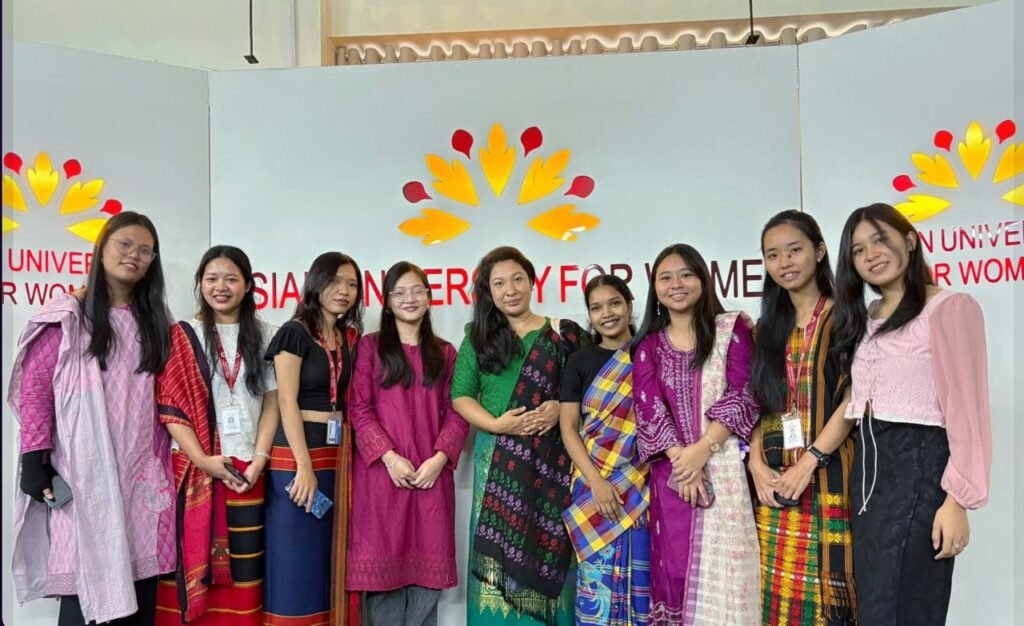
Many may assume the Bengali diaspora is a monolith of South Asian Muslims, but there are actually around 50 recognised indigenous and ethnic minority groups in the region, such as the Chakmas, Marmas and Santhals, who all adopt different languages, cultures and religions.
Ukhengching Marma is one of the ceremonial queens for the Indigenous tribes of the Chittagong Hill Tracts (CHT), in south-east Bangladesh. She aims to raise global awareness specifically for gender-based violence towards indigenous women integrated within Bengali and South Asian communities, where justice systems facilitate the sexual harm and discrimination exercised against them. This interview looks at her work which advocates for her indigenous people’s rights and her community-based research.
What kind of gender-based violence are indigenous girls and young women in the CHT most susceptible to?
“Much of the gender-based violence, such as rape and sexual assault, that happens comes from settler populations, not indigenous tribes. There haven’t been many perpetrators from the indigenous community itself, but also its patriarchal roots do still create problems that prevent victims from speaking out or feeling comfortable.
The reasons why the indigenous girls and women are extremely vulnerable to settler violence is because the perpetrators are being safeguarded by some state agencies, and they, the offenders, know that if they enact any sort of violence, they are protected by the lawlessness of these districts”.
Indeed, the police have been accused of deliberately covering up rapes and distorting evidence to nullify the investigations. For example, in September 2025, riots broke out in CHT, Khagrachahri district, as a result of the alleged rape of a 12-year-old school girl within that community by three unidentified men. This led to protesters from the Chakma tribe protesting for justice and protection for their women and girls, as they argued access to justice was continuously forsaken. Rani Yan Yan, human rights defender and advisor for the Chakma Circle, writes about how this incident was an example of tampered criminal investigation. She explained how the police manipulated the investigation through “deliberately omitted” evidence and even relied on fake medical reports, as medical examiners risked “serious retribution” if they didn’t cover up the sexual assaults through producing negative results. Amnesty International similarly reported how, in May of the same year, the murder of an Indigenous Khyang woman who was also raped was also followed by subsequent lack of action by the police, where witnesses and autopsy reports were sloppy and neglected, thwarting justice for the crime.
What are the issues with this legal system in the CHT?
“The Chittagong Hill Tracts is left with a mixed colonial legacy and legal pluralism. This is because Bengali land law is still regulated by British concepts such as the Torrens system and Roman law principles like usufruct rights. However, this is mixed with indigenous customary law, Trah, so circle chiefs like rajas, village headmen and karbaries, village elders and leaders, also help deal with marriage, inheritance, social disputes and minor criminal matters. They especially dominate the natural resource law, since the CHT has one of the best sustainability food systems in the world.
However, the customary law often clashes with state law, for example, incidents where state-appointed district councillors would impose Hindu law, Dayabhagu, or Muslim law, Sharia, without consulting the chiefs first. This is especially stark in land law cases, because whilst indigenous law allows women to inherit property, other communities’ beliefs restrict this from being enacted. In these cases, often state law prevails, and as we can see this particularly advantages settlers and gives them confidence in committing transgressions against indigenous law which is less enforceable”.
However, when the law is unsatisfactory, it shows that riots break out, villages burn and the people take the law into their own hands, at the cost of justiciability for both the victim and the perpetrator. For example, in October 2024, a teacher was beaten to death for allegedly raping a 14-year-old student, before a court had time to take proceedings forward. I also recall how, at the end of my first semester of teaching at the Asian University for Women (AUW), some of my indigenous students from the CHT could not return home for the December break because their villages were set on fire by rioters from both the settler and indigenous side, due to the dissatisfaction with law enforcement. Paralysed with fear of violence and displacement.
What kinds of initiatives have you taken with gender-based violence?
“I prioritise raising awareness with women, through conferences and focus groups. Teaching them how and why indigenous women are targeted by different groups. How due to social classes, some women are easier targets of sexual violence because they are more vulnerable with less legal fees, family protections and work more difficult field jobs, putting them in risky position. This is alongside school girls from lower-middle-class backgrounds who live in remote villages. Because of the environment too, like for those who reside near forests and jungles, it is easier for crimes to be committed against them, and for the criminal to get away”.
“There are many cases of school girls being targeted by their own school teacher, and young university women are also susceptible to this. This is because indigenous women are a fantasy, and both exotified and eroticised. They are even targeted by the educated Bengali class. I go to universities and villages alongside female leaders, to teach these girls how to report and network with community leaders for protection”.
What are your favourite values that you have learned and continue to use from your indigenous community?
“In Marma customary law, there is no specific translation that describes the word ‘Trah’ which is a legal value that prioritises the balancing of moral character. We also have ‘Thoong Jaing’ which means the eternal knots of kinship across generations. This captures the idea of how indigenous tribes have maintained customary law through passing it down as familial practice. These concepts have strong historical influence from Burmese Buddhist law.
Our values emphasise collective harmony and reciprocity with nature — protecting the environment so that it can also protect us. For example, it is forbidden to cut down trees at night, rooted in Vinya Buddhist law, because it prevents accidental harm towards nocturnal life. I believe it is important for us to collectively raise awareness of these values for younger generations”.
That’s why Ukhengching has been working with the students and teaching fellows at the Asian University for Women on sustainability projects — teaching them how to record food systems and practices within the CHT through field work data, academic writing and workshops.
Do you think the new government in Bangladesh will enforce any change?
“The situation has been settled for the last few months, but with any government we don’t know, it is unsure, and we need to advocate for your own constitutional recognition. For example, during the election run-up, a lot of Muslim community leaders were coming to win elections and support amongst the indigenous people through politicised religion. They were taking very young children from orphanages, or giving money to poorer parents, to change their names to Islamic ones.
Especially when it comes to indigenous advocates like me, I realised the state will constantly monitor you and control what you say to the media. Indigenous organisations and spokespersons like myself are still watched and censored, regardless of regime”.