
From the muddy banks of the Wishkah in Aberdeen, Washington, Kurt Cobain, a troubled teen rooted with angst and spirit, began writing melodies and lyrics to release and express the frustrations of his day-to-day life, from his disillusionment with society to the slow burnout of his familial breakdown. He began to meet others, fellow punk-rock misfits to shoot the breeze with, with the cheapest instruments and equipment they owned. Alongside bass player Krist Novacelic and drummer Aaron Burkhard, in March 1987, at 17 Nussbaum Road, came the reported first basement gig of the band we now know today as Nirvana.
Years go by, drummers change, the band grows and grows and tours the country to all four corners, from the Pacific Northwest to the South of the Atlantic. Nirvana, within what seemed a matter of weeks, became the leaders of a new musical movement which would define the 1990s — the grunge movement. Alongside other bands such as Pearl Jam, Soundgarden, Alice in Chains and Stone Temple Pilots, the image of rock ’n’ roll was beginning to shift. The days of hair metal, glam rock and hard rock were losing their lustre. The people wanted realness for once, not something manufactured. Nirvana, hosting nothing more than shaggy flannels and T-shirts, emitted a sign that punk rock was back, punk rock which lit up stages and crowded mosh pits with only the bare necessities — the band themselves.
Nirvana, in their short history, took part in several live shows that were recorded and preserved for us today. I took the time to watch their best work, performed in the state where grunge was at its most electric — the infamous Live at the Paramount show.
On 31 October 1991 at the Paramount Theatre in Seattle, Washington, the heart of the grunge scene, Nirvana, alongside fellow acts Bikini Kill and Mudhoney, produced one of the most acclaimed live shows of the year, with Nirvana’s performance recorded and released to the public in 2011. Filmed in 16 mm film, Live at the Paramount was performed at the peak of the band’s popularity, with their album Nevermind released only a month prior, which set the world alight.
For $10, fans were packed into the venue like sardines, with the opening of the film showing crowds surrounding the venue, lined up and fired up with nostalgic neon signs glowing around them. The camera pans around the fans dressed in vintage flannels and band tees, ripped jeans and alternative make-up, with the 16 mm film exhibiting an unbridled feeling of excitement. The live show kicks off with a cover from one of Cobain’s favourites, “Jesus Don’t Want Me for a Sunbeam” from the Vaselines — “and they are very punk rock”, as Cobain mentions. Immediately, the crowd begins to mosh and crowd surf, with the shots of the front row being squished to the barriers and security with grins on their faces.
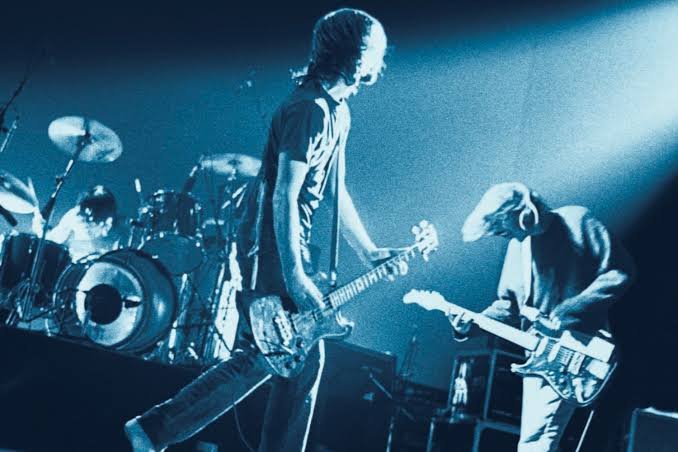
The first thing that you notice is the immense illumination of the stage and how it wraps around the band, where Kurt stands with particles of dust, smoke and fog orbiting around him. It creates a spotlight so alluring, a punk-rock halo where even Krist, jumping like a rabbit, looks and plays like the greatest to ever play the bass, so impactful yet so casual.
The stage production is so simple yet perfect for Nirvana. Nothing flashy except the literal flash that is needed. Next, Kurt wastes no time in breaking into a fan favourite riff and kicks into gear with “Aneurysm”. The reds and blues of the stage are mesmeric, the chorus screaming “Beat me out of me!” over and over gives you no choice in rocking your neck like you’ve been put into a trance, and Dave Grohl shows off his vocal talents with a proud and loud backing performance, which is heard for the rest of the show.
After, my favourite live performance of any song ever, a song I’ve come to put on repeat almost every day of my life since I first heard it, and at the Paramount, the band proves why it’s one of their favourites to play. “Drain You” was discussed to be Kurt’s favourite, his most cherished song, and Kurt sings his heart out here. The camera exhibits the scale of the audience, moving like molecules in a liquid. My favourite frame of Nirvana comes from the end of the bridge leading into the final verse and chorus, where the lights come back on, and Kurt and Krist face each other and jam like there’s no one else there.
My best-loved Nirvana lyric, “One baby to another says I’m lucky to have met you”, rings so true when you think about Kurt and Krist as the perfect duo for Nirvana. I will never get bored with it, and a special acknowledgement to the groupies on stage, Nikki McCure and Ian Dickson, the “boy-girl-girl-boy” go-go dancers, each to one side of the stage, dancing with no choreography except whatever they felt.
Live at the Paramount gives each band member a chance to show off their personality, with Krist and Dave each taking a moment between songs to talk to the audience. Dave calls out the audience for not dressing up for Halloween, with Dave seeing only “about 2% are in costume, which personally, I think is pretty lame, unless you’re all supposed to be punk rockers”. Krist, being the most goofy of the bunch, takes a shot with the audience while playing a slick and funky bass line and yells, “white boy funk sucks”.
I could only want more with Kurt talking to the audience just like his fellow bandmates. Still, his star power is pulled off so easily, you immediately magnetise to him, particularly when the hit single is strummed on his guitar, “Smells Like Teen Spirit”. The song itself needs no introduction as one of the best of all time, but you can really just see how radical the song was when it was first released in 1991, with the crowd exploding with collective screech. A privilege to watch today, and the jealousy you feel is immense — why could I not have been alive in that pit!
A major talking point of the grunge movement is its fashion, the alternative style defined not by its mould-breaking flashiness but its directness, a reflection of a post-Reagan youth rebellion. None of this clean and tucked-in corporate power dressing, but instead casualness and loudness, wearing your identity on your literal sleeves and, in this show, we see that on full display. The audience dressed head to toe in ripped denim, black leather, countless plaid patterns and graphic tees, signalling the turn of the counterculture and raging youth, long hair flowing and swaying with sweat.
Dave sported a Pixies band shirt and cargo shorts, Krist torn-up cuff denim jeans and a black graphic T-shirt. Kurt, an accidental fashion idol of the decade, clad as casually as a punk rocker could, wore a dark, washed-green sweater and denim jeans marked with scars from mosh pits and many other live shows. The band and Kurt’s individual identity are illuminated by the stage, not just their fashion but their instruments as well, with Kurt’s black Fender Stratocaster marked with creased duct tape and a sticker that reads “Vandalism: Beautiful as a rock in a cop’s face”.
If you know anything about Cobain growing up, you’ll know his staunch anti-authority beliefs are tied to everything he does, having run-ins with the police. The iconic sticker on his guitar is just a reminder of not only his own ideals but the rebellious, anti-establishment culture birthed in crowds and music scenes such as the grunge movement; Nirvana made it mainstream, for better or for worse.
The midpoint of the show hits us with renditions of “About a Girl”, where the Beatles-esque melody swoons us while still keeping the atmosphere live and loud; “Polly”, where the band takes a moment to strip down to play one of their darkest songs, with Dave heightening the depth of the song with his soft and sombre backing vocals. The band locks back in with “Breed”, an insane display of radical energy, highlighting one of Nevermind’s most underrated tracks.
Crowd surfers galore fly over the mosh pits, and fans jump past security and take stage dives to the delight of the band, breathing in the galvanising buzz of the Paramount. Krist is lost in the sound, Dave does a spit take, leaving particles of water around him, bouncing to each hit of his drum, and Kurt leaves us with one of the best guitar solos of his career, running around the stage like a headless chicken and collapsing to the ground, still nailing every chord. Kurt will never be forgotten as a symbol of what true musical expression is within the rock genre, and he shows that sometimes, choreography is overrated. Feel the music.
The entire Paramount show would not feel the same if it weren’t for the 16 mm film on which the production was filmed. The organic textures of the dust and smoke in the air, the way the light bounces off the bodies of the band, feels near physical, as if you can touch the light itself, near malleable. The colours feel organic, nothing oversaturated and over-touched, feeling less like a concert film you’d find today but a real live show you can see straight from your living room, with rich skin tones with shine on every forehead in the crowd. It’s not pristine and as clean as it would be achieved digitally; the graininess of it all adds a coarse touch to the film, which parallels the music and culture of the event itself, a juncture of a scene put to screen, preserved forever.
It is the end of the show, and the band walk off the stage with the crowd moving and swaying like individual grass blades in the wind. Of course, they are awaiting an encore worthy of ending a brilliant Halloween night. The band returns and debuts a new track they have been working on, a feature that would be a part of their next record, In Utero — the grave and heavy “Rape Me”, and it is a hit with the audience.
The reverb and vibrato in Kurt’s vocals in the chorus ring in your ears like a punk siren; it’s near-trance-inducing. What happens next could only be expected if you were a seasoned Nirvana fan, but to the audience, the next performance was a secret, just like its place in the album. The band let go of all restraint they had and start “Endless, Nameless”, an encore of pure musical brutality. Kurt screeches into the microphone, spouting what sounds to be near gibberish, and Krist loses all musical necessity and begins throwing his bass into the sky, not caring at all if it hits a stage light. Kurt begins throwing his guitar on the ground, the speakers are producing nothing but muffled reverb, and it’s brilliant. The show ends with Kurt playing baseball with Krist’s bass, breaking both instruments. It’s enthralling and a perfect end to the show.
The legacy of this show cannot be understated. Everett True, a music journalist, described the event as “the end of an era”, the final nail in the coffin to the faux rebellion of hair metal and arena rock, which had its foothold in the charts while still sinking the rock ’n’ roll genre. Nirvana redefined what mainstream rock sounded like, a sound built with raw emotion, with artists who were unashamed to not look the part of what a rock star was but changed the answer as to what a rock star should be.
In this retrospection, I discuss how this event was a snapshot into the grunge movement and the culture surrounding it, but it is also a scene into the peak of the band’s success, a highlight reel of Nevermind and the band at its technical and creative peak, pumped with adrenaline and not a care in the world. Watching the show back today, fans have the hindsight to see how fame affected Kurt, before the whirlwind of being the last true rock star met him with immense pressure, constant paranoia under the spotlight and breakdown within the band behind closed doors.
Although other live performances, such as the incredible and undoubtedly more famous MTV: Unplugged show, still show the band at a peak of creative freedom, the Live at the Paramount show shows when they were just kids on the ledge of the punk-rock dream. A band surrounded by hype, having a final hurrah as kids before cementing themselves as legends and one of the greatest bands of all time.