
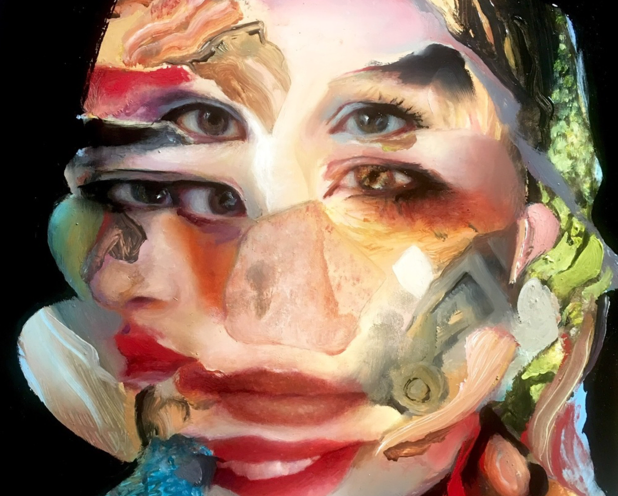


Caroline Westerhout, born in Weert in 1970, asks “Why are we all pretending to be normal when we could be insanely interesting instead?” in her Instagram biography — an entirely appropriate reference to the spirit that courses throughout her art. Westerhout’s artistic practice primarily features unique, non-traditional portraits rooted in classical techniques. The Dutch artist embraces experimentation, blending figuration with raw, abstract elements while playing with deformation and perspective — all of which contribute to the contemporary aura of her work. She creates a dualistic effect by juxtaposing refined, realistic facial features with rough strokes, resulting in an emotionally charged atmosphere. Some pieces even appear to trace the remnants of a self-portrait, with the finalised outcome being the composition of an entirely new face or being.
It is clear that Westerhout is an exciting contemporary artist. When asked about the meaning of her work a few years ago, she replied: “Cause I like it. Cause faces can be boring. Cause the inside is not so symmetrical as the outside. Cause people have multiple faces that don’t show. Cause it looks great sometimes”. Westerhout agreed to a more recent discussion surrounding her art, the ethics and commerciality of the industry and the things that remain hidden — those elements that do not always come to the surface but, nevertheless, gradually seep through.
Q: You mentioned that your approach to painting portraits was based on the fact that “faces are boring, ‘cause the inside is not so symmetrical as the outside, ‘cause people have multiple faces that don’t show”. Is this still your approach?
Caroline Westerhout: “I didn’t mean to say faces are boring. Faces are never boring. But for me, painting a perfect face is boring. I like to add something or change things. I don’t think very much about it these days; I just do what my hand and brain want me to do until my eyes see what they like. I am a bit less aware now while painting.”
Q: I also remember you saying that part of your method is to simply paint what you liked. It was the first thing you mentioned, and the last. Do you feel there is a struggle between figurative artistic expression and the idea of beauty, or aesthetics, in art?
Caroline Westerhout: “One of my gallery owners said to me that I paint a beautiful face before I make it ugly. I know he dislikes it a bit sometimes, and it made me think. The other day I read a quote that said artists need to paint ugly things for their own good — to let go of standards. That also made me think. Last week, someone typed the word ‘horrific’ regarding my latest painting. It is all brainfood. What I want to see or paint, what I need — this is just what is happening right now. People see things I didn’t notice. I will think about it and, if they are right, I will change something, or everything. I’ll grow from it. When I feel they are ‘wrong’ — which means their opinion just doesn’t match mine — nothing will change. So there is no struggle, just conversations.”
Q: Can you elaborate on how this concept influences your work and artistic vision, and how it relates to the idea of letting go of standards?
Caroline Westerhout: “Although I like the idea of painting ugly things, the thwarted me says it is useless. Of course I paint ugly things, but that is during underpaintings. I only deliver work that is not ugly, in my opinion, at least. I am thwarted a lot of times; it just happens. So when someone says to do beauty, I do anything but beauty. The artistic me has no control over the commercial me.”
Q: How does your intuitive approach contribute to the evolution of your artistic vision until your eyes find satisfaction in the work?
Caroline Westerhout: “The evolution lies in trusting myself to let go. I used to think I needed control to create, but I need to let go of that control to create better things. I know that now.”
Q: I found your mention of asymmetry very interesting, as it is one of the most visible aspects of your work — specifically in your Figurative – Faces series. Is this formula still applicable to the body branch of your Figurative series?
Caroline Westerhout: “I think so. I paint realistically, but just fragments. If I were to paint a body, I would like to compose it too. I am not a painter who copies lifelike — not anymore — unless it were a commissioned work.”
Q: I see that. One of my favourite paintings of yours, Phantom Thoughts, seems to focus mostly on the nude. It is also fragmented, but much more discernible than the faces of your subjects. I also see this in The Afterparty from your Muse Post-Mortem series. Does the composition of bodies receive a sort of special attention that faces do not?
Caroline Westerhout: “No special attention. They arise from another way of working. I think it also inspired a different way of thinking. Or maybe the face has fewer possibilities for my mind? Though I have some portraits with the same vibe. I just don’t move the same way every day. Today or tomorrow — different mood, different painting.”
Q: Am I right to assume that a lot of your portraits are, in a way, self-portraits? Or is this label no longer applicable once you are done with them?
Caroline Westerhout: “Yes, you’re right. I use my own face or parts of it a lot. But even when I don’t, it seems to have something to do with me. It is not on purpose, but it is okay.”
Q: What have been the biggest influences on your recurrent use of asymmetry in your latest work?
Caroline Westerhout: “The more experienced I become, the more I influence myself. Asymmetry is not a thing I pursue; I just like it. At the same time, I could change my mind about it tomorrow. It is all good.”