

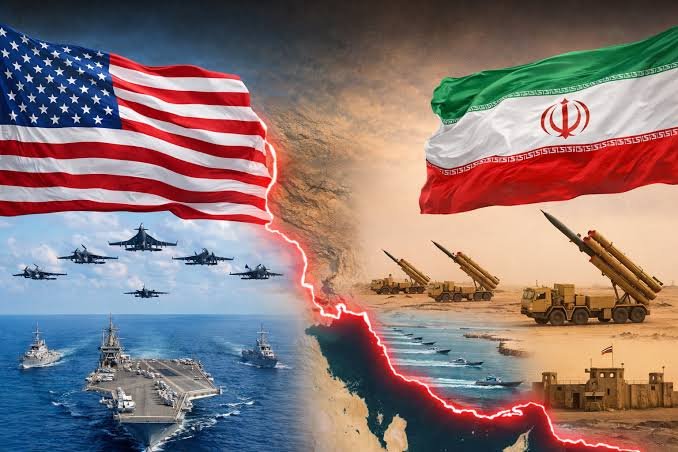
The conflict between the United States and Iran that has unfolded in 2026 is increasingly understood less as a single, linear war with one decisive battlefield and more as an extended struggle of coercion, deterrence and intermittent force. In this form, the “war” is not defined only by strikes or dramatic confrontations, but by sustained pressure campaigns, maritime and financial friction and a continuing contest over escalation control. As tensions have intensified and then partially moderated at various points, observers have described the overall dynamic as resembling a prolonged system of confrontation: periods of negotiation and attempted de-escalation exist, yet military readiness, sanctions pressure and operational risk remain in place, keeping the conflict’s consequences alive for both sides and for much of the wider international system.
To understand the most recent phase of the US–Iran conflict, it helps to focus on how the US and Iran pursue their objectives. The United States has relied on a combination of economic and diplomatic strategies paired with military signalling and operational actions designed to constrain Iran’s options. Economic pressure and diplomatic engagement are meant to change incentives and raise the costs of continuing conflict, while military posture is used to deter attacks, demonstrate capability and impose friction on adversary planning. In parallel, Iran has sought to maintain its deterrent credibility and preserve bargaining leverage. This produces a recurring pattern: diplomacy and coercion run side by side, rather than replacing one another. When talks appear to progress, the pressure does not fully disappear; instead, both sides keep their escalation options available in case negotiations fail. This “managed escalation” structure has become a key feature of how the war is experienced in practice.
The conflict’s effects on the United States are therefore multi-layered. On the military and operational level, the war has required Washington to sustain heightened readiness across multiple theatres, particularly where maritime risk and regional proxy activity can threaten US personnel, assets and partners. Sustained deployments and increased surveillance are expensive and can strain operational tempo, especially when the US is also managing other global commitments. Just as importantly, the US faces constant risk management decisions about escalation thresholds. In a conflict defined by intermittent strikes and coercive postures, leaders must weigh tactical gains against the danger that local events could trigger broader retaliation. This dilemma is not confined to the battlefield; it also plays out in domestic political constraints and in diplomatic relationships with allies who may be affected by US actions even if they are not direct targets of Iran.
Economically, the US impact is not limited to direct effects from Iranian exports, because the main linkages often run through global markets. Even when US trade with Iran is limited, the conflict can raise insurance costs, complicate shipping routes and increase uncertainty in energy pricing — changes that then feed into inflation dynamics and investor risk appetite. International institutions have argued that geopolitical conflicts in the Middle East can darken the global economic outlook by increasing energy price volatility and complicating macroeconomic stabilisation efforts. In other words, the US is affected not only by what Iran does, but by how the global system prices risk in response to heightened confrontation.
For Iran, the war’s consequences are often more immediately felt through economic channels, particularly when sanctions pressure and enforcement actions constrict trade and limit revenue streams. Iran’s economy has already faced significant headwinds for years, and additional military and maritime risk can make the business environment even more difficult. When firms perceive that maritime operations are increasingly dangerous, costly or unpredictable, they demand higher risk premiums or shift logistics entirely, which can reduce practical access to markets. Analysts and reporting have emphasised how maritime pressure and restrictions are not just tactical issues, but economic ones that ripple into the ability to procure critical goods and generate export income. This kind of pressure also affects negotiation leverage: when domestic economic conditions are squeezed, governments must balance the benefits of compromise against the perceived political and strategic costs of appearing to yield.
Iran’s security calculations are shaped by the same escalation logic that pressures the United States. Even when Iran avoids direct, large-scale conventional confrontation, it still must plan for the likelihood of incidents, retaliatory cycles and proxy-related attacks. This leads to a situation where deterrence is maintained through a networked posture, signals, asymmetric capabilities and relationships with regional actors, that can complicate US and partner efforts to predict outcomes. In such an environment, both states can interpret ambiguous events as either deterrence successes or escalation provocations. The result is a cycle where risk is persistent, and the distance between diplomacy and conflict is shorter than it would be in a more stable deterrence relationship. Some coverage and analysis have framed Iran’s approach in terms of preserving regional influence and refusing to be fully cornered, even as the broader security environment grows more dangerous.
The conflict does not remain confined to US and Iranian territory. It is regional, and its regional effects can become global through trade, shipping and energy markets. Several countries in the Middle East — whether they are allied with the US, aligned with Iran or trying to remain neutral — face heightened security dilemmas as they try to prevent spillover violence and protect infrastructure. Maritime and shipping routes become especially important because the Middle East is a major crossroads for global commerce. When the threat of interdiction or attack rises, shipping companies reroute, increase costs, adjust schedules and demand higher insurance premiums. Even without a constant stream of kinetic events, the probability of disruption alone can change economic behaviour across borders.
This is where “everyone else in the world” becomes part of the story. Energy and shipping are global businesses: risk in one region changes price expectations elsewhere. Geopolitical uncertainty can lift oil and refined product risk premiums, and it can alter how quickly markets price in future supply disruptions. Energy-focused analyses have highlighted how geopolitical factors contribute to uncertainty in oil markets, and how past patterns of escalation can keep markets nervous even when supply remains technically adequate. Meanwhile, institutions discussing economic stability have argued that Middle East war shocks can influence inflation and growth through defence spending pressures and energy-market effects, complicating the efforts of governments and central banks to manage economic downturn risk.
Because the conflict combines military risk with economic coercion, its political implications reach far beyond the Middle East. Governments must decide whether to align with US pressure efforts, hedge through diplomatic channels or attempt to maintain independent trading relationships. Public opinion can constrain policy choices, while corporate risk management can constrain state policy as well, because firms may limit exposure to sanctioned entities or avoid routes perceived as too dangerous. International organisations also face strain: monitoring and enforcement become harder when the environment is more militarised, and humanitarian and disaster preparedness become more complex when conflict conditions worsen. The US and Iran can thereby affect global politics not only through strikes, but through how the world adapts — financially, commercially and militarily — to the existence of a persistent crisis.
Meanwhile, diplomacy continues to matter precisely because the stakes are so high. Recent reporting has pointed to continued efforts to build frameworks or pathways that could reduce violence, even as the military and economic pressure tools remain available. In such a setting, ceasefire discussions can provide temporary relief, but they are fragile if enforcement structures and economic sanctions remain unresolved. A ceasefire that reduces immediate violence without easing economic pressure may still leave each side uncertain about future leverage, which can renew the cycle of coercion. This is why many analyses treat the US–Iran crisis as an ongoing competition over conditions, not only a competition over timing.
In conclusion, the US–Iran war in 2026 is best understood as a conflict that operates simultaneously on several planes: direct adversarial pressure between the two states, regional spillover through security dynamics and proxy activity and global economic effects via energy pricing, shipping risk and financial uncertainty. For the United States, it shapes military posture, escalation risk and market conditions that influence economic stability. For Iran, it shapes constrained trade, economic strain and the calculation of negotiation versus resistance. For countries far beyond the Middle East, it changes how markets price uncertainty, raises the cost of maritime commerce and increases volatility in energy expectations. Even when negotiations intensify or strikes pause, the structural drivers of risk remain, ensuring that the conflict’s consequences continue to be felt across borders.