
Trying to understand an epic poem 2,000 years after it was originally performed as an oral ballad is quite difficult. Especially when it is translated with various interpretations, commentaries and debates regarding words, grammar, syntax, structure or even how we are to perceive a certain character. I really enjoyed studying The Odyssey for IB English and my favourite translation is by Alexander Pope. I also taught The Odyssey when I was a former Classics teacher. Naturally, as a poet myself, I found it easier to read. So to be able to view a long awaited adaptation is quite exciting for many lovers of epic tales, history and cinema everywhere.
Many audiences crave authenticity; more are certainly opting for a more analogue life rather than busying themselves with social media and AI. It was therefore a pleasure to witness a film by Christopher Nolan where CGI was limited in favour of spectacular visuals associated with the human experience. Naturally, with a creative reimagining of a famous epic tale, there will be people who agree, disagree, like or dislike what’s in front of them. I aim to give a fair, honest and balanced review as The Odyssey has been fairly divisive, particularly amongst the Classicist community. I suppose my former teacher-life has helped me to learn how to deliver constructive critical feedback. So let’s delve into my review journey of the film.
One of the most interesting debates has been whether an expert filmmaker and director surpasses other fields of experts who have studied and dedicated their lives to translating and teaching the actual text of The Odyssey, as well as ancient civilisations. Film adaptations will always have changes that are not exact; like Odysseus, Nolan is human and some choices make for interesting discussions. He tells more of a suitor’s tale than perhaps having Penelope’s faithful understanding of Odysseus that students, teachers and appreciators of the Classical world may have.
Now, granted, creativity, art and film-making is expression. There are, however, elephants in the room like American accents, no Greek actors (I’ll explain this later) and plot lines that have been entirely altered which either surprise or disappoint the viewer. The Odyssey is clearly a visual and cinematic masterpiece. I liked the opening and the appearance of Travis Scott who plays the role of Demodocus, a bard. Some of his lines were some of the most authentic according to the original text. The link of rap, oral ballads and poetry was a great ode included by Nolan as well. It would have been nice to see a little more narration as the original epic was orally delivered, and narrators play a huge part in many Ancient Greek plays.
“Sing, O Muse of a man…” (delivered before the infamous slaying of the suitors at the end of the film and the original story). I think that is the core theme of Nolan’s adaptation; a commentary on the tragedy of humanity, brutality, war and coming to terms with a changed personality. Coming home doesn’t always mean coming home happily or with an instant wish to. Granted, this theme is overly relayed (perhaps it may have been better as a delayed reference throughout the film) but nonetheless Odysseus is human. He is not a demi-god, immortal or a man with special powers.
Two things can be true at the same time: the representation of a story, its characters and who plays them can be vaguely referenced with great creative licence/error, and you can make an excellent film, too. For example, the line “our age of Bronze is collapsing” is probably one of the most poorly-written ones in the film. The term “Bronze Age” was not used until the 1830s; a quite Homeric-less tone, one could argue. The separation created between Penelope and the suitors as well as her weaving, however, were accurate elements to the text and Ancient Greek civilisation. The kyria (Greek wife) would be separated from her husband (kyrios) whilst he held symposiums (drink, chatter, entertainment, courtesans) including other women. Naturally, the kyria would learn how to weave and ultimately become a domestic breeding machine, along with maintaining her virtue and faithfulness to her husband.
Another aspect I and many others really enjoyed was the music. The strategic strings of Odysseus’s bow, that strummed with the beat of a supposed lyre or guitar, was fabulous to hear. Ludwig Göransson may yet win another Oscar for his incredible craftsmanship. The composer helped to deliver the language of emotion with every note he produced; a perfect accompaniment and arrangement to support some of the most ferocious and sombre scenes. The “Sirens” is a prominent example of this; Odysseus is the only one to hear it without death in the original translation and the film. The Sirens attacked the ship and had a woman’s head with a bird’s body in the original translation. It is interesting that our own modern and potentially sexualised interpretation was included in the adaptation; topless, welcoming, albeit dangerous for Odysseus and his men. I do wonder how one would imagine the Sirens and their song; perhaps it may have been an interesting experiment if Nolan had included this. I don’t think many would want to hear squawks instead of fluid sounds.
There is the standout performance of Samantha Norton as Circe with the magical and mystical elements of an epic; the deconstruction of men into pigs and her delivery of “back to your disguises” when the men are returned to their human form was brilliant. Everything Circe discusses with Odysseus including the rape and pillage of women is a hard truth that has happened in every chapter of history. It still happens now. But her scene was too short; it could be argued that all the scenes with important women in the film were too short. Nolan does, unfortunately, in my eyes, ultimately use some of the most important female characters as plot devices. We do see many scenes of Anne Hathaway as Penelope but it doesn’t detract away from the issue. In the original story there is far more importance and time given to goddesses and female protagonists that Nolan could not achieve with his adaptation. It was very lovely to see a gorgeous Charlize Theron as Calypso; her character is much more interesting and developed in the original story though. Zendaya’s performance as Athena for example was less impactful than the actual character of Athena in the translation. Wise-thinking Athena is far more involved, depicted as being adorned in battle armour with Ancient Greek statues and descriptions, which is a far cry from who we see in the film. Perhaps it is not the visuals which need to be enhanced in the film but further character development in line with what the Ancient Greeks orally performed and believed.
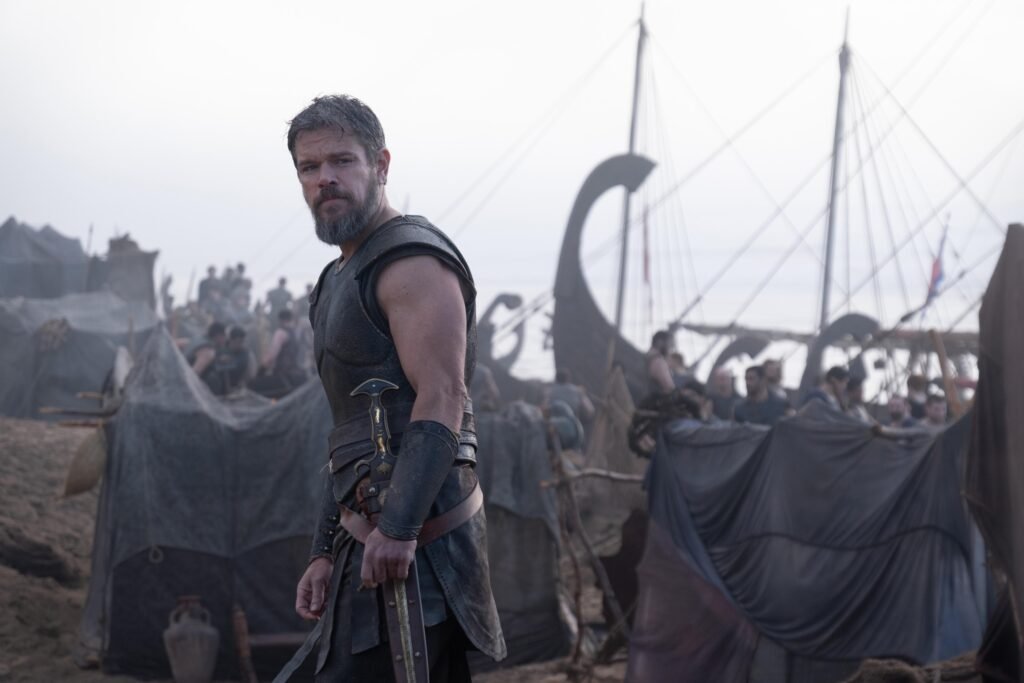
Tom Holland’s Telemachus was a stand out performance; I think he played the role extremely well. Matt Damon’s Odysseus on the other hand lacked the charm, wit and sass we saw with Telemachus, which is disappointing given these are major character traits in the original story. Part of the human experience is sadness and lamentation but we also experience joy, cunning and wit which was very vague on Odysseus’s part here. On the scale of dramatic human emotion, the needle does not point so much towards passion and play. I can see why the “Nobody” joke was removed from the film in line with Nolan’s vision with Polyphemus, but it also made for a more tedious Odysseus. It was hugely important to the Ancient Greeks that drama alongside comedy, wit and humour were included with complex characters. Moreso, there is far more mention of sex, intimate relations and Odysseus’s appreciation of female beauty found in others aside from his wife (it was common for Ancient Greek men to have relationships with men and women outside their marriage.) So many important elements of Ancient Greek culture become xenos (foreign) to Nolan’s portrayal of this epic set and retold in this time.
The visual locations and cinematography were absolutely stunning which made up for some confusing storytelling. The siege of Troy is absolutely sensational to watch (I would regard them as some of the best scenes) however littered flashbacks have confused those unfamiliar with the story. Perhaps it may have been better to place at the beginning of the film. Chronologically it also makes sense. The sounds of Polyphemus crying were jarring and exciting to hear. I believe it was the closest gift we get to hearing monsters and magical creatures in the entirety of the film. One important element missing, however, is the Greek gods and their mischief, destruction, involvement and support. We already live in a human world; let people see the epic parts of fantasy and legend fully. We needed more mythological magic.
A favourite and highly anticipated scene was Odysseus’s return and his slaying of the suitors. The consistent references to his infamous bow is important to see and another great stand out performance with comedy and dark humour was Robert Pattinson’s Antinous. “Someone get these beggars out of here” is already a huge meme. The crescendo of Odysseus’s skill matched the music perfectly. The lack of marital bed test from Penelope to Odysseus as well as the exclusion of Eurymachus was disappointing (these elements are central to the plot of the original story). And this is where it may feel that we are completing an archaeological excavation, digging for basic plot elements that could not be found within some of Nolan’s interpretations.
On the one hand Nolan did not want to use the word xenia (guest-friendship) in the script, but Matt Damon refers to himself as Xennon in the movie, disguised as a beggar when he returns to Ithaca. Zeus’ Law was the replacement and repeated a little too much. We have the reference to Odysseus’s dog Argos which is an emotional scene but it would have added some authenticity to include more of the Ancient Greek language with subtitled references as all the characters retain their original Greek names in the film.
And this brings the article to an important point regarding inclusion. If I were to make the Ramayana epic from India with an all white cast (as an Asian Indian woman), it would not go down well. Respect for peoples’ cultures, traditions and history is sometimes lost in favour of Hollywood appeal. Not to mention that I may be shamed for making such an audacious choice, considered “brave” by a man, and metaphorically tied to a mast being blasted with the song of patriarchy. In my humble Classicist, humanitarian, poet and writer opinion, this was a glaring elephant in the room both in the promotion of the film and while watching it. “It is just a piece of entertainment, why do people care?”. The point is in both instances, the epic stories are myths and legends but are tied to real cultures and people and those who live today have ties to ancient ancestors. So to completely discount and ignore Greek people and actors in an adaptation of an Ancient Greek epic tale is a deliberate choice that can be considered to be dismissive. We should aim to care, not to be dismissive of people and their cultures.
There could have been a huge celebratory opportunity to hold the premiere in Athens with the Parthenon, a temple dedicated to all the gods and Athena, where Ancient Greeks came together, religiously celebrated and worshipped with the Great Panathenaia festival, possibly even performed the same tale being remade. What an honour and a privilege to be able to show it 2,000 years later at the heart of Ancient Greek civilisation. But this was not part of the promotion of the film, which is a great shame.
Overall, The Odyssey had some epic elements and others to be greatly improved. I actually believe Nolan would have made an excellent Iliad adaptation; I think that story speaks more to his film-making style he demonstrated with the siege of Troy and lamentation of war themes in the film. I think The Odyssey would do better as a series (and there are some adaptation suggestions below to watch if you were interested). As his son pointed out, Nolan didn’t win an Oscar for screen writing; I believe this was one of the weaker elements also suggested by other critics. In place of a buried treasure with Nolan’s The Odyssey we may have stumbled upon a Black Attic pot; beautiful, visually intricate, but one still wants more to be found inside.
*Translations to read and adaptations to watch*
Translations —
Alexander Pope (1725-1726): written with heroic couplets, 18th century English poetry
Richard Lattimore (1965): free verse, considered more faithful structurally, for students
and scholars
Robert Fagles (1996): quite dramatic, free verse, fast-paced
Emily Wilson (2018): in strict iambic pentameter, modern translation, good for first-time readers
Daniel Mendelsohn (2025): a rolling six-beat line, mimics ancient hexameter, for literary readers
Films —
Ulysses (1954) – Golden age Hollywood film
L’Odissea (1968) – miniseries considered to be a faithful adaptation
The Odyssey (1997) – mini series, highly entertaining
O Brother Where Art Thou (2000) – loose modern adaptation set in Mississippi
The Return (2024) – with Ralph Fiennes and Juliette Binoche; no sea monsters or gods.