
Anyone who’s ever had the misfortune of asking me for book recommendations has unknowingly been condemned to listening to a rather lengthy, but gloriously flattering, rant about Sally Rooney. I believe she’s one of those rare cases of people becoming rapidly famous and central to cultural discourse, where I believe the “hype” around her creations has been wholly reasonable.
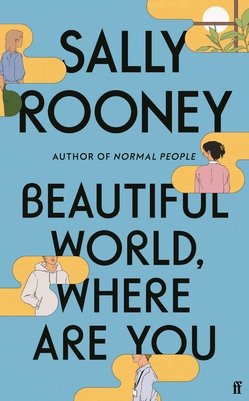
I read Intermezzo during my last summer holiday and absolutely fell in love with the writing. This year, while being stuck and sickeningly bored at Schiphol airport, I decided to pick up a copy of Beautiful World, Where Are You, which was published prior to Intermezzo. I lugged it around for nearly 10 days in the sunny south of France, soaking the pages with pool water, cigarette ash, beer and overall just getting it to a dire state.
For almost two weeks, I was joined at the hip with this poor book—and initially, I really hated it.
I know hate may be considered a strong word here, but I am someone who develops quite firm opinions supported by strong sentiments, and indeed, the first few chapters I was audibly scoffing and scolding, furiously driving the black ballpoint pen deeply into the pages, which quickly became filled with my never-ending criticisms.
Initially, I found reading it incredibly… tedious. It felt like what I’ve loved about Rooney’s writing the most, which made you feel as though not a single word was out of place or could’ve had a better substitute, as though nothing was redundant, was completely absent from this book.
To make it clear that my contempt had more than a few sweeping phrases to support it, let me supply you with some examples.
“Towards the end of her remarks she seemed to have become slightly nervous which expressed itself in the shortness of breath and a kind of self-mocking expression”
So we know what she’s feeling as it is clearly evidenced, but we’re not committing to saying it certainly, but also not committing to showing instead of telling—what is this?
One of the characters was also described, many pages after already having been introduced, as: “a woman named Alice”. Now, this may be a private pet peeve of mine, but I despise it when it is said so—just say her name! We already know it!
And then at this point, I was starting to cause some inconvenience by the pool as I read: “After the second, they had a third.” I mean, come on.
The very first page is full of tedious and unnecessarily almost Victorian realism-coded descriptions of all the surroundings and every smallest action of every character (which are also terribly self-explanatory and basic). Rather than being insightful, it just felt terribly… unnecessary. All this was followed by a painfully awkward and unnatural interaction between two of the main characters. A hiccup which would’ve been overall easily overlooked if Rooney’s greatest power wasn’t in… people. Here I mean describing them, their actions and their relationships, making everything about them so believable that it almost hurts.
While it may be wrong to judge a book by its cover (although that’s highly debatable), I find it perfectly reasonable to judge it by its first 25 pages (or less!). Needless to say, my hopes for this book were low.
And then, about 55 pages in, I had to scold myself and bow my head to Rooney’s writing once again. So perhaps, do not take the advice above to heart too much.
With her mastery, I simply could not resist but find the book utterly beautiful in the simplest but most meaningful way. I slowly but surely became incredibly charmed by the story, its characters and most of all, the way in which it was told.
As with all of Sally Rooney’s books, it is rather challenging (if not impossible) to sketch out a specific plot, as people are much more central than events. The best I can explain it is that it is a book about friendships, sex and love—which is rather vague at best. The book follows two women who happen to be best friends: Alice and Eileen. Alice, a successful writer, moves to a tiny town where she meets Felix; following a rather unsuccessful first date, she invites him to come along on her work trip to Rome. Eileen, who works in a small literary magazine in Dublin, goes through a breakup and falls back into flirting with her childhood friend.
First-hand experiences of love and friendship are interwoven with emails that the two women exchange. Although highly theoretical and lengthy at times, they do offer rich reflections on topics varying from culture, the state of the contemporary novel, class struggle and more. This does not only offer a welcome variety of the style and mode of writing, but also skilfully makes a point for the existence of the novel itself—which is undoubtedly impressive. The personal and general are smartly woven in, and are only as pretentious as actual conversations between two English literature graduates might be.
The simplicity of the plot, so characteristic of Rooney’s writing, works perfectly well due to the absolute skill that the author possesses for portraying people. The mannerisms they have, the opinions they hold and the thoughts that occupy their minds—all of it is so realistic, so familiar, that the characters do not only almost jump out of the page, but they feel like old friends of ours, or even better, like us.
Simplicity, in this context completely devoid of the largely negative connotations that the word may have, is one of the greatest characteristics of Rooney’s writing. The simplicity is what makes the writing so captivating. The simplicity of the characters, their humanity, their lives, their thoughts and the stories they have to tell.
Having read the rest of Rooney’s work, it is evident that Beautiful World, Where Are You? is clearly representative of the author’s characteristic style, most notably the themes of miscommunication (supported by a lack of quotation marks), while not replicating the same pattern of events and characters as the rest of her books. In a way, Rooney manages to make all of her works coherent and singular at the same time.
What continually intrigues me across her books is how closely her style and themes echo Virginia Woolf’s writing—the tides, the non-linear sense of time, the shifting focalisation and more. These threads are already visible here, and by Intermezzo they sharpen into something closer to stream of consciousness (fittingly, given the acknowledgements credit James Joyce as a major influence). I’m genuinely impressed by how these techniques evolve across her work, and even more curious to see where she takes them next.
So, the takeaway — yes, you should read Sally Rooney, and Beautiful World, Where Are You deserves a place on that list. If your complaint is that “it’s just about people”, I hate to break it to you, that is the point. It drags in places (though a little exercise for your attention span never hurt anyone), but it’s undeniably beautiful and an easy read that can pull you out of a reading slump.
I’d highly recommend it to all my friends in their twenties, especially those who may feel lost or even disillusioned with the world. Reading this may not answer all your questions or solve all your problems, but it’ll make you feel better.