
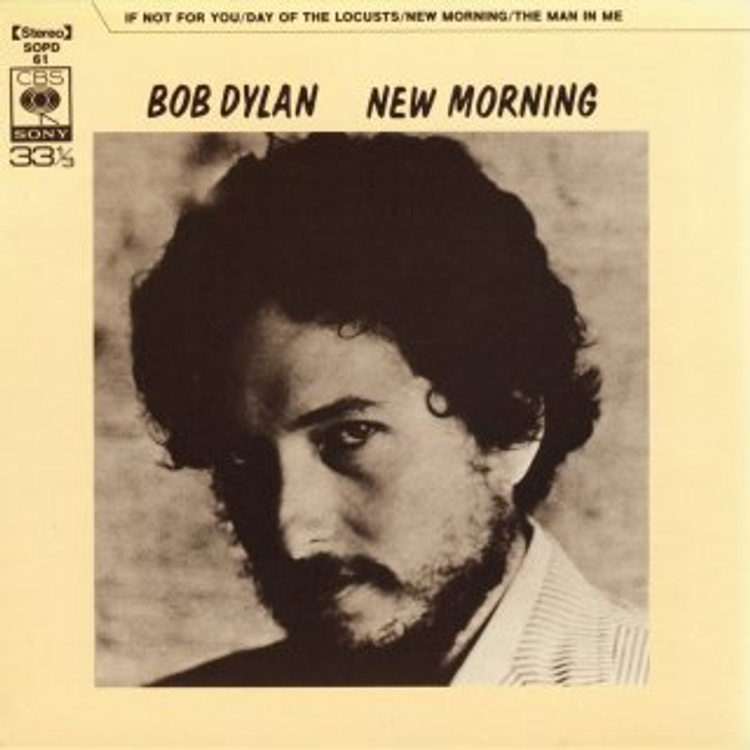
Bob Dylan’s early 1970s period is often viewed through the lens of a man in retreat. Following the era-defining snarl of Highway 61 Revisited and the enigmatic isolation of the Woodstock years, Dylan released Self Portrait (1970)—an album so intentionally confounding that Rolling Stone famously opened its review with: “What is this shit?”
However, just four months later, Dylan released New Morning. It was, and remains, a striking pivot: a record that swapped the detached irony of his previous work for a warm, almost startlingly sincere embrace of domesticity and nature. If the mid-60s Dylan was the poet of the nocturnal urban sprawl, the Dylan of New Morning was the singer of the moral sunrise.
A pastoral shift
The album’s title track, “New Morning”, sets the tone immediately. With its rolling barrelhouse piano and Dylan’s uncharacteristically hearty vocals, it celebrates the mundane with the fervour of a hymn. He sings of “roosters crowing”, “rabbit runs” and the simple joy of a “country pie”.
This wasn’t just a change in subject matter; it was a change in philosophy. Dylan was moving away from the role of the generational oracle—a title he had come to loathe—and toward the role of the family man. The record reflects a period where he was largely ensconced in Greenwich Village and upstate New York, prioritising his life with his wife, Sara, and their children over the “star-maker machinery” of the music industry.
The sound of “New Morning”
Musically, New Morning is defined by its intimacy. It leans heavily on Al Kooper’s organ and piano, giving the tracks a gospel-inflected, organic feel.
- “Sign on the Window”: A masterpiece of understatement, the song moves from a bleak description of a breakup to a hopeful vision of a cabin in Utah, complete with “lots of kids” and “a wife that cooks”.
- “The Man in Me”: Later immortalised by the Coen brothers in The Big Lebowski, the track is a soul-stirring admission of vulnerability. It suggests that behind the public mask of the “protest singer” or the “rock star” lay a person whose stability was entirely dependent on a partner’s grace.
- “Three Angels”: A spoken-word piece that observes three Christmas angels on a street corner whom everyone ignores. It serves as a commentary on the world’s inability to see the sacred in the everyday—a central theme of the album.
The “New Morning” voice
One of the most notable features of the album is Dylan’s “full” voice. Eschewing the nasal “sand and glue” rasp of his folk days and the smooth country croon of Nashville Skyline, he sings here with a rich, natural resonance. There is an audible smile in his delivery, particularly on tracks like “If Not for You”, a love song so pure it was later covered by both George Harrison and Olivia Newton-John.
A misunderstood legacy
Critically, New Morning was initially hailed as a “return to form”, largely because it wasn’t Self Portrait. But over time, it became overshadowed by the monumental heartbreak of Blood on the Tracks (1975) and the religious fervour of his late-70s gospel period.
Yet, in 2026, the album feels more relevant than ever. In an age of digital saturation and constant performative outrage, Dylan’s 1970 insistence on the value of a “quiet life” feels radical. It is an album that argues for the “moral sunrise”—the idea that one can find a sense of purpose and ethical grounding not in global movements or grand theories, but in the immediate, the local and the loved.
New Morning is not a record of a man who has given up; it is the record of a man who has found something better to do than being a legend. As he concludes on the title track: “Can’t you hear that rooster crowin’? / Rabbit runnin’ down the log / Hungry dogs are barkin’ / It’s a new morning, it’s a new morning.”