
There are times when I think of Monet, not the artist immortalised on posters and tote bags, but the man standing knee-deep in mud beside the Seine, brush trembling in cold fingers on an autumn morning much like this one. The sting of rejections whirling through his mind, and the quiet ache of believing in something that no one else can see yet. I think it is strange how that feeling seems to reverberate through time, like the silent confession of those trying to make art in a world that rewards monotony over authenticity.
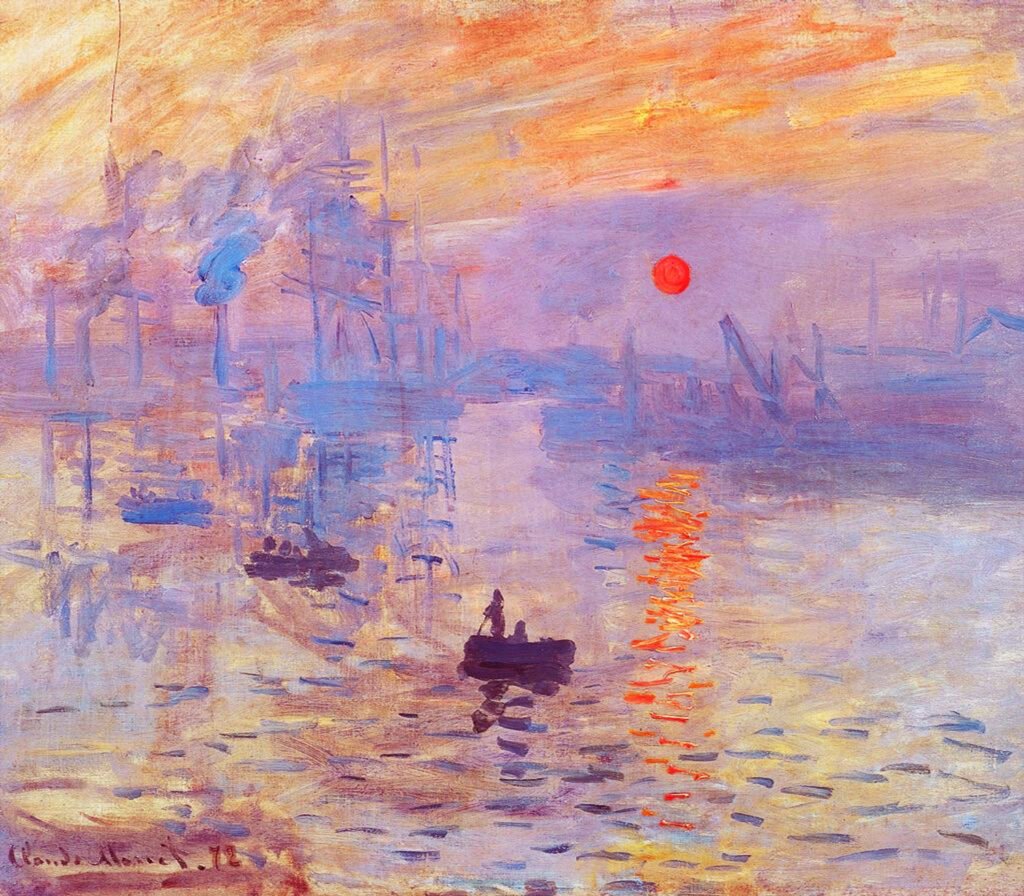
As I continue my studies of the Impressionists, I have come to realise that I do not just admire Monet’s technique, but rather the tenacity and determination behind his artistic vision. When I learned about their first exhibition in 1874, I did not think about history being made. I pictured a room full of nerves and ambition, canvases hung neatly in a crimson studio and a group of artists waiting for the world to decide if they were dilettantes or visionaries. Monet’s Impression, Sunrise was not a proclamation; it was a quiet act of honesty. He did not paint the world with arbitrary precision like those of the Paris Salon, but as it appeared to him — transient, always changing and impossible to pin down.
That audacity to see differently came at a price. Monet often had to borrow money or trade his paintings in order to keep food on the table and a roof over his head. His paintings, now considered masterpieces, once sat unsold and dismissed. Louis Leroy called his work unfinished, careless, an impression rather than a painting. He meant it as an insult, but Monet turned those words into a revolution.
There is something haunting in that: how close genius and ruin can stand together. I think about this when I see artists today, as I scroll through an algorithm that feeds off conformity and endless content. Sometimes, I see my own insecurities reflected there — the desire to stay true to my artistic vision even when it does not pay the bills, or the trade-off of conforming to the unquenchable desires of a system that is never satisfied. It is strange how that hunger has not really changed; it has just moved from the riverbank to the screen. Walking the streets in the rain, shoes clicking against the pavement, those thoughts hum beneath everything else when I make my way to work.
Maybe that is why Monet’s story feels like a mirror. His struggle was not just about art; it was about faith — faith in perception and in the stubborn conviction that what you feel is worth the brushstroke, the sleepless nights and the empty pantry. He painted what he saw and felt even when no one took the time to look deeper. Perhaps that is the real task of any artist: to protect your truth before the world teaches you to doubt it.
In his garden at Giverny years later, when fame had finally caught up to him, Monet still chased the same light he once starved for. He painted the lilies again and again, as if trying to prove that beauty was not a single moment but a persistence of belief. That is what moves me most about him. Even after all the praise, he was still searching, and that hunger never left.
Sometimes I wonder if creation is just another form of prayer. To paint, to write, to build something from nothing — I think it requires the same surrender. You step into the unknown, trusting that the act itself will make meaning. That is what Monet did, and that is what every artist still does, in one way or another. We reach for the light knowing it might burn us, but we do it anyway.
In an age that rewards constant output and novelty, Monet’s patience for his art feels almost radical. He watched the same water for decades, learning how morning fog could make a bridge disappear or how dusk could turn a garden into memory. He did not chase novelty; he sought truth. And perhaps that is what we have forgotten is most important: that art does not always shout. Sometimes it whispers, and the bravest thing you can do is listen.
When I think of Monet now, I do not see a painter at all. I see a man standing before a canvas, quietly determined, painting light that would outlive him. Maybe that is the secret — not to create for praise or to be noticed, but to build something that will one day speak for you when you are gone.
We all carry that weight in our own way. For Monet, it was the hunger in his belly, the unpaid bills and the constant strain of survival. For us, it might be doubt, obscurity or the restless pull of comparison scrolling endlessly across a screen. And yet somehow, in that struggle, there is a stubborn little promise: that beauty, once glimpsed, lodges itself in the mind and does not leave. Maybe that alone is reason enough to keep going, brush in hand, even when no one else is looking.