

One day, not long after Mark Edwards had completed his first collection of ‘white wood’ paintings, he got chatting to a tourist who was visiting Mark’s native Scotland. The visitor was a psychologist and he was very interested in the work. “The trees in your paintings…” said the psychologist. “They’re all dead aren’t they?”
The comment stunned Mark. He hadn’t intended the trees that way. But he had to concede the guy had a point. Perhaps they are all dead. And if they are, what does this mean?
Well, Mark certainly doesn’t know. Chat with the artist and it quickly becomes clear that he is not in the business of explaining his work. Not because it’s a secret. But because there is no explicit meaning. And maybe this is the secret of their success. The viewer can stand in front of the these intriguing little dramas and decide for themselves.
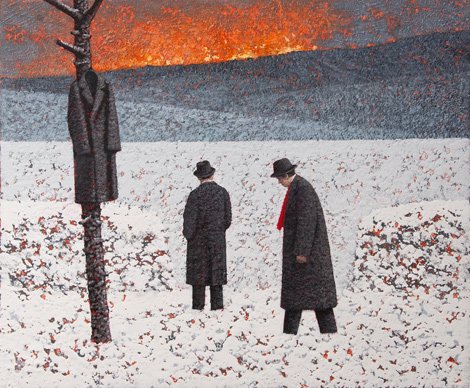

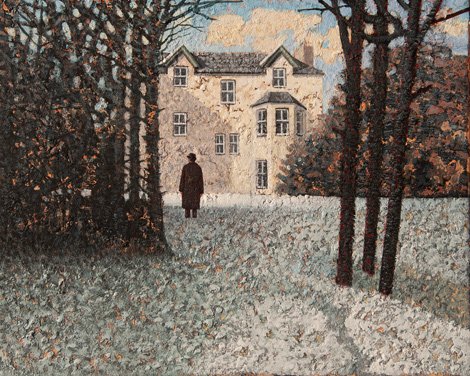
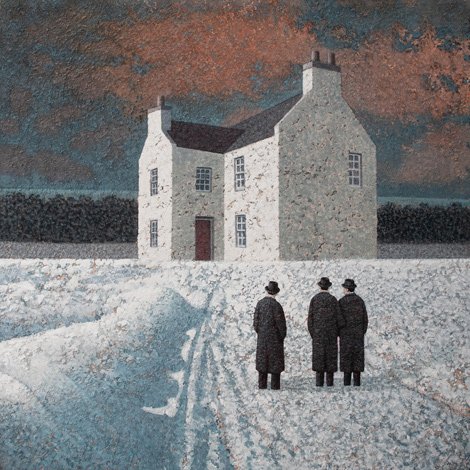
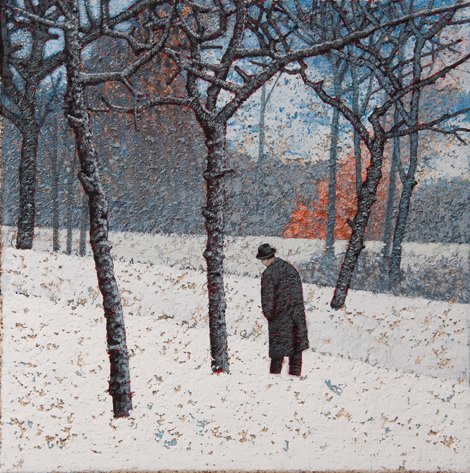

Why? Because the paintings are just the right side of oblique. The mysterious men in their overcoats and bowler hats are never at the centre of the drama. Instead, the action is taking place somewhere else: in that mysterious house or on the train that is disappearing into the distance. The point is that the men are stuck here instead, in a kind of eternal limbo. This limbo might even be self-imposed; titles such as Deciding Not to Go Further and Stopping at the Boundary certainly suggest so.
As you can see, it is possible to go very deep when you start thinking about Mark’s work. However, it should also be pointed out that the artist cares just as much about the composition as he does the “story”. Mark says he sees his figures — like his trees, houses and trains — as “pieces” that can be moved around the canvas until the right effect is achieved. This explains in part why the men often look the same.
“I have come to realise that I have this small repertory of about ten men that reappear constantly in the paintings”, Mark explains. “I used to worry that this was a bit repetitive. But the postures just work. And anyway, they are my paintings so I can do what I like!”
Mark started creating his “white wood” paintings one day in 2007. He had been painting since the 1970s at his remote home in the Scottish Highlands — so remote he had no mains electricity for many years. He was mostly depicting the deer stalkers on the nearby Duke of Westminster estate. He had also earned a living as a book illustrator.
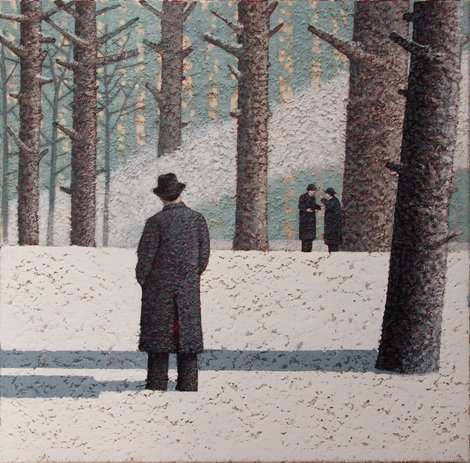
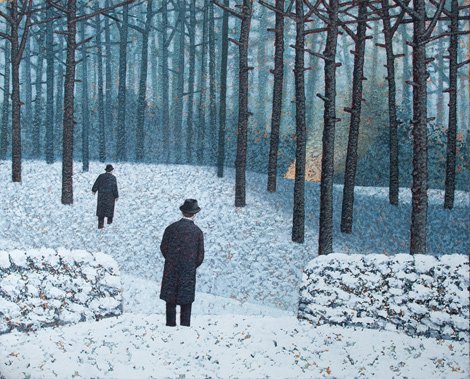
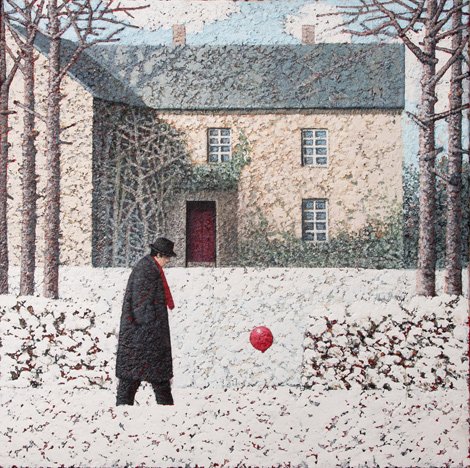
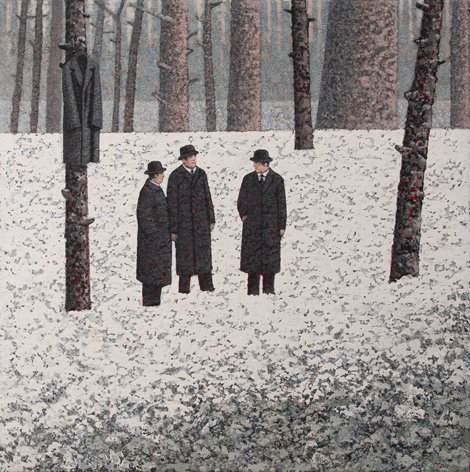
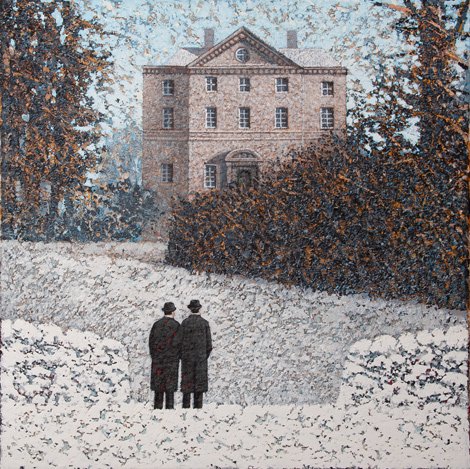

His change of direction was sparked when he saw a 1950s photo of James Dean on a New York street. In the background was a man in a bowler hat. It triggered something. Mark bought some hats and overcoats and ventured into the woods with a few friends to try out some compositions. He had found a style that generated untold artistic possibilities. Happily, the public absolutely loved the work.
This new collection adds to Mark’s substantial repertoire. Although the themes are similar to what has gone before, Mark concedes that there is a slightly darker edge this time. “I am aware that there is an ominous quality to some of the paintings”, he says. “Maybe it is the state of the world.”
Interestingly, this oppressive sense even surfaces in the physical quality of the works. “I found myself laying the paint on really thick this time. It was as if I wanted the compositions to be literally heavy”, says Mark. “Anyway, if you buy one, you will certainly get your money’s worth in terms of weight.”
Q: Which painters do you admire and why?
Mark Edwards: “There are too many to choose. But I love the work of Christopher Wood, Mary Newcomb and Hammershøi, and I also get inspired by illustration.”
Q: Where else do you look for inspiration?
Mark Edwards: “I like to browse YouTube for old British black-and-white films featuring bowler-hatted gentlemen. I am always looking out for anything that could be added to the world of the white wood: an old grand house, a figure walking in a long coat and so on.”
Q: Do you paint every day? Are you disciplined?
Mark Edwards: “I am in my beloved studio every day from 9 am to 7 pm, six days a week. If I can get away with it, I might creep down on Sunday too.”
Q: How important is texture to the world you create in your work, and how do you achieve it?
Mark Edwards: “Very important, as it creates depth within the painting. By building up the various layers of colour, I hope to exaggerate the surface of the finished painting. I am usually aiming for random sandpaper!”
Q: What’s on fire?
Mark Edwards: “I do not know! But the flames give me an excuse to use red and suggest something else is happening in this dark wood.”
Q: Do you ever wear an overcoat and bowler hat?
Mark Edwards: “I have three hats. I am one of the men in the wood, so whenever we have heavy snow I am out there with the camera.”
Q: Are the men dead?
Mark Edwards: “Good question! I would say no. But I can imagine some viewers might think they are.”