
In the last few weeks, the Bayeux Tapestry has been talked about everywhere. You’ve probably seen it on the news, front pages of newspapers and scrolled past posts about it on social media. The Bayeux Tapestry documents the Norman conquest of England in 1066, aka the Battle of Hastings from 1064–1066. It’s culturally significant because it gives us an insight into medieval art and what they perceived to be worth documentation. This battle was between William, Duke of Normandy and King Harold II of England.
The tapestry was on display in Bayeux, northern France, and has not been back in England since its assumed creation in the late 11th century. It is currently on display at the British Museum in London, a ‘once in a millennium moment’, before its return to France in July 2027. The first set of tickets sold out; however, more tickets will go on sale on Wednesday 21st October at 10 am, if you’d like a chance to see it!
The Bayeux Tapestry is not actually a tapestry, but a piece of embroidery. A tapestry is woollen fibres woven together using a loom; rather, the piece is woollen thread embroidered onto a linen background. In the 18th century, French historians described the piece as a tapisserie, translated broadly as a ‘decorative wall hanging’; however, this was lost in translation, and the piece is known as a tapestry despite the incorrect technicality.
The tapestry measures 68 metres long—which is about seven London buses—and half a metre high. The piece may have been longer, as the end of it appears to have been damaged and repaired, with rumours that more of the tapestry may be missing or lost. It is made of nine linen panels that would have been embroidered separately, then stitched together, each of them varying in length, with 58 scenes in total. The woollen threads would have been dyed with natural substances, like the madder, woad and weld plants to make the primary colours, where iron would be used for darker colours and depth.
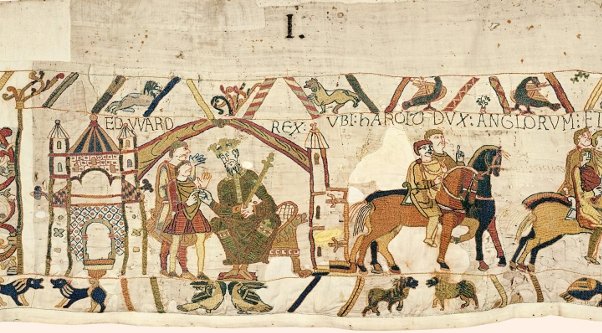
The main section of the tapestry is called the ‘central frieze’. This section is horizontal and is mostly chronological; however, there are some flashbacks and slips in time. The characters here are displayed with vigour and personality, with contemporary comparisons to comic books. Trees that are embroidered in a curvy and twisty fashion serve as breaks within the narrative.
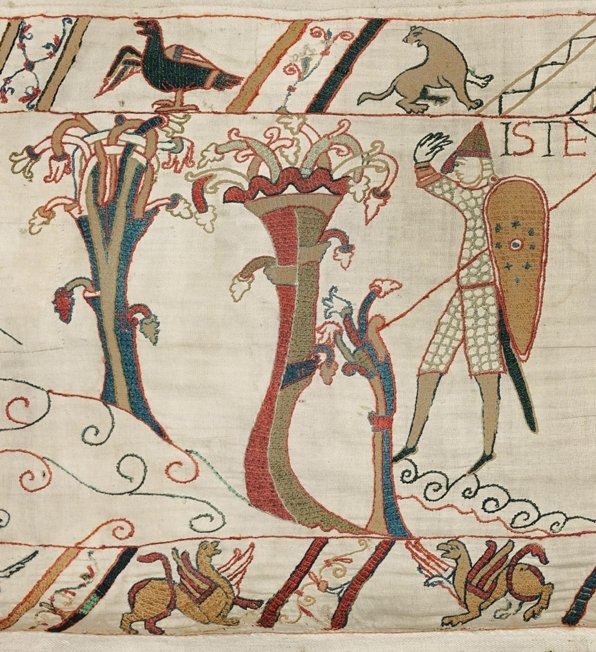
Short Latin captions are woven throughout to help observers understand what is happening, although they are vague and don’t give much away. It allows us to believe that the piece was intended to be enigmatic and elusive in its creation, where historians have to use other documentary sources to infer what is happening. Bordering the central frieze of the tapestry are two sections with decorative motifs which depict mythological creatures and animals, while there are also mini cartoons of action that loosely relate to what is going on.
But what is actually happening in the tapestry, and what is it about?
At the beginning of the tapestry in 1064, we see Harold Godwinson, the Earl of Wessex, meeting with Edward, King of England, who was his brother-in-law. Edward was without an heir, so there was a strong desire for his throne. King Edward sent Harold to France, where he met with William, the Duke of Normandy. It is unclear exactly what this meeting was for, but the embroidery shows Harold making an oath to William. There is no evidence declaring what this oath was, with many speculating it was a declaration of his loyalty to William or perhaps a promise for William to take the English throne; it is ambiguous.
Earl Harold returns home to England and meets with King Edward. The next scene is Edward’s funeral in Westminster Abbey on 5th January 1066. Later we see Harold is crowned King; his new title is Harold II, King of England. Halley’s Comet is seen in the top border of this image, which was supposed to bode bad luck, foreshadowing the battle to come, further supported by the boats sewn in the lower border beneath this scene.
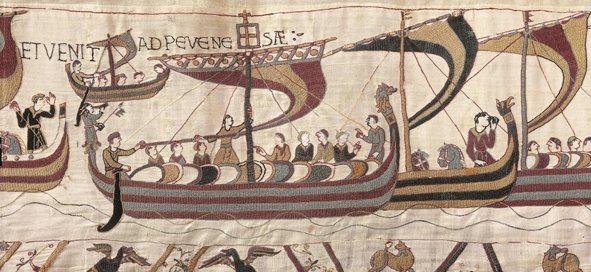
William hears the news of Harold’s coronation and talks to his half-brother, Odo, Bishop of Bayeux (what they discussed is unclear). William declares travel to England; the French troops set off in boats with weapons and wine, arriving in Pevensey, southern England. Atop William’s boat was the Pope’s banner, signifying the blessing of the Pope.
However, in England, Harold had been waiting for William to arrive. While he was waiting, Harald Hardrada, King of Norway, and Tostig Godwinson (King Harold’s younger brother) were working together to take over England. This part isn’t included in the tapestry. They defeated the Earls of Northumbria and Mercia at the Battle of Fulford on 20th September that year. Harold’s militia had to take a break to harvest crops, making the King appear weak. With a smaller army, he marched to York in four days and surprised the invaders, killing both Hardrada and his own brother at the Battle of Stamford Bridge.
In this time, William arrived in England and his army were pillaging Hastings, which is where the story resumes on the tapestry. They were dining on the livestock they killed upon their arrival and making forts. William hears the news from a messenger that Harold has been in battle and declares that they are to set off and find him, inciting a battle of their own.
The tapestry becomes busier with horses galloping and men in armour, until they meet with the English troops. Dead bodies litter the floor, and arrows fly forwards, landing in English shields. Swords and arms are up high, archers pulling back their bows. The vigour and animation of this scene give us an insight into how loud, dangerous and chaotic the battle would have been.
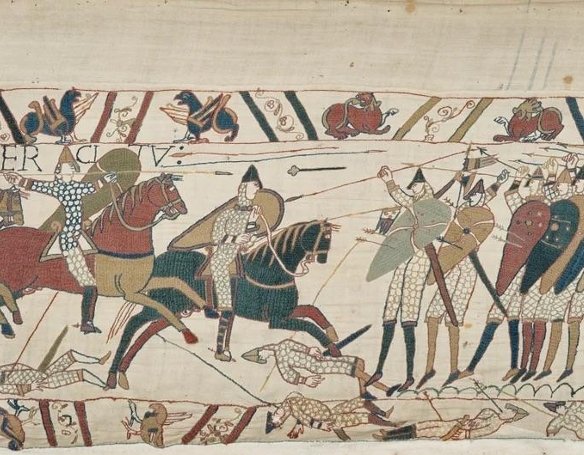
As the scene progresses, we see the English falling; two of Harold’s brothers are killed, leaving him without an heir. As the battle continues, the fate of the English is slowly sealed, with more bodies littering the bottom of the piece and Normans stabbing the English. Moments later, King Harold of England is killed; the French have won the battle. In the lower border we can see cut-up bodies and detached heads, where we can infer the gore left behind.
The tapestry ends abruptly where we see the English fleeing. Many assume a final scene of William’s coronation was part of the tapestry but damaged, while others think it wasn’t completed. William was renamed from the Duke of Normandy to King William I of England, aka William the Conqueror. It is important to note that although it is unclear who made the tapestry, it did serve as a piece of historic propaganda. Winners often write history, and the omission of Harold’s battle on English soil before the battle with France, along with the inclusion of Halley’s Comet after Harold’s coronation, highlights the bias. It is believed that William’s half-brother, Odo, the Bishop of Bayeux, commissioned the piece, meaning it would have been made within 20 years of the battle, definitely before the close of the 11th century.
Where was the tapestry made?
It is unknown exactly where it was made, but from many years of research, scholars found clues within comparisons of the embroidery style of the time. There were links between the piece and manuscripts that were held in the monastic libraries of Canterbury from a similar time. Comparisons were drawn between images in the 11th-century Old English Hexateuch and the Harley Psalter, due to the shape of the human form woven in the tapestry and the curvy trees.
Due to this, scholars believe whoever created the tapestry would have had these 11th-century sources as inspiration, most likely linking them to creation in England. While the captions are written in Latin, the forms of the letters and spelling portray an English hand rather than a Norman. Embroidery was a respected job for women in Anglo-Saxon England, so it is believed that women would have professionally created the piece.
The tapestry has been in Bayeux from at least the 15th century, where an inventory from 1476 recalls it being hung in Bayeux Cathedral. The cathedral’s crypt, where the tapestry is believed to have been stored, dates back to the 11th century, with medieval paintings and architecture. Despite the damage of markings, holes and missing pieces, the tapestry has survived almost 1,000 years, which is remarkable in itself. From it, we gain a greater understanding of how medieval narratives were told and documented, the tools they used and how these tales were respected.