
School shootings are often described by the media as singular eruptions of violence that momentarily fracture public life before disappearing back into political deadlock. The focus is usually placed on the instantaneous horror — the death toll, the shooter, the blunders of law enforcement and the debate over gun control that follows.
Yet this framing obscures the long-term rebuilding of how young people fathom safety, societal response and the future. What was once perceived as an unimaginable cataclysm has, for many students, become a permanent part of modern-day life.
This is what differentiates school shootings from other forms of violence. Their virus lies not solely in physical destruction, but in psychological permanence; it plants itself into routines and childhoods.
A generation raised alongside violence
In the United States, firearms are now one of the leading causes of death for children and teenagers. Every day, 12 children die from gun violence, while dozens more are injured. Since the Columbine High School massacre in 1999, more than 390,000 students have experienced gun violence at school.
For previous generations, schools symbolised predictability — places associated with structure, learning and protection. For many young Americans today, however, schools exist within an atmosphere of conditional security. Lockdown drills, emergency alerts and active-shooter protocols are no longer unusual protocols. They are the muscle memory of education itself.
Research conducted by institutions including Stanford University has linked school shootings and exposure to gun violence with enhanced rates of PTSD, anxiety and depression. Students exposed to shootings often experience a decline in academic achievement and memory difficulties.
The infrastructure of fear
Active-shooter drills were launched into schools following the 1999 massacre and have since become embedded across much of the American education system. Today, at least 37 states require some form of lockdown or intruder-response exercise.
Studies suggest that up to one-third of students report feeling terrified during lockdown drills. In some cases, schools have applied hyper-realistic simulations involving fake blood, simulated gunfire or role-played intruders. While supporters argue that such exercises improve preparedness for the inevitable reality, critics question whether repeatedly rehearsing massacre scenarios fundamentally alters a child’s perception of normal life.
The architecture of schools indicates this alteration. Security cameras, armed officers and emergency notification systems have become increasingly common, offering immediate on-site protection and the ability to neutralise an active shooter.
Yet despite this expansion of surveillance and security infrastructure, attacks continue to occur in schools of every size, location and demographic.
The warning signs we continue to ignore
Studies carried out by the US Secret Service National Threat Assessment Center found that the majority of attackers revealed concerning behaviour before carrying out violence. Almost all mass school shooters shared threatening messages, violent interests or observable warning signs before the attacks occurred.
Nonetheless, the research repeatedly stresses that there is no singular “type” of school shooter. Attackers vary widely in race, age, social background and psychological presentation.
Bullying, social isolation, unstable home environments and easy access to firearms frequently intersect rather than function independently. Violence rarely materialises out of nowhere like a rabbit out of a top hat. As security expert Gavin de Becker argued, “people don’t just snap”. The process is often gradual, visible and ignored until the warning signs appear obvious.
The Columbine massacre established this as, prior to the attack, Eric Harris recorded videos discussing the violence they intended to commit weeks before entering the school.
From tragedy to cultural memory
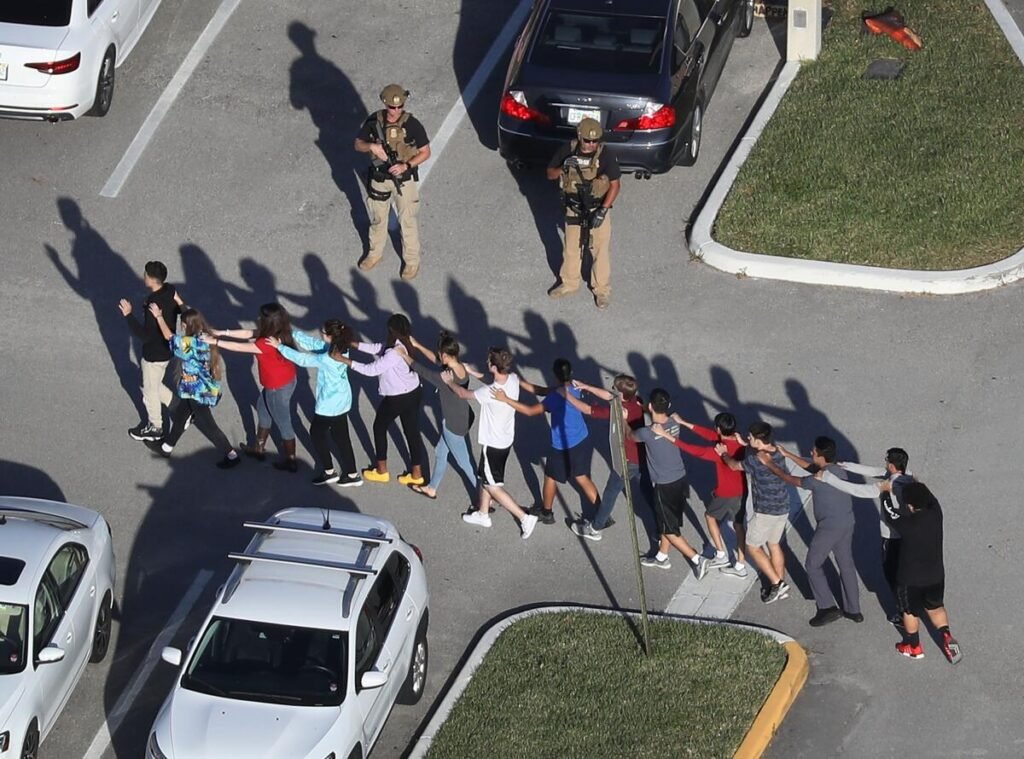
The massacre transformed school shootings into a recognisable social phenomenon. Images of armed students, televised evacuations and rolling news coverage became permanently fixed within American cultural memory.
Researchers studying media contagion effects have argued that extensive coverage of mass shootings can unintentionally contribute to imitation. Detailed reporting, public fascination with perpetrators and the circulation of manifestos may grant attackers a form of fame capable of creating a chain of copycat crimes.
This is why campaigns such as “Don’t Name Them” have emerged, encouraging media organisations to minimise focus on perpetrators and reduce sensationalism surrounding attacks.
The burden carried beyond survivors
Teachers, parents and emergency responders often experience forms of collective trauma that continue for years. Survivors frequently describe persistent fear and distrust long after public attention disappears.
One student interviewed by the BBC after surviving two separate mass shootings, described moving across the country to escape the psychological weight of violence, only to realise that the fear itself had followed her.
“It’s an epidemic that touches every single community”, she explained.
The cost of normalisation
The warning signs are visible not only in recurring attacks, but in the systems built around anticipating them.
They have transformed the meaning of safety for an entire generation — teaching young people that violence can emerge inside the very institutions designed to protect them.
The tragedy is not only that children continue to die. It is that millions more are learning to grow up expecting that they might.