

There are few stories Hollywood laps up more than the myth of reinvention. Every year, the same well-worn narrative is dolled up once more in louder soundtracks, larger budgets and glistening visual effects, each promising to curate a better film than the last. Yet somewhere between endless franchise sequels, the concept of retelling has become hollow, more concerned with recognisable intellectual property than the timeless original ideas that made those stories worth reliving. Christopher Nolan’s The Odyssey arrives as both participant and protest. Adapting Homer’s Greek epic through tactical realism with a reported $250 million budget and becoming the first feature film shot entirely on IMAX 70mm cameras, Nolan does not merely resurrect one of literature’s oldest adventures; he reminds modern cinema where many of its greatest stories began.
Many of you reading this probably are familiar with this classic, but for those of you who are unfamiliar, here is a quick reminder of everything you need to know: one) Odysseus, the king of Ithaca, is followed in The Odyssey as he battles to return home following the ten-year Trojan War. He meets characters like Calypso, Polyphemus, Circe and the Sirens on his ten-year voyage across the Aegean and Mediterranean. His wife Penelope and son Telemachus fend off over 100 suitors vying for her hand in marriage while his crew perishes and he is thought to be dead. two) Nolan’s cinematic adaptation is 172 minutes long, although Homer’s epic is broken into 24 books. After Oppenheimer, which lasted precisely three hours, this is the director’s second-longest picture. three) One of the elements of Greek mythology that is brought up throughout the entirety of the film is Zeus’s law—which is essentially the Greek law of hospitality—requiring hosts to give food, drink and shelter to any traveller or stranger before asking who they are.
Long before audiences entered the cinema, debate surrounded the production: historians questioned the historical accuracy of the armour and ship designs, critics challenged the decision to cast predominantly non-Greek actors and the use of contemporary English with unmistakably American accents as “unrealistic” and “detracting from important aspects of the story”, while social media dismissed the project as another example of Hollywood polishing ancient history for commercial appeal. Nolan dismissively responded to the criticism, arguing that “These conversations that happen before people see the film… they’re always irrelevant, because no one having them knows what the film actually is yet”.
For those acquainted with Nolan’s filmography, The Odyssey feels preordained. The director has spent the last two decades chipping away at the same recurring motifs, used as a means to intrigue and confuse the audience by waving small clues in the audience’s faces. For example, fractured memory in Memento, identity in The Prestige, the elasticity of time in Interstellar and the burden of extraordinary intellect in Oppenheimer. Homer simply provides the blueprint those films have been quietly tracing all along. Amy Nicholson described the film as “a mighty Trojan horse of [Nolan]’s thematic obsessions”, arguing that he “cuts and rejiggers Homer… to transform the classical texts into his type of tale: one fixated on memory, self-identity, destructive genius and the slippage of time”. Rather than abandoning his signature style for classical mythology, Nolan discovers that mythology has always been the missing puzzle piece.
Where many blockbuster filmmakers construct fantasy through plenty of digital techniques, namely computer-generated imagery (CGI) and colour grading, Nolan pursues belief through physical reality. “If you can believe in it, relate to the textures of everyday life, you’re taking the audience on a more extreme journey”, he has argued, and The Odyssey becomes perhaps the purest expression of that philosophy yet. Nolan aimed to espouse the “physicality of the real world” by filming on locations like Italy, Morocco and Iceland to help inform the storytelling and capture “how hard those journeys would have been for people. And the leap of faith that was being made in an unmapped, uncharted world”.
One of the most standout scenes of the whole movie, which had the entire audience on the edge of their seats, was the hiding scene inside the 40-foot, sandy-toned Trojan horse, which instigated the opening of the gates of Troy, enabling the Greeks to conquer Troy and win the war. Something that stood out, besides the tight, claustrophobic interior shots, was the visceral soundscapes—a kind of sound design that uses suppressed breathing, the creak of wood and muffled outside noise—in order to maximise tension as it immerses the audience into the scene so we, like the actors, feel like we’re going to get caught.
“At the end of the day, it was like, cramming into a horse with all these guys and with Chris and with Hoyte van Hoytema, who was operating the camera”, Damon said in an interview with On Film KM. “And they shut the door of the horse, they seal us in and we just start getting all the shots that we need. It’s about him and Hoyte understanding visually what that is, what the moment is and what exactly he wants to capture to tell the story”.
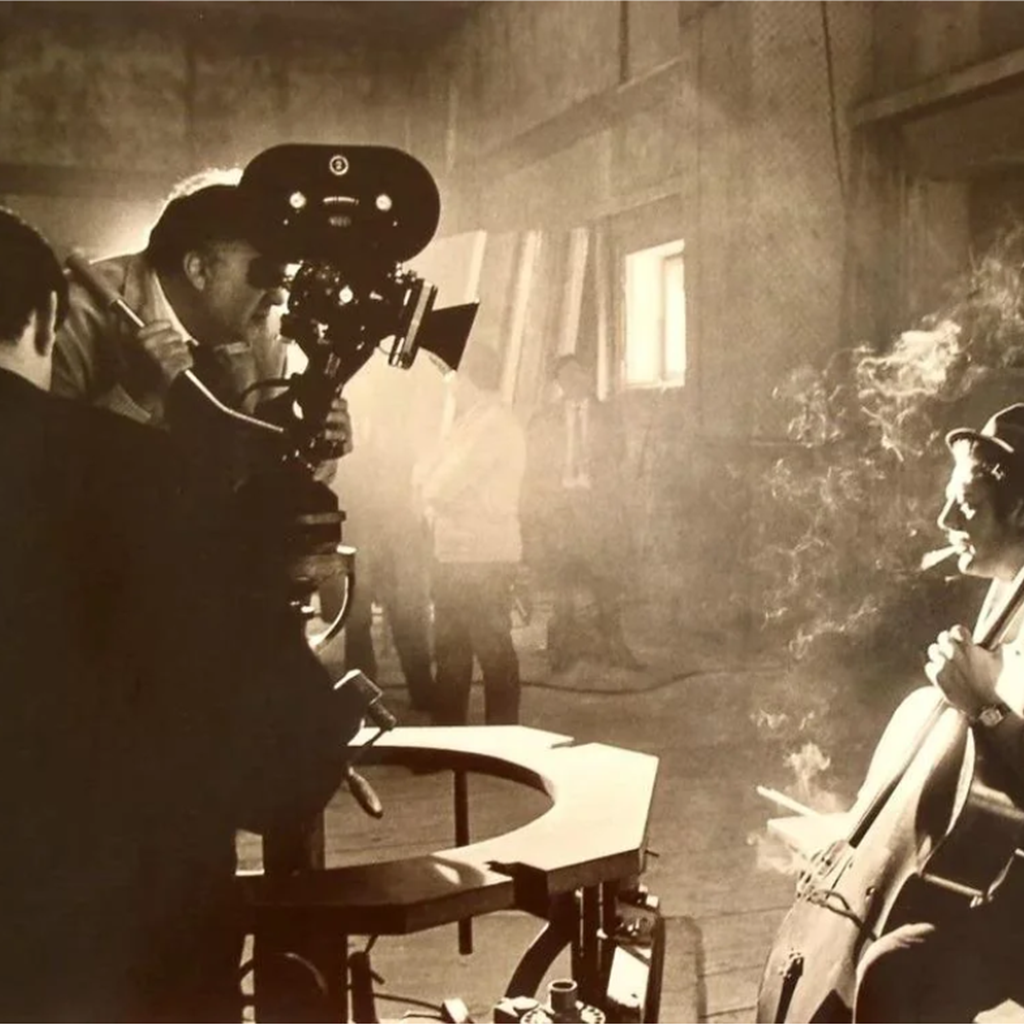
It is precisely this devotion to create a raw cinematic experience that separates Nolan from many of his contemporaries. The decision to shoot the entire film using newly engineered IMAX 70mm cameras is not “technological showboating”, but an extension of his view that storytelling should be both intellectually and visually compelling. “There’s nothing more dispiriting when you turn up to work and there’s just a green screen—the magic is not there”, said Nolan in an interview with Studiobinder. The cameras could record only around three minutes of footage before requiring a reload, which forced actors to pause during emotional performances while technicians hurried to replace the 15/70 film. Dialogue scenes demanded enormous soundproof “blimps” to stifle the sound of the cameras, while an intricate mirror system allowed performers to maintain eye contact despite the equipment being so close to them. Tom Holland, who plays Telemachus, likened the camera department to “a Formula 1 pit crew”, watching “excellence unfolding in front of you”.
In an industry gradually more satisfied with safe repetition, The Odyssey stands as a reminder that cinema, in the hands of an unyielding auteur like Nolan, can still feel like an expedition into uncharted waters.