
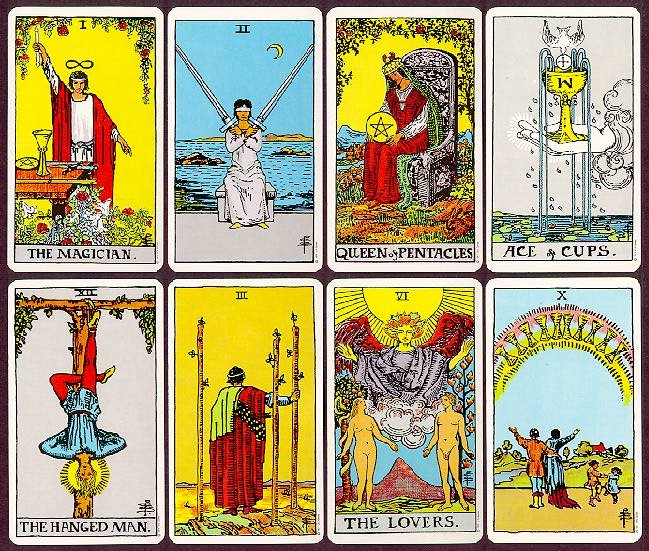
“It’s bad,” I look to Cerys in the most deadpan way, “No, I know it’s bad because I’ve started getting those Tarot card readings on my For You page, and now I watch the full thing.”
She looks at me, amused, “Yeah, you’re done.”
It’s how they get you.
In your most vulnerable moments when life feels like it’s turned to shit, or the person you’re desperately obsessed with becomes a recluse, you feel like shattering into a thousand pieces. Then, as you’re itching with desperation, looking for a sign, a middle-aged woman with twenty earrings and a feather in her hair appears on your screen. She tells you, “your avoidant misses you”, “the ace of cups is telling me you’re about to get an important message from someone”, “your moon being in Saturn is going to change your luck” and “if this message is on your for you page, it’s meant for you.”
Then you indulge, taking a bite from this forbidden and strange goblin fruit like Rossetti’s curious Laura, only to be trapped in an endless hunger for more self-affirming prophecies and open-ended predictions from strangers on the internet. Feasting on their validation with wide, dry eyes and anxiety-bitten lips :
“I ate and ate my fill,
Yet my mouth waters still”
Or so I’ve heard.
It made me think, what is this strong relationship with women and tarot? How has the internet distorted our understanding of a formerly community-based practice and turned it into an algorithm piggy bank?
Widespread Witchcraft
A while ago, when I was a teenager, I came across a religious prophecy in a Muslim scholarly piece. It said one of the signs of the end times was witnessing a widespread practice of witchcraft.
This made me scoff a little because we were currently living in a society where religion felt like it was on a decline. Most Christians in England weren’t practising or heavily spiritual. The idea that the population would be practising magic in the Western world, and not in some jungle in Kashmir, like I would hear my father talk about in my bedtime stories, was so utterly ridiculous to me (yes, I can see how postcolonists would find my teenage interpretations of spiritual practices a little concerning). However, growing up in London, the concept of believing in the supernatural beyond the age of 12 was something that made you a tin foil-esque figure in the classroom.
That has severely changed now.
It started as a joke with your friends:
When he starts messing up and acting awful after two weeks, you have to “make a voodoo doll with his chest hairs and burn it with a lighter under the fourth full moon of the year, to put him back in place”. Comedically ridiculous jargon that amuses us, because its ridiculous desperation in itself is a joke.
“A curse on his family” when he misses a date, you insist; yet you’re aware he’s just another bisexual, latte-drinking, tote-bag-wearing, Sartre-reading non-threat who has communication issues.
However, I don’t think it’s a joke anymore. Looking at some of the videos that come up on my For You page, the tarot reading and the spell-making tutorials aren’t simply musings but a real lifeline targeted to women who feel they need magic or prophecies to deal with their anxiety, depression and obsessive disordered behaviour, especially in regards to their personal relationships. These videos rack up millions of likes and views, and they’re a magnet for specifically these women navigating murky waters.
I want to examine why these videos are so popular now, and also explain why I think they’re conclusively harmful for us as a collective.
The Art of Meaningful Superstition and Spirituality
I’m not here to burn the witches. I think that spirituality and superstition are beautiful, rich historical concepts that have been woven into generations of culture and faith — a cornerstone for community.
Fatik Mandal explains it best as something “religious, cultural and personal” that demonstrates “cultural evolution and environmental psychology”. Spirituality and superstition showcase the habit formation of our species.
Superstition is also a necessary collective practice in effective storytelling because it passes down wisdom and modes of interpersonal thinking from different countries, sometimes foreshadowing a narrative arc in literature figuratively.
One of my favourite superstitions comes from Wide Sargasso Sea where the protagonist Antoinette shares how she feels her life was always bound to go wrong since she disobeyed her wet nurse as a child, by “sleeping in the moonlight for too long”. At the height of her psychological pain and dissonance, when she feels emotionally destroyed by her lover’s indifference, her ambiguous sense of belonging in Jamaica, and her inability to feel understood by anything around her, she simply makes sense of it by pondering whether, by sleeping under moonlight, perhaps she had driven herself crazy, due to its lunar effect.
How beautiful and unfortunate was this Creole superstition to me. How quaint it was to realise her innocent rest and desire to be closer to what she admired inevitably drove her crazy in both a figurative and literal sense, through the moon and her lover. Superstition to me was moving and so powerful in this regard.
Similarly, The Coffee Cup Reader by Nizar Qabbani left an effect on me, as the cup reader’s words “trembled in the air like an omen”; a man felt his heart drop at the sound of hearing love yet being told he will never hold it. All because of the grains of his coffee.
Is Tarot real spirituality? A historic deep dive.
John Last has written a very interesting article about the history of Tarot, looking at the original Visconti-Sforza decks as the earliest modern blueprint coming from Italy. In summary, despite popular misbelief that Tarot cards are from a Roma spiritual background, they were actually a popular country-card game commissioned by rich aristocrats in the height of Renaissance Italy. When wealthy courts began accessing ancient texts, and scholars were peaking in their bookish endeavours, Tarot emerged, and so the symbolism of the cards could just be reflecting the earnest scriptural fascinations of that era.
The Community They Create, that TikTok Desecrates
Yet, the point of doing Tarot readings with your friends (shoutout to Ania) is that the hours of flurry and fun create an opportunity for community. A piece by Socio-Health looks at how women have been more historically religiously socialised, and so they were deemed as having guardianship and integration of domestic spirituality. Some of their safest spaces and opportunities for community building have existed through spiritual practices built by and for them generationally. Therefore, these practices have strengthened female solidarity and visibility through their international transfer of knowledge, as well as an assertion of autonomy and authority in this collective domestic sphere.
And so when Tarot comes to us now in the form of a random video based on an algorithm created to profit on your attention, this removes all the healthy, life-building elements of spiritual activities like Tarot. Without the community, it sort of strips the practice of any meaning and just leaves you with the sad bits that aren’t really individually tailored to your interaction with it.
Distorting the Narrative to Control the Uncontrollable
In Last’s article, he compares the old uses for Tarot with the new modern surge of interest. He makes an excellent point to quote researcher Helen Farley, who claims that Tarot is “simply a mirror of society”.
When looking at the definition of magical practice and superstition, I kept seeing the word “uncertainty”. We are living in uncertain times. Whether with jobs, technology or people. I think the communication between men and women, especially, is so uncertain; their desires and failures (a whole article on its own) reach irreconcilable differences.
So what is easier to do? To believe in Tarot. To see a video of someone telling you you are loved and you are remembered, because you can control that narrative. You can claim to have closure you don’t have in reality. Yeah, some of the predictions may be right, but that video went to thousands of screens; probability-wise, someone was going to relate.
Last mentions how Jung analysed Tarot’s influence as being down to its “psychological images” and symbols because they’re impactful. However, I think it’s growing online because a lot of women are experiencing similar circumstances due to the socio-economic nature of our lives. Therefore, the meanings we get from a stranger online can sometimes provide a more superficial, easy band-aid than the digging we would have to otherwise do within ourselves to find a solution.
Tarot is important because community is important. But don’t believe your fate is on a screen, we’ve already given too much of our lives away to algorithms, we can’t let them literally decide our futures as well.