
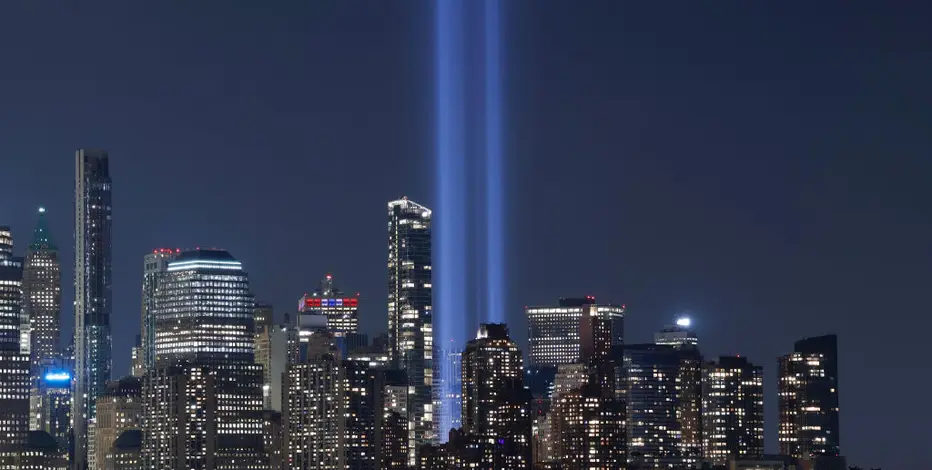
When people think of 9/11, their minds instantly jump to the smoke cascading from the Twin Towers as the buildings crash to the ground—turning into mere specks of dust as the screams of its victims echo for the whole world to hear.
For others, it became an event that defined a generation of foreign security and intelligence policy.
The morning that changed the trajectory of America forever
It was a clear, crisp morning on America’s East Coast when, at 8:46 am, American Airlines Flight 11 crashed into the North Tower of the World Trade Center. Seventeen minutes later, United Airlines Flight 175 struck the South Tower.
Then came the Pentagon. American Airlines Flight 77 crashed into the building at 9:37 am, killing everyone aboard and people inside. Less than 30 minutes later, United Airlines Flight 93 crashed near Shanksville, Pennsylvania, after passengers attempted to regain control.
They were parents, children, colleagues, students and strangers who happened to be in the wrong place at the wrong time. The victims came from 27 states and parts of Europe. Nearly 3,000 children lost a parent.
George W. Bush was visiting Emma E. Booker Elementary School in Florida when he was informed: “A second plane hit the second tower. America is under attack.”
Nine days later, Bush declared the “War on Terror”—the invasion into Afghanistan targeting al-Qaeda and removing the Taliban regime that protected them.
The evidence hiding underneath the rubble
The National Institute of Standards and Technology (NIST) launched an investigation looking into the collapse of the World Trade Center buildings, largely thanks to Congress passing, and the President signing into law, the National Construction Safety Team Act of 2002.
NIST unveiled through extensive examination of design and structural steel components that three factors, if dealt with better, could have reduced the tragedy experienced on 9/11.
Firstly, NIST made 31 proposals to upgrade building and fire safety, which has led to updates in US codes and standards covering structural integrity, fire resistance, evacuation and emergency communications. NIST’s testing of WTC steel aided developments in the standards of fire-resistant steel, which can give inhabitants more time to flee during a fire.
Secondly, there was DNA identification. Identification was difficult due to intense heat, moisture and decay, which gravely deteriorated DNA. NIST and its partners developed shorter DNA markers, or “mini-markers”, that were more likely to survive degradation. This helped identify thousands of remains and led to forensic techniques now routinely used to solve crimes such as sexual assaults and homicides.
Thirdly, more than 400 first responders died on 9/11, exposing major weaknesses in public safety communications. In response, NIST expanded its research and helped establish FirstNet, a nationwide broadband network dedicated to first responder communications. Its work has since improved radio interoperability and modernised emergency communication technology.
This matters because institutions can make mistakes, governments can conceal information and investigations can be incomplete. But scepticism only becomes significant when it is willing to follow evidence wherever it leads.
The failures before the attack
Many assume that the United States was unaware of al-Qaeda before September 2001. However, al-Qaeda had already declared it was in a state of war with the United States. Bin Laden did so in 1998, stating that the murder of “the Americans and their allies—civilian and military—is an individual duty for every Muslim who can do it in any country in which it is possible to do it.”
George Tenet, the Director of Central Intelligence at the time of the attacks, recognised this state of war, noting: “Even before September 2001, we knew we faced a foe that is committed, resilient and has operational depth. The Intelligence Community was already at war with al-Qaeda.”
The 9/11 Commission report published in 2004 described the failures in four words: “imagination, policy, capabilities and management”. According to the report, the CIA and FBI did not adequately evaluate intelligence, exchange information or take any action to prevent the plot from unfolding.
Al-Qaeda did not act on impulse
Khalid—arguably the driving force behind the 9/11 operation—claims to have learned from the 1993 World Trade Center bombing that using aircraft might circumvent ground protection, making it a more effective and less complex form of attack than traditional bombing techniques.
As a result, the al-Qaeda leadership was free to select the targets it desired, mostly dictated by the “statement” it wanted to convey through the acts of violence. The World Trade Center is regarded as a symbol of American economic power, the Pentagon as a symbol of American military might, the US Capitol as a symbol of American policy towards Israel and the White House as a symbol of overall American political power.
The hijackers established a comprehensive view of the procedures at all the airports and the security loopholes that existed by acquiring airline timetables, Western aviation magazines and searching for US flight schools to train the pilots.
At this early stage in the planning process, it was crucial to be familiar with the enemy’s tactics and to give the suicide operatives the fundamental abilities and information they would need to operate in a hostile and unknown environment.
One of the suicide operatives, Khallad, conducted intelligence-gathering missions. In January 2000, he flew first class from Bangkok to Hong Kong on a US airline to evaluate security. He found that he could not see the cockpit from his seat and tested airport security by carrying a box cutter in his toiletries bag and removing it from his carry-on without attracting staff attention.
The hijackers were able to achieve their operational targets with confidence by making sure that their precautions were set in place.
Familiarity with the West was therefore highly valued by al-Qaeda leaders when selecting pilots and cell leaders, as it enabled the hijackers to integrate into US society while remaining anonymous. They did this by concealing their identities by adopting Western ways of life—shaving their beards and wearing Western clothing, establishing a suitable cover without raising suspicion.
Post-9/11, al-Qaeda emphasised the mujahidin’s ability to defeat even powerful opponents, portraying the United States as particularly vulnerable to military defeat despite its “great power” status.
When scepticism becomes conspiracy
The most persistent claims suggest the World Trade Center was brought down by controlled demolition, that a missile struck the Pentagon or that the US government had advance knowledge. The phrase “jet fuel cannot melt steel beams” is often cited as proof, but NIST found that aircraft impacts, dislodged fireproofing and intense multi-floor fires weakened the structures until collapse began.
Another conspiracy theory falsely claims that no Jewish people were killed because thousands of Jewish employees were allegedly warned not to work that day. Yet of the 2,071 World Trade Center victims, 119 were confirmed Jewish and at least 72 more were believed to be Jewish—around 9.2%.
Conspiracy theories do not fail because they ask questions, but because they can turn legitimate questions into answers the evidence cannot support.
What we choose to remember
George W. Bush at the time of 9/11 described seeing Americans “grab for a neighbour’s hand and rally to the cause of one another”.
9/11 should be remembered through the failures that preceded it, the people who died, the first responders who ran towards danger, the decisions made afterwards and the evidence gathered in the years that followed.
But remembering does not mean accepting every narrative. And questioning does not mean rejecting every established fact. Instead, it’s about revealing the truth and granting the families who suffered a sense of closure and justice.