
For much of the last decade, Britain’s political affiliation has been defined by instability. We have gone from prime minister to prime minister, each of which arrived with sweeping promises of transformation only to walk into the jaws of crisis, short-term decision making and erosion of public trust. Leadership has become increasingly associated with steering a sinking ship rather than shaping the country’s future.
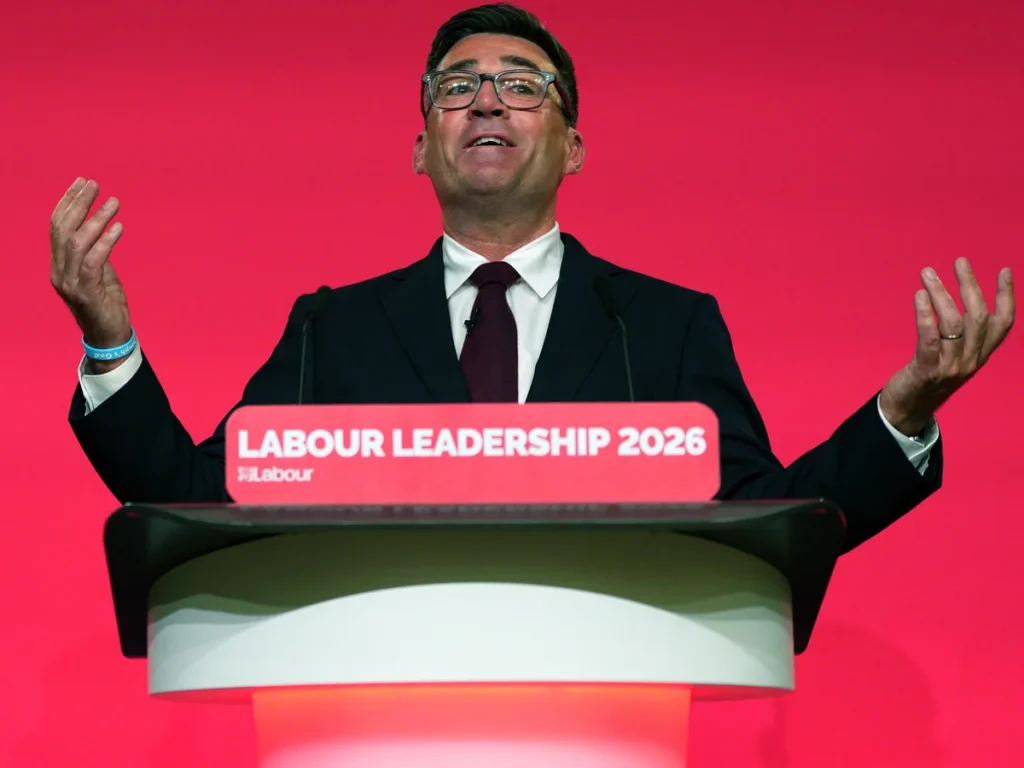
Andy Burnham enters Downing Street attempting to rewrite that narrative.
Unlike many of his predecessors, Burnham has not built his reputation through backroom dealing or ideological conflict. Instead, his political identity was crafted in Greater Manchester, where transport reform, homelessness and regional investment became proof that the government could still better people’s everyday lives. His being prime minister therefore is a test of whether Britain can open the door towards long-term investment and national renewal, rather than the usual dull reactive politics.
Supporters view Burnham as a pragmatic mediator capable of restoring public confidence while rebuilding Britain’s international credibility. Critics, including conservative leader Kemi Badenoch, question whether he is up for the job — “He is behaving like he’s still the mayor of Manchester. He is now the prime minister of the United Kingdom.”
The question, then, is not merely whether Burnham will become a successful Prime Minister. It is whether Britain itself still has the potential to transform as he promises.
The mayor who challenged Westminster
After serving as Health Secretary under Gordon Brown and twice failing to become Labour leader, Burnham’s decision to leave Parliament in 2017 to become Mayor of Greater Manchester appeared, to some, like a crab scuttling back into its shell. Instead, it became the cornerstone of his leadership.
His decision to establish No.10 North in Manchester, which operates out of Heron house, is perhaps the clearest symbol of his belief that problems cannot be solved exclusively from London. Burnham describes it as “the biggest rebalancing of power our country has seen”, insisting that “power, energy, and new ideas are going to flow” through the new office.
Burnham is scheduled to work from No. 10 North every week. Burnham took charge over a meeting of the National Economic Council, a cabinet group that Gordon Brown initially established following the 2008 financial crash. Badenoch has already dismissed the move as a “political gimmick”, adding it “does not make decision-making any better, it’s just creating another branch of the civil service in a different place.”
Liberal Democrat MP Calum Miller told the BBC that No 10 North ought to be “more than just a convenient Friday working from home base for him and other Manchester MPs.”
Miller continued — “He needs to demonstrate it’s more than just that and that this represents something for the whole country — that rural and coastal communities that have been really left behind are actually part of his plan for decentralisation.”
Repairing Britain on home soil
Rather than being hot on the heels of pricey structural reforms, his early decisions indicate an effort to restore confidence through tangible improvements to daily life for the British people. A £340 million commitment to end rough sleeping in England, a reduction in VAT on domestic electricity bills, restoring the £2 cap on bus fares outside London and a 20% cut in business rates for pubs and live music venues all mirror a government prioritising advancements to living standards with a more “social first” approach.
Costing approximately £1.5 billion together, these policies represent around 0.1% of projected government spending for 2026–27, estimated at £1.4 trillion. Consequently, Burnham is striving to illustrate that the government can intervene and improve the lives of overlooked communities. Yet questions over affordability remain. The Office for Budget Responsibility has already indicated that the proposed VAT cut on electricity bills lacks a clear funding mechanism, while economists have warned that several measures rely upon uncertain future spending decisions.
Beyond short-term cost-of-living measures, Burnham has promised to fundamentally reshape Britain’s welfare state. His drive to introduce the largest council house building programme since the post-war period and expand employment and social care support reflects a long-standing belief that the government should tackle the structural causes of inequality rather than merely manage its consequences. Nonetheless, such policies, which may cost several billions of pounds, would probably need to be outlined in future spending reviews and budgets, along with specific proposals for how they would be funded.
Perhaps no policy better exemplifies the actualities of governing than Burnham’s decision to pause the planned early release of prisoners in England and Wales. The scheme which would have seen the release of around 700 prisoners in early September, originally brought in to mitigate severe prison overcrowding, would have allowed thousands of offenders to leave custody earlier while serving the remainder of their sentences under community supervision. Following criticism from victims’ groups — including the family of murdered police officer PC Andrew Harper, who was killed in Berkshire in 2019 when he was hauled by a car down a country road by three teenagers — Burnham ordered a critical re-examination, demanding that “no prisoners will be let out under this policy until we have conducted an urgent review and done everything we can to minimise risk to the public.”
Badenoch said she embraced the pause but demanded that killers and rapists be “permanently” exempt from any future version of the scheme. In a post on X, she stated that the Tories have been “campaigning against this dangerous scheme from day one.”
Burnham’s governing style extends beyond policy into the way he communicates with the public. Rather than relying solely on traditional media, Downing Street has embraced collaborations with social media personalities — “influencers” — in an effort to reach younger audiences who often consume political information through platforms such as TikTok,
Instagram and YouTube. Videos featuring figures including Sir Mo Farah and content creator Max Klymenko illustrate a deliberate attempt to present Burnham as charismatically accessible rather than the stereotypical distant politically-centered PM. For supporters, this reflects an understanding that modern political communication must evolve in order to keep up with evolving media consumption. However, some contend that relying more on influencers runs the risk of coming across as a publicity stunt.
Britain’s influence begins beyond Westminster
In his first major interview, with the BBC, the Prime Minister exemplified the precarious stability necessary for international negotiations. While describing Donald Trump as “really warm” following their initial conversation, Burnham also insisted he would “of course” defy the American president whenever Britain’s national interest required it.
“You have to defend your own national interest before anything else,” he argued.
Burnham also supports building a closer relationship with the European Union and “consolidating the progress made”, remains committed to long-term support for Ukraine and faces immediate decisions concerning defence spending amid growing instability across the Middle East and Eastern Europe, all of which prove that Britain remains a powerful force for democracy on the world stage.
A government struggling to fund housing, social care and transport simultaneously faces growing demands to increase defence spending towards 3% of GDP. The challenge is no longer choosing between domestic priorities and global ambition. It is financing both simultaneously.
Beyond one prime minister
Burnham may ultimately succeed. He may equally discover that Britain’s political traditions and geopolitical pressures make a significant transformation very hard to come by.
The defining question of his time as prime minister is more than whether Burnham can change Britain.
It is whether Britain is finally prepared to change itself.