

how India’s NEET paper leak crisis reshaped education policy
For millions of Indian students, the National Eligibility-cum-Entrance Test (NEET) represents far more than an examination. It is the gateway to a medical career, years of academic sacrifice and, for many families, the promise of economic mobility. In 2026, however, that promise was shattered when India’s National Testing Agency cancelled the examination after investigators uncovered evidence of widespread paper leaks, affecting approximately two million students. What began as an examination scandal quickly escalated into one of the country’s largest youth-led protest movements in decades, ultimately forcing the resignation of Education Minister Dharmendra Pradhan and prompting sweeping reforms to India’s public examination system.
The crisis unfolded after authorities received evidence that organised criminal networks had obtained confidential examination papers before students sat for the NEET examination. According to investigators, leaked question papers were distributed to paying candidates through a coordinated network operating across several Indian states. The scandal immediately raised concerns about the integrity of India’s highly competitive entrance examination system, where a single test determines admission into medical colleges for millions of aspiring doctors. The Central Bureau of Investigation (CBI) was tasked with leading the criminal investigation, pursuing those responsible for obtaining, distributing and profiting from the leaked examination papers while examining whether public officials or testing personnel had facilitated the breach.
As the investigation expanded, the human cost of the scandal became increasingly apparent. Reuters reported that the cancellation of the examination left nearly two million students uncertain about their academic futures after years of preparation and financial investment by their families. The emotional toll proved devastating. The controversy was linked to more than a dozen student suicides, transforming what might have been viewed as an administrative failure into a national tragedy. While authorities have not publicly identified the students or confirmed the individual circumstances surrounding every death, reports of the suicides intensified public anger and highlighted the immense psychological pressure associated with India’s competitive examination system. Parents who had invested significant savings in coaching programmes described feelings of betrayal, while students questioned whether merit alone could determine their futures in a system vulnerable to corruption.
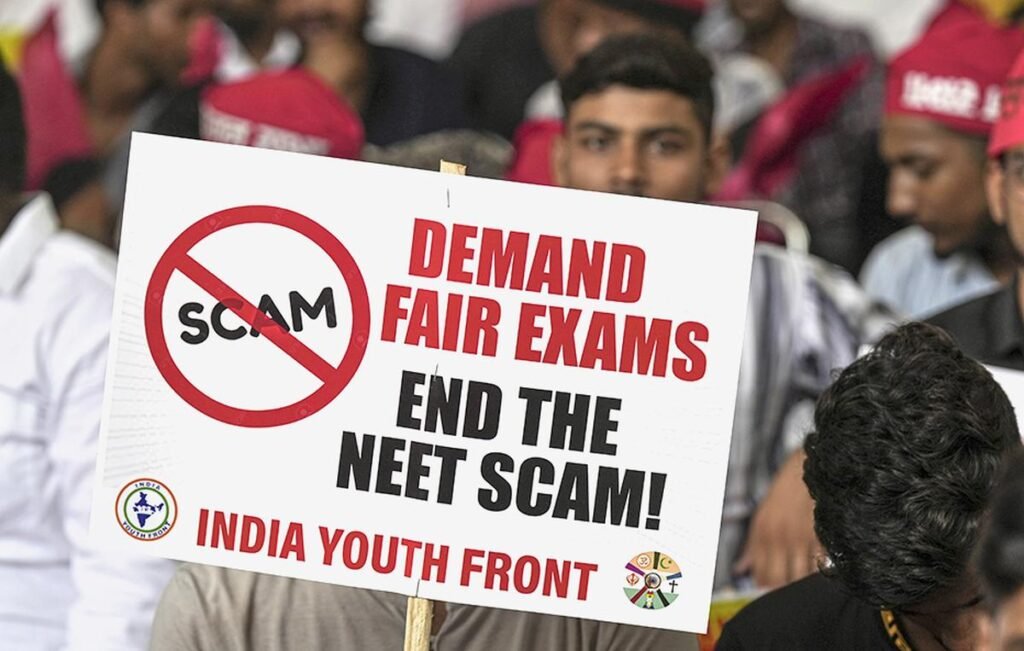
Public frustration soon evolved into organised demonstrations across New Delhi, Mumbai, Bengaluru, Kolkata, Patna and other major cities. Students demanded accountability from the National Testing Agency, criminal prosecution of those responsible for the paper leaks, compensation for affected families and guarantees that future examinations would be conducted securely. Protesters argued that repeated examination irregularities had destroyed public confidence in institutions responsible for ensuring equal opportunity. What distinguished the movement was its focus on institutional reform rather than partisan politics. Demonstrators insisted that the crisis reflected systemic governance failures rather than isolated criminal acts.
One of the movement’s most influential supporters was engineer, education reformer and Ramon Magsaysay Award recipient Sonam Wangchuk. Already recognised internationally for advocating educational innovation in Ladakh, Wangchuk joined the student movement by launching an indefinite hunger strike at Delhi’s Jantar Mantar. His protest soon became a defining symbol of the campaign. Wangchuk demanded the resignation of Education Minister Dharmendra Pradhan, stronger protections for students participating in peaceful demonstrations and comprehensive reforms to India’s examination system. He also insisted that no legal action be taken against peaceful protesters before agreeing to end his fast. As his health deteriorated during the 26-day hunger strike, opposition leaders, education experts and civil society organisations appealed to the government to negotiate with him rather than allow his condition to worsen.
After nearly four weeks without food, Wangchuk ended his hunger strike following discussions with government representatives, who pledged to consider major reforms and review legal action against demonstrators. Although his decision ended one chapter of the movement, nationwide protests continued as students maintained pressure on the government. Demonstrators argued that promises alone would not restore confidence in an examination system that had already failed millions of candidates. The continuation of protests after Wangchuk’s fast illustrated that the movement had grown beyond any single leader and had become a broader campaign demanding accountability throughout India’s education system.
Political pressure intensified after violent confrontations between protesters and police near Parliament in New Delhi drew national attention. Images of students being detained and reports of restrictions on demonstrations generated criticism from human rights organisations and opposition parties, who accused authorities of suppressing peaceful dissent rather than addressing the underlying causes of the crisis. The government initially defended its handling of the scandal, but sustained demonstrations, public sympathy for affected students and growing political pressure eventually forced a dramatic response. On the 25th of July, Education Minister Dharmendra Pradhan resigned, marking one of the most significant political consequences of a youth-led protest movement during Prime Minister Narendra Modi’s tenure.
Following the resignation, the Indian government announced an ambitious package of examination reforms designed to restore public confidence. Prime Minister Modi established a high-powered task force led by technology entrepreneur Nandan Nilekani to recommend long-term improvements to examination security. The government simultaneously introduced amendments to the Public Examinations Act of 2024, proposing significantly tougher penalties for those involved in examination fraud. Under the proposed legislation, the minimum prison sentence for major examination malpractice would increase from three to five years, maximum financial penalties would rise substantially and companies found guilty of facilitating examination fraud would face longer bans from participating in government contracts. Officials also pledged to accelerate the transition toward more secure computer-based examinations and stronger technological safeguards against organised cheating networks.
The impact of the protests extended beyond India’s borders. Governments across South Asia closely monitored the crisis because many neighbouring countries also rely on highly competitive national entrance examinations for university admissions. Education policymakers in countries including Nepal, Bangladesh, Pakistan, and Sri Lanka began reviewing their own examination security measures amid growing concerns that similar vulnerabilities could undermine public confidence. Regional education experts argued that India’s experience demonstrated how examination failures could rapidly escalate into wider governance crises capable of mobilising millions of young people. The protests therefore served as a warning that educational integrity is increasingly viewed as a matter of democratic accountability rather than merely administrative competence.
Globally, the NEET crisis has become a significant case study in the challenges facing standardised testing systems. Universities, policymakers and education researchers have pointed to India’s experience as evidence that large-scale examinations require not only rigorous academic standards but also sophisticated security infrastructure capable of preventing organised fraud. The protests also highlighted the growing political influence of digitally connected student movements, demonstrating how social media can rapidly transform local grievances into nationwide campaigns demanding institutional reform. International observers noted that the crisis reinforced a broader global lesson — public trust in education depends as much on transparency, fairness and accountability as it does on academic excellence.
The NEET paper leak crisis ultimately became far more than an examination scandal. It exposed weaknesses in institutional oversight, devastated families who had invested years preparing for a single opportunity and prompted one of the largest youth-led protest movements in contemporary India. The reported student suicides underscored the severe human consequences of examination failures, while Sonam Wangchuk’s hunger strike transformed public frustration into a national demand for reform. The resignation of the Education Minister and the government’s commitment to strengthening examination laws demonstrated the power of sustained civic activism. Whether these reforms ultimately restore confidence in India’s education system will depend on their implementation, but the movement has already reshaped discussions about educational integrity both regionally and globally, ensuring that the lessons of the NEET crisis will influence education policy far beyond India’s borders.