

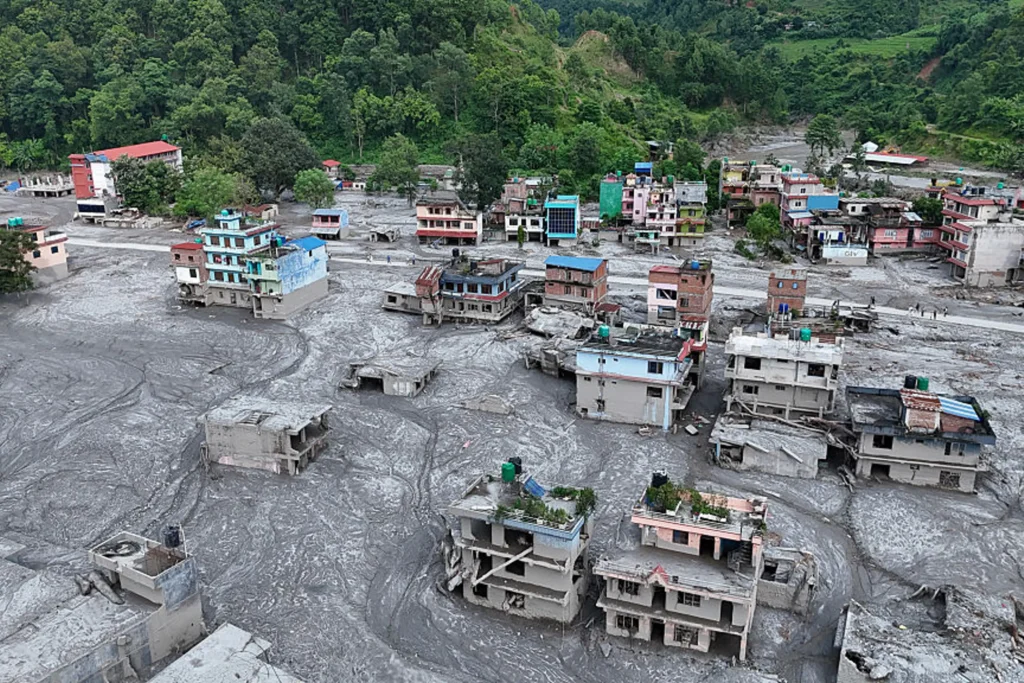
Nearly a week after a wall of ice, rock and mud tore through the Himalayas, Nepal is still digging out from one of its deadliest disasters in a decade. What locals and officials are calling a “Himalayan tsunami” has left more than 1,000 people dead across the Nepal-China border, thousands missing and entire communities erased.
On the morning of 26th August, a massive glacier collapse high in the Langtang region near the Tibet border sent a debris-laden surge crashing into the Lhende and Bhotekoshi rivers. The resulting flash flood roared downstream along the Trishuli River system, sweeping through Rasuwa, Nuwakot, Dhading, Gorkha, Chitwan and other districts. Villages vanished under thick layers of mud. Bridges and roads disappeared. Hydropower plants, critical to Nepal’s energy ambitions, were gutted, their tunnels filled with debris and, in many cases, trapped workers.
By Tuesday 1st September, Nepal’s National Disaster Risk Reduction and Management Authority reported 987 confirmed deaths in the country. Chinese authorities had earlier confirmed 16 deaths in Tibet’s Gyirong County, pushing the combined toll past 1,000. Roughly 3,900 people remain missing in Nepal alone, including about 583 foreign nationals from more than 30 countries. Hundreds more are unaccounted for on the Chinese side. Many of the missing are hydropower workers feared trapped in mud-filled tunnels at a dozen project sites. Bodies have been recovered far downstream, some as far as India, and morgues have been so overwhelmed that authorities have resorted to mass burials of unidentified remains after DNA sampling.
Prime Minister Balendra Shah, whose young government has been in power only about six months, described the human cost in stark terms. “Thousands of citizens have lost their homes, families, loved ones and property,” he said. More than 11,800 people have been rescued so far, with security forces and volunteers still pushing into remote valleys using helicopters, temporary bridges and heavy machinery. Electricity and some communication lines have been restored in parts of the worst-hit areas, including Nuwakot, one of the most devastated districts. Yet about 600 workers remain stranded or trapped at hydropower stations, where rescue teams have pulled out nearly 300 so far.
The scale of destruction is staggering. Preliminary estimates put physical damage in Nepal at over $1.3 billion, with reconstruction costs potentially reaching $4–5 billion. Dozens of bridges and tens of miles of roads are gone. Schools have been destroyed or damaged, leaving thousands of children in need of support. The Red Cross estimates more than 90,000 people have been affected. Survivors speak of walls of freezing water and debris arriving with little warning. One hydropower worker in Rasuwa called his survival pure luck. Families downstream are still searching riverbanks for relatives.
Scientists and officials link the disaster to glacier instability driven by long-term global warming. China’s state media described it as a consequence of climate change on the Tibetan Plateau. Shah has echoed that view, calling on the international community to confront the growing risks facing the Himalayan region and seeking support from global climate funds for loss and damage. Early reports of a magnitude 4.4 earthquake were later revised by the US Geological Survey: the seismic signal came from the collapse itself, not a tectonic quake.
Nepal’s response has been massive and multi-layered. More than 20,000 security personnel—army, police and armed police—have been deployed. Helicopters have flown hundreds of sorties delivering supplies and evacuating the stranded. Temporary bridges built with help from neighbours have reopened access to isolated areas. The government’s Prime Minister’s Disaster Relief Fund has received billions of Nepali rupees from domestic donors, corporations and ordinary citizens, reflecting a strong public response.
International assistance has been swift and wide-ranging. India and China, Nepal’s giant neighbours, have led the effort. India has flown in more than 57 tons of relief materials—tents, blankets, medicines and food—and sent specialised tunnel-rescue and technical teams. China has provided tunnel experts, DNA testing support, drones, water purification equipment and additional supplies. South Korea has deployed a team with drones after several of its nationals went missing at a hydropower site. Australia has committed millions in aid, deployed personnel and is sending supplies via military aircraft. The United States provided an initial $500,000 and a disaster advisor. The United Kingdom pledged millions. Ireland, the UAE, Japan and others have contributed funds or materials.
The United Nations and its agencies moved quickly. The UN released emergency funding (around $2–2.5 million early on), while UNICEF, the World Food Programme, WHO and others assessed needs and delivered supplies. The International Federation of Red Cross and Red Crescent Societies launched an appeal and supported the Nepal Red Cross Society, which has distributed body bags, run shelters, provided water and psychosocial support and assisted search efforts. The World Bank indicated potential emergency financing in the tens of millions of dollars. Overall, Prime Minister Shah said more than $42 million in aid had already flowed into the country, with more expected.
Nepal has welcomed specialised technical help for tunnel rescues, DNA identification, body storage and restoring transport links, while handling the bulk of general search-and-rescue with its own forces. Foreign Minister Shisir Khanal has thanked partners and stressed the need for climate compensation, describing the event as a “Himalayan tsunami” that Nepal did not cause alone. Coordination challenges remain in the remote, unstable terrain, and secondary risks, such as landslide-dammed lakes, have required careful monitoring.
The human stories continue to emerge. Children have been separated from parents. Tourists and guides on popular trekking routes near the border remain among the missing. Downstream communities in Chitwan and Nawalparasi have recovered hundreds of bodies. Relief workers report entire settlements reduced to mud-covered wastelands. Yet there are also notes of resilience: power partially restored, roads reopened in places and communities organising mutual support.
As rescue operations shift towards recovery and reconstruction, the long-term challenges are clear. Rebuilding homes, schools, roads and critical hydropower infrastructure will take years and substantial resources. Nepal is already calling for international climate finance to help. For the families still waiting for news of missing loved ones and for those burying the dead, the immediate focus remains survival and support.
The disaster has underscored the vulnerability of high-mountain communities in a warming world. As one UN official put it earlier in the response, the impact has been immense. Nepal, with the world’s help, is now beginning the long work of healing and rebuilding.