

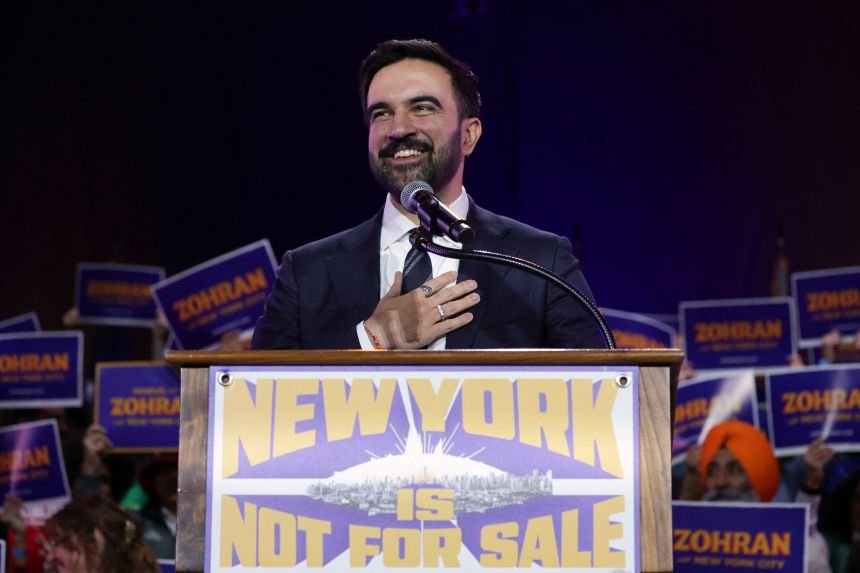
New York City has long been more than just America’s largest city. It has often served as a political testing ground where new ideas are introduced, challenged and sometimes exported across the country. From public health initiatives to policing strategies and housing policies, decisions made in New York frequently influence national conversations. Seven months into the administration of Mayor Zohran Mamdani, the city once again finds itself at the centre of an important political experiment—one that could reshape the direction of the Democratic Party and, potentially, American politics as a whole.
When Mamdani was elected in 2025 and took office on 1 January 2026, he made history in several ways. As the city’s first Muslim mayor, first Indian-American mayor, first Ugandan-American mayor and one of the country’s most prominent democratic socialists, his victory represented a dramatic shift from the city’s traditional political establishment. His campaign focused heavily on affordability, arguing that New York’s biggest challenge was not simply economic growth but ensuring that ordinary residents could afford to live in one of the world’s most expensive cities. His platform included ambitious proposals such as expanding universal childcare, freezing rents for stabilised apartments, opening city-owned grocery stores, increasing taxes on wealthy individuals and corporations, and reforming public transportation.
Now, after seven months in office, the results have been mixed but politically significant. Some of Mamdani’s initiatives have begun moving forward, while others remain tied up by legal, financial and political obstacles. His administration has secured funding to expand childcare services and has begun implementing early childhood education programmes that supporters argue could dramatically reduce costs for working families. Plans for city-owned grocery stores have also advanced, with the first location identified in East Harlem as part of a broader effort to reduce food insecurity in underserved neighbourhoods.
However, governing New York has proven far more complicated than campaigning. Many of Mamdani’s largest promises require approval from the state legislature, cooperation from Governor Kathy Hochul or substantial new sources of revenue. His proposal for fare-free city buses, for example, remains stalled because of funding challenges, while several housing initiatives continue to face negotiations with the City Council and Albany lawmakers. Critics argue that many of his campaign promises exceeded the powers available to a mayor, making implementation far more difficult than originally presented.
Despite these obstacles, Mamdani has managed to maintain relatively solid approval ratings during his first six months. Polling suggests that he continues to enjoy strong support among younger voters, progressives and many residents of Brooklyn and Manhattan, although his approval has softened somewhat as governing realities have replaced campaign enthusiasm. His communication style has played an important role in maintaining public support. Unlike many traditional politicians, Mamdani relies heavily on social media, public events and direct engagement with residents, helping him cultivate an image of accessibility that resonates with younger generations.
One of the most interesting aspects of Mamdani’s administration is how it reflects a broader ideological struggle within the Democratic Party. For years, Democrats have debated whether the party should move towards the political centre to appeal to moderate voters or embrace a more progressive agenda focused on economic inequality, affordable housing, healthcare, labour rights and climate policy. Mamdani has become one of the clearest examples of the latter approach. His victory demonstrated that a candidate openly identifying as a democratic socialist could not only win a major American city but also build a broad coalition around affordability rather than purely cultural or ideological issues.
Whether this model can succeed over the long term remains uncertain. Political opponents argue that many of Mamdani’s policies would require significant tax increases that could drive businesses and wealthy residents away from New York. His administration is already advocating for new taxes on high-income earners and corporations, proposals that have generated sharp criticism from business groups and moderate Democrats alike. Some analysts warn that these policies could create economic risks if implemented too aggressively, particularly as New York continues competing with lower-tax states for investment and jobs.
Supporters see the situation very differently. They argue that New York’s affordability crisis demands bold action rather than incremental reforms. Skyrocketing rents, expensive childcare, rising grocery prices and widening income inequality have left many middle-class and working-class families struggling to remain in the city. In their view, Mamdani’s willingness to challenge conventional economic thinking represents exactly the kind of leadership needed to address problems that have developed over decades. Rather than focusing solely on economic growth, his administration emphasises making the benefits of that growth more widely shared.
The national political implications may ultimately be even more important than the local ones. Across the US, younger Democratic voters increasingly prioritise housing affordability, student debt, healthcare, childcare and wages over some of the traditional issues that dominated previous generations. Mamdani’s campaign successfully framed these concerns as everyday economic struggles rather than abstract ideological debates. If his administration demonstrates measurable improvements in quality of life over the next several years, other progressive candidates may attempt to replicate his approach in major cities across the country.
There are already signs that his influence extends beyond City Hall. Progressive candidates supported by Mamdani performed strongly in recent Democratic primaries, suggesting that his political brand carries weight among left-leaning voters. His endorsements have helped strengthen New York’s progressive movement and could influence congressional races, state elections and eventually national Democratic strategy heading into future presidential campaigns.
At the same time, his administration illustrates the limits of ideological politics when confronted with the realities of governing. Budget constraints, legal challenges, negotiations with Albany and disagreements within the City Council have slowed several signature initiatives. Even supporters acknowledge that campaign promises often collide with institutional barriers that cannot easily be overcome by political popularity alone. This tension between ambitious vision and practical governance may become the defining test of Mamdani’s mayoralty.
For New York itself, the stakes remain exceptionally high. Success could provide a blueprint for tackling affordability in other expensive American cities such as Los Angeles, San Francisco, Boston and Seattle. Failure, on the other hand, could reinforce arguments from moderates that progressive economic policies are politically attractive but difficult to implement effectively.
Seven months is far too early to judge any mayor definitively, especially one pursuing such an ambitious agenda. Yet Mamdani has already changed the political conversation. Instead of debating whether government should play a larger role in reducing living costs, many political leaders are now discussing how such policies could be implemented. That shift alone represents a significant political achievement.
Whether Zohran Mamdani ultimately becomes remembered as a transformative mayor or simply an ambitious reformer facing structural limits will depend on the next several years. What is already clear, however, is that New York once again serves as America’s political laboratory. The success or failure of Mamdani’s experiment will likely influence not only the future of New York City but also the direction of progressive politics across the US for years to come.