
For generations, communism has been debated as though it existed in two separate worlds. In one, it is an ambitious philosophy — a vision of equality, collective ownership and emancipation from exploitation. In the other, it is retained via photographs of starvation, concrete apartment blocks, camps designed to stop citizens from leaving. The juxtaposition is so noticeable that debate often settles into two opposing sides of the table: either communism is still in uncharted territory, or every failure demonstrates that the ideology itself is inherently flawed.
Reducing the twentieth century’s communist governments to the ambitions of dictators neglects the philosophy that inspired them. Therefore, the question we should be asking ourselves is not whether communism began with good intentions, but why governments claiming to implement those ideals repeatedly exploit autocracy and economic turmoil, resulting in some of the deadliest catastrophes in history.
The promise that captivated millions
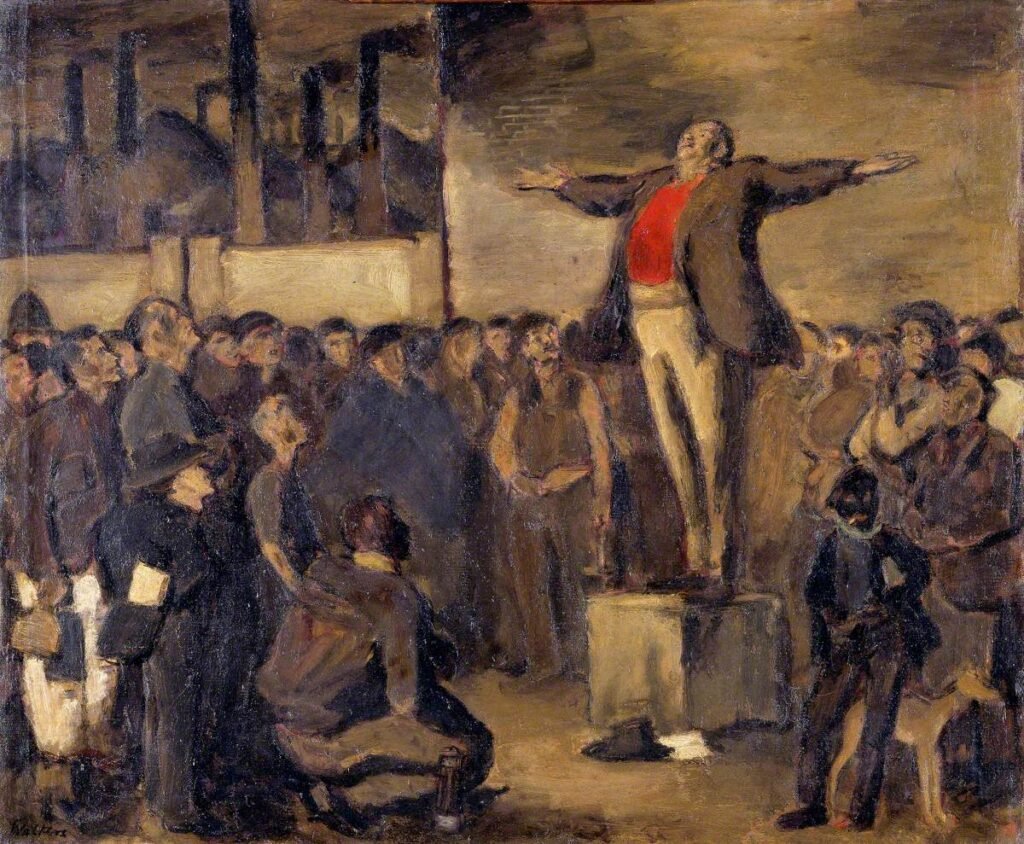
When Karl Marx and Friedrich Engels published The Communist Manifesto in 1848, Europe was undergoing huge social and economic change. The Industrial Revolution had generated unprecedented wealth, yet a large part of it remained concentrated in the hands of factory owners while millions of workers tolerated long hours, dangerous conditions and poverty.
Marx argued that this imbalance was not accidental but an inevitable consequence of capitalism itself.
According to Marx, society had become divided into two opposing classes: the bourgeoisie, who owned the means of production, and the proletariat, who possessed nothing except their labour. Because workers were forced to work simply to survive, Marx believed exploitation was built into the capitalist system.
A simple breakdown of his theory: private ownership of industries would be repealed. Economic production would be communally arranged rather than just for pure competitive gain. Wealth would be dispersed according to necessity as opposed to private profit.
Ultimately, Marx envisioned a classless society where governments themselves would become unnecessary as parity begins to flourish.
For millions living under unscrupulous and exploitative working conditions, communism symbolised a light in the darkness rather than oppression. Even today, many historians acknowledge that Marx identified genuine flaws within nineteenth-century capitalism, many of which triggered later policies in workers’ rights.
When revolution replaced reform
The first successful communist revolution occurred not in industrial Britain or Germany as Marx had hoped, but in largely agrarian Russia.
Following the 1917 Russian Revolution, Vladimir Lenin modified Marx’s ideas into something else entirely. Lenin argued that a controlled “vanguard party” should seize political power on behalf of the proletariat and guide society towards communism.
The Soviet Union paved the way for a political regime that would later be duplicated across much of Eastern Europe, China, North Korea: one-party rule, centralised economic planning and the elimination of political opposition.
Supporters argue these developments reflected a desperate need for change as Russia had emerged from war and economic collapse. Critics counteract this, saying that by concentrating both political and economic power within one institution, it inevitably took away the means to prevent a manipulation and obstruction of power.
Power without opposition
During the Great Purges of the 1930s, under Stalin, hundreds of thousands were executed while millions more were imprisoned within the Soviet Gulag system, where forced labour, disease and brutal conditions dominated. Entire social groups — including the so-called Kulaks (peasant farmers in the Russian empire) — were labelled “enemies of the people”, deported or killed as communism reshaped Soviet agriculture.
In his book, historian Norman Naimark argues that there was more likeness between Hitler and Stalin than the history books suggest: “Both chewed up the lives of human beings in the name of a transformative vision of Utopia. Both destroyed their countries and societies, as well as vast numbers of people inside and outside their own states. Both, in the end, were genocidaires.”
Mao Zedong’s China, from 1949-76, similarly prioritised ideological dogmatism above political protest. During campaigns such as the Great Leap Forward, officials, fearful of disputing central authority, routinely exaggerated the success of China’s agricultural production to the world while concealing widespread famine, resulting in tens of millions dying from starvation.
Perhaps nowhere demonstrated ideological extremism more than Cambodia. When Pol Pot’s Khmer Rouge seized power in 1975, the regime declared “Year Zero”, striving to erase existing society entirely. Cities were emptied, money abolished and religion outlawed. Within four years, approximately two million Cambodians — around a quarter of the country’s population — had died through execution, starvation, disease or forced labour.
Were the leaders or the ideology the problem?
Marx never advocated Stalin’s purges, Mao’s famine policies or Pol Pot’s genocide. His vision centred upon democratic ownership and the disappearance of state authority — not its expansion into every aspect of public life. Even Leon Trotsky argued that Stalin’s Soviet Union had become a “degenerated workers’ state”, abandoning Marx’s original intentions through bureaucratic dictatorship.
Perhaps authoritarianism was not simply the result of flawed individuals. Perhaps it reflected the enormous concentration of political and economic power required to abolish private ownership, reorganise society and centrally direct an entire economy.
Without competing political parties, independent courts, free media or private economic institutions capable of limiting state authority, governments increasingly became accountable only to themselves.
The collapse that became impossible to ignore
Across Eastern Europe in the 1980s, shortages of consumer goods, declining productivity and economic stagnation increasingly undermined public confidence in communist governments. While Western European economies became associated with expanding consumer choice and rising living standards, many citizens behind the Iron Curtain experienced a very different reality.
When the Soviet Union formally dissolved in December 1991, it marked the failure of the twentieth century’s most ambitious attempt to build a communist society on a global scale.
What is communism like today?
Fifteen independent republics emerged from the former Soviet Union, while many Eastern European nations joined NATO and the European Union, fundamentally altering Europe’s political landscape. Free-market capitalism expanded rapidly across much of the globe, while the ideological certainty that had defined the Cold War largely faded.
Today, five communist states officially remain. China, perhaps the most significant example. Governed by the Communist Party, it has adopted extensive market reforms, namely coastal tax-free hubs to gain foreign investment and lower tariffs, that revamped it into one of the world’s largest economies, lifting hundreds of millions out of poverty.
This evolution demonstrates that modern communist governments have often survived not by adhering strictly to Marxist economics, but by departing from them.
The cost of utopian certainty
Communism continues to provoke fierce disagreement because it represents two very different ideas at once. One is philosophical. The other is historical.
It does, therefore, raise fundamental questions about whether any political system that requires the concentration of both economic and political power can realistically preserve individual liberty while pursuing collective equality.
Perhaps, then, communism’s greatest failure is that in an attempt to build an idealistic society, many governments dominated and ripped away its people’s freedom and basic autonomy.